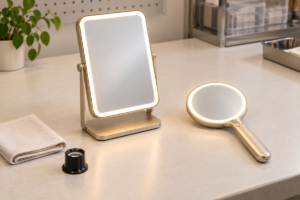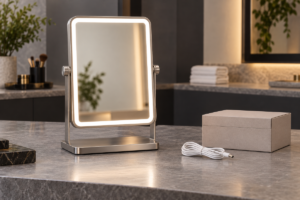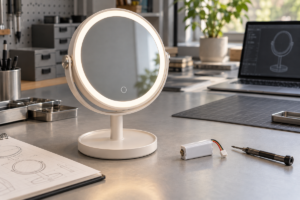

For most retail and e-commerce buyers, a profitable LED makeup mirror assortment is not built by adding every available feature. It is built by matching mirror format, lighting, magnification, power source, packaging, and price tier to the sales channel. One possible assortment covers core, compact/travel, value and premium roles. Use only the roles supported by your budget, channel demand and supplier MOQ, with clear differences customers can understand.
The goal is simple: fewer confused shoppers, fewer duplicate SKUs, better inventory turnover, and a cleaner private-label quotation. Before asking for bulk pricing, buyers should decide which mirror role each SKU plays in the line.
Why Retail Mirror Assortments Often Become Too Complicated
Beauty brands, distributors, and Amazon sellers often start with a long wish list: rechargeable battery, touch sensor, three-color lighting, 5x or 10x magnification, folding design, gift box, travel size, and a low target price. The problem is that too many overlapping SKUs make purchasing harder, not easier.
If two LED makeup mirrors have similar size, similar lighting, similar packaging, and only a small finish difference, buyers may split demand across both items. That can increase MOQ pressure, slow replenishment, and make customer reviews less concentrated. A better assortment gives each SKU a clear job: entry product, core seller, premium upgrade, travel/gift option, or channel-exclusive item.
For Mingda Mirror buyers sourcing makeup mirrors, the most useful starting point is not the full catalog. It is the shelf or listing structure the buyer wants customers to see.
Start With Channel Role Before Choosing Features
A mirror that works well for an Amazon listing may not be the best retail shelf item. A mirror that photographs beautifully online may need stronger box communication and damage protection for store distribution. A wholesale distributor may need a simple assortment that can serve many downstream accounts without too much SKU fragmentation.
| Sales channel | Better assortment role | Key buying priority | Common sourcing risk |
|---|---|---|---|
| Amazon / e-commerce | One core rechargeable tabletop mirror plus one compact travel SKU | Review quality, product photos, low return rate, clear accessories | Overpromising brightness, weak battery documentation, fragile packaging |
| Beauty retail chain | Good-better-best shelf set with visible packaging difference | Clear price steps, retail box strength, shelf display value | Too many similar SKUs competing with each other |
| Gift / travel retail | Compact LED mirror or folding lighted mirror | Small size, appealing finish, gift-ready box, low damage rate | Choosing a design that looks premium but fails hinge or drop tests |
| Wholesale / distributor | Stable core models with controlled finishes | MOQ efficiency, repeat availability, replacement support | Customizing too many finishes before demand is proven |
| Brand private label | Hero SKU plus extension SKU | Brand consistency, package story, approval sample control | Changing battery, adapter, finish, or packaging after sample approval |
This channel-first view helps buyers avoid a common mistake: choosing mirror features one by one without deciding how the product will sell.
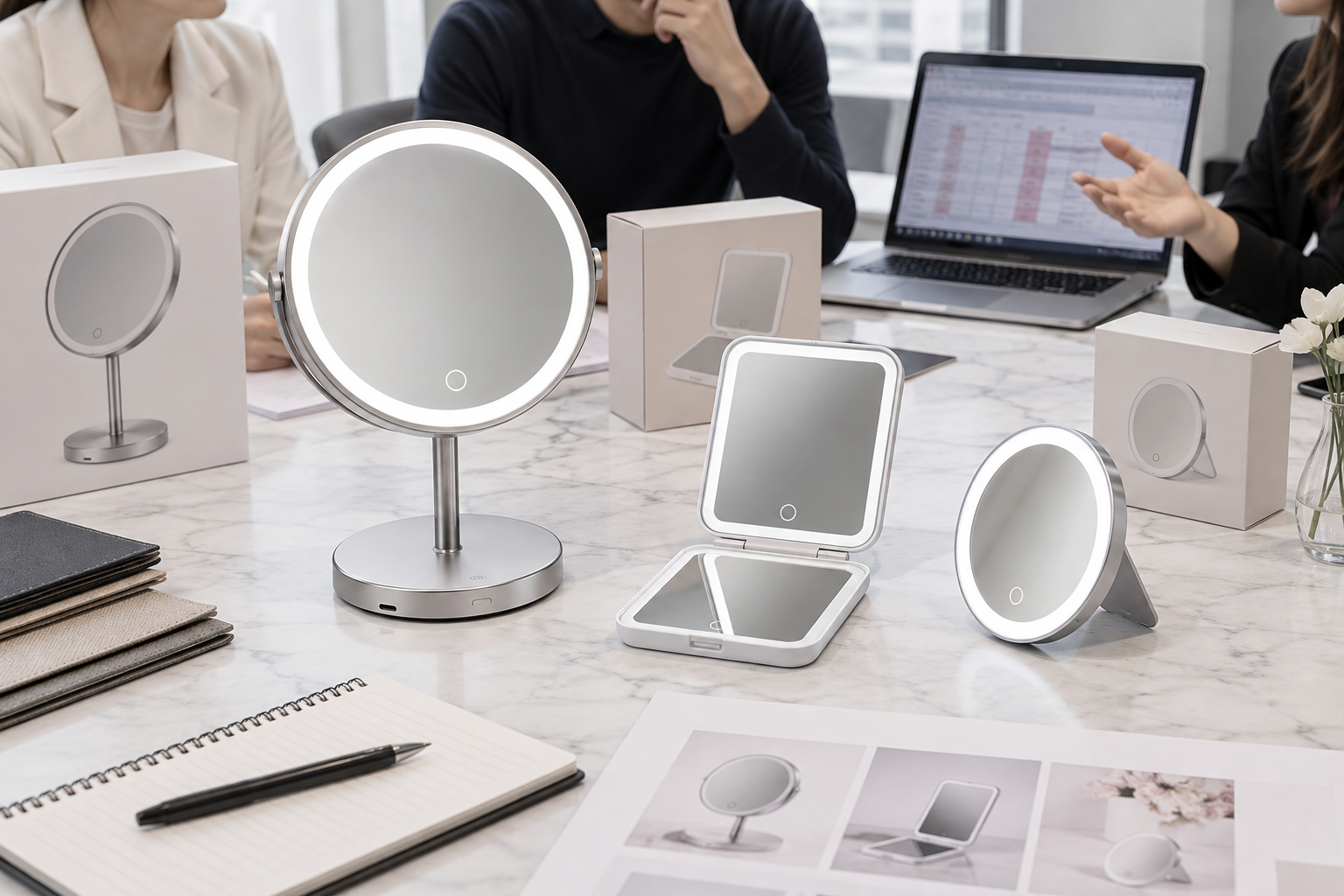
Build a Four-SKU LED Makeup Mirror Line
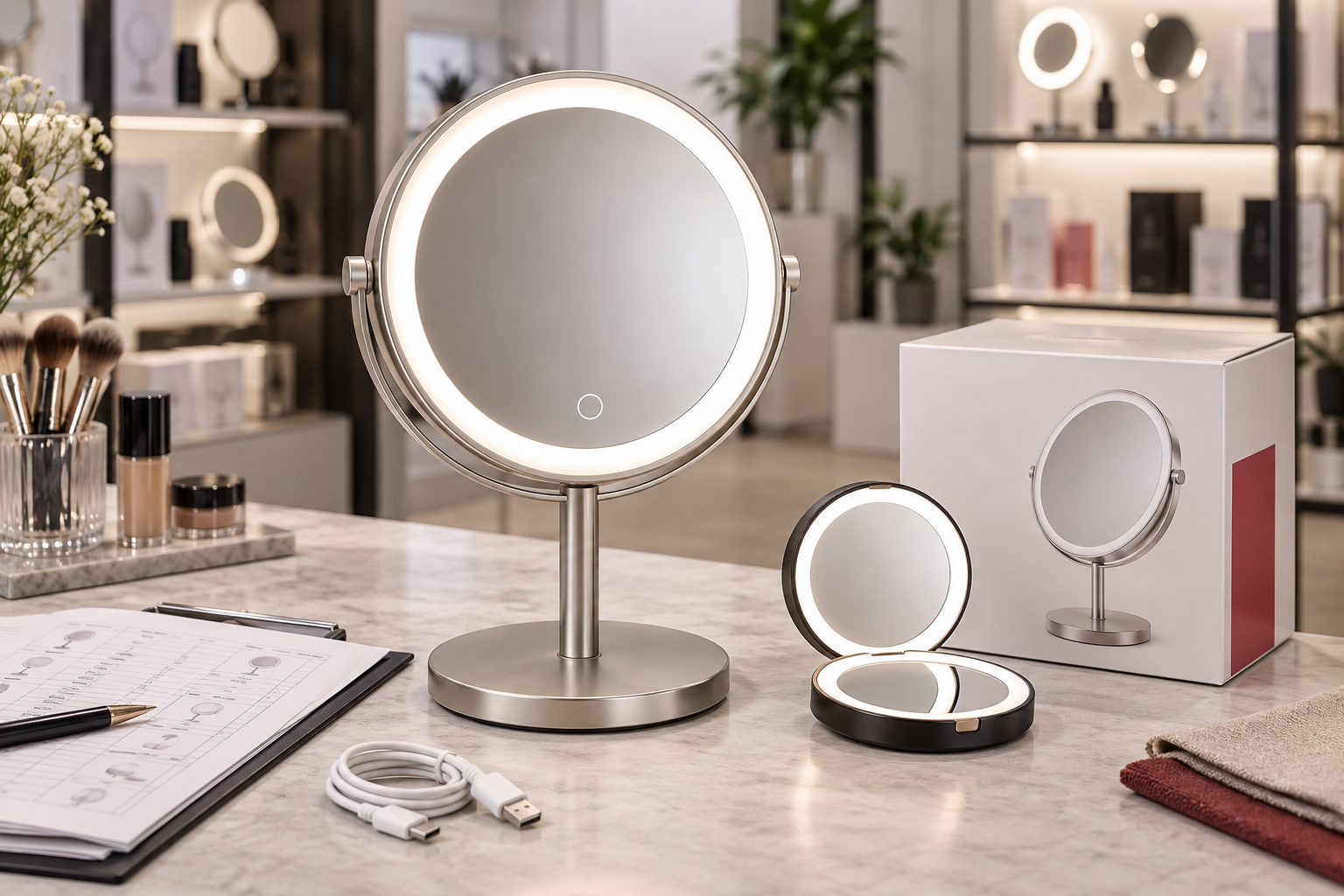
For a first order or a refreshed private-label line, many buyers can begin with four carefully separated SKUs rather than a large catalog.
1. Core Rechargeable Tabletop Mirror
This is usually the hero SKU for beauty brands and online sellers. It should have stable LED brightness, adjustable color temperature, a comfortable viewing size, and a rechargeable battery specification that can be documented clearly. Buyers should confirm charging cable type, battery capacity, charging time, working time, and whether the sample brightness matches the mass-production standard.
This SKU is where product reviews matter most. If the light is uneven, the stand is unstable, or the touch button feels unreliable, the line can lose trust quickly.
2. Premium Magnification or Finish Upgrade
The premium SKU should not be a tiny variation of the core SKU. It should offer a visible reason for the higher price: stronger finish, better magnification arrangement, improved base, larger mirror face, better gift box, or a more refined lighting system. For example, a buyer might compare 5x and 10x magnification based on customer use case rather than adding both without explanation.
If the market is sensitive to returns, avoid making the premium version harder to use. Higher magnification can be valuable, but it also requires the user to stand closer to the mirror. Buyers should specify the target user and product page explanation.
3. Compact or Travel LED Mirror
A compact LED mirror supports gift, travel, checkout, and bundle strategies. It should be evaluated differently from a tabletop mirror. Buyers should check hinge durability, battery or charging structure, surface scratch resistance, closure strength, and whether the box can survive parcel delivery.
This SKU can also help a brand test new colors or finishes before applying them to a higher-cost tabletop product.
4. Value SKU for Entry Price or Promotion
The value SKU should still protect the brand. It can use simpler packaging, fewer finishes, or a smaller mirror body, but it should not compromise basic lighting consistency, safety, or stability. The purpose of a value SKU is to create a clean entry price, not to create after-sales problems.
Feature Decisions That Affect MOQ and Inventory
Buyers often focus on the unit price first, but feature choices can change inventory cost more than expected.
- Finish color: too many colors can split MOQ and leave slow-moving stock.
- Magnification: 1x/5x, 1x/10x, or detachable detail mirror options should match customer education and product page copy.
- Lighting modes: three-color lighting can support premium positioning, but only if brightness and memory function are stable.
- Power source: rechargeable models need stronger documentation and charging tests; plug-in models may suit vanities or projects better.
- Packaging: retail shelf packaging and e-commerce parcel packaging solve different problems.
- Accessories: USB cable, adapter, cleaning cloth, manual, and warranty card should be controlled in the sample approval file.
For OEM and ODM projects, these decisions should be locked before the final pre-production sample. Mingda’s OEM/ODM customization service can help buyers organize specification sheets, packaging artwork, sample review, and mass-production controls before ordering.
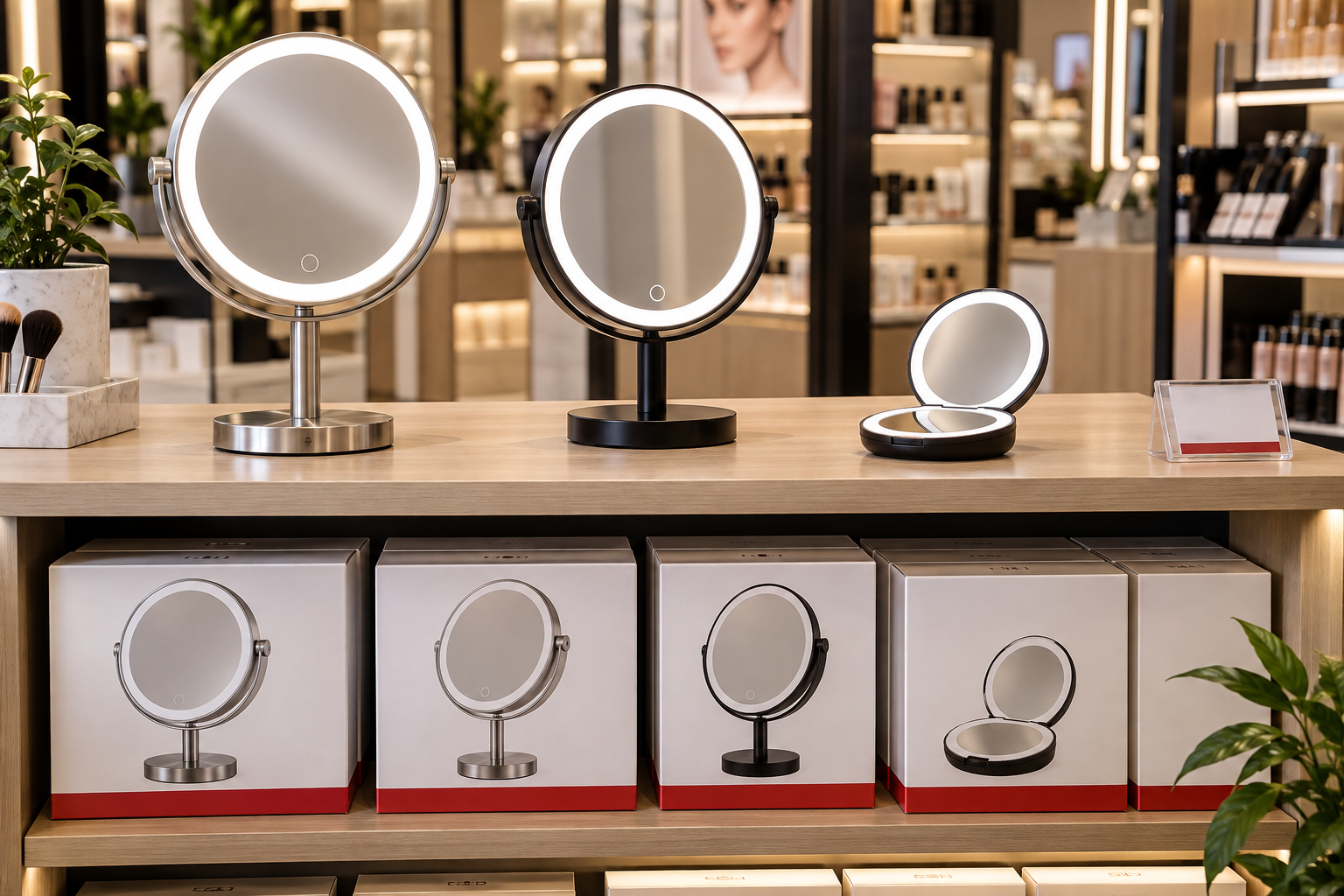
Retail Box, Display, and Replenishment Planning
Assortment planning does not stop at the mirror itself. A buyer also needs to think about how the product will be displayed, stored, shipped, and replenished.
For retail channels, the box should make the mirror type easy to understand from the shelf. The customer should quickly see whether the item is rechargeable, lighted, magnified, travel-friendly, or suitable for a vanity table. For e-commerce, the box and insert must protect the product during parcel delivery, not only look attractive in photos.
Buyers should ask the supplier for:
- product dimensions and box dimensions for every SKU
- gross weight, carton quantity, and carton size
- battery and charging information for rechargeable items
- retail box structure and protective insert material
- carton drop-test or internal packaging review records
- replacement-part policy for common after-sales issues
- lead time for repeat orders and packaging reprints
This information helps the buyer calculate landed cost, warehouse space, shelf display, and replenishment timing before confirming the order.
RFQ Checklist for an LED Makeup Mirror Assortment
Before sending an RFQ, prepare a simple assortment brief instead of asking only for a catalog and price list.
- Target sales channel: Amazon, retail chain, distributor, gift, salon, or private label.
- Planned SKU roles: core seller, premium upgrade, compact/travel, or entry price.
- Required mirror size, stand type, magnification, lighting modes, and power source.
- Target finish colors and which colors are required for the first order.
- Packaging goal: retail shelf, e-commerce parcel, gift box, or wholesale carton.
- Compliance needs: battery documentation, charging test, label requirements, or market-specific reports.
- Sample approval points: brightness, CCT, touch function, hinge, base stability, packaging, and accessories.
- Order planning: estimated MOQ, launch date, repeat-order forecast, and split shipment needs.
The clearer this brief is, the easier it is for a manufacturer to recommend the right product structure rather than simply quoting the cheapest available mirror.
Common Mistakes Buyers Should Avoid
The first mistake is building the line around too many similar tabletop mirrors. This creates internal competition and makes it harder to identify the real best seller.
The second mistake is choosing a premium feature without enough customer education. Magnification, color temperature, and rechargeable function all need clear product-page or packaging communication.
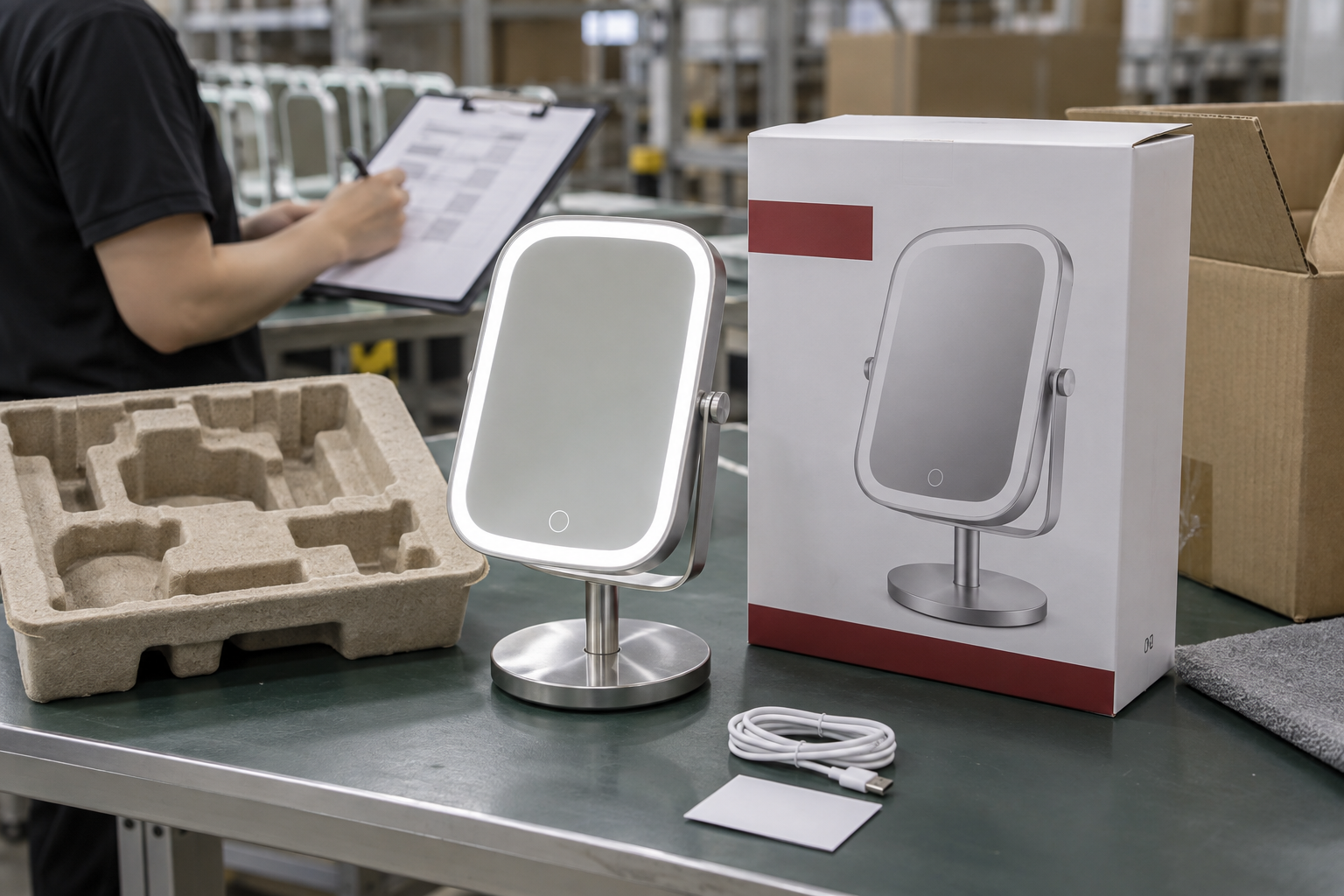
The third mistake is separating packaging decisions from product selection. A beautiful LED mirror can still create losses if the insert is weak, the retail box is too soft, or the master carton is not matched to the shipping channel.
The fourth mistake is changing details after sample approval. A different battery, cable, surface finish, or package insert can change the sourcing risk even if the product name stays the same.
Set Trial, Reorder and Exit Rules for Each SKU
Give each candidate SKU a channel role, trial quantity, review date and named buying owner before placing the first order. A four-role range is a planning example, not a minimum order recommendation: launch fewer models when the available budget, shelf space or supplier MOQ cannot support a meaningful trial of every role.
| Decision | Evidence to record | Action before replenishment |
|---|---|---|
| Keep or expand | Units received and sold, selling period, stockout days, discounts, returns and reasons by SKU | Compare like-for-like periods and confirm the agreed margin and service targets |
| Reorder timing | Usable stock, confirmed inbound units, open commitments, lead time and demand assumptions | Agree the stock buffer and order date; do not treat a forecast as confirmed demand |
| Hold or exit | Slow stock, repeated complaints, packaging failures and unresolved corrective actions | Assign an owner and review date before committing another finish or packaging batch |
Keep item price, tooling, sample charges, packaging, freight assumptions and expected service costs separate when comparing offers. Review the mirror return-risk guide alongside sales records; a high sales total can hide a costly failure pattern. Before combining packaging across the range, use the molded-insert approval checklist for each actual mirror and accessory configuration.
Two-Week Review: Compare Available Selling Days
At the first review, record each SKU by channel: received quantity, saleable stock, units sold, days actually available, promotion period and returns reported by the cutoff date. Keep damaged or quarantined stock out of available inventory. A model that was out of stock for half the trial should not be judged against one available throughout the period using unit sales alone.
Separate a packaging complaint from a lighting or magnification mismatch, and assign an owner to each unresolved issue. Treat early results as provisional while return windows remain open. Before reordering, compare sell-through and contribution after discounts, freight and observed service costs against the targets agreed for that SKU. Use the MOQ and material-commitment checklist to check supplier batch commitments and residual packaging stock before dropping a finish or expanding the range.
Bottom-Line Recommendation
An LED makeup mirror assortment can use four distinct roles as a starting framework: one core rechargeable tabletop mirror, one premium upgrade, one compact or travel mirror, and one value or promotional SKU. Each item should have a clear channel role, price position, packaging plan, and sample approval checklist.
Mingda Mirror can support buyers with LED makeup mirror product selection, private-label packaging, sample approval, and quality-control planning. To discuss a retail or e-commerce mirror assortment, send your channel, planned roles, quantity per SKU, destination, price range, packaging goal and launch date. Request itemized sample, tooling and packaging costs, MOQ per finish, packed dimensions and repeat-order lead time through the contact page.
FAQ
How many LED makeup mirror SKUs should a new brand start with?
Start with the fewest SKUs that serve distinct customer needs and fit your trial budget and MOQ. Three to four roles are an example; add a model only when its demand, packaging and replenishment assumptions justify the extra stock commitment.
Should buyers choose rechargeable or plug-in LED makeup mirrors?
Rechargeable mirrors usually fit e-commerce, gift, and modern vanity use. Plug-in designs may suit fixed vanity, salon, hotel, or project applications. The better choice depends on the channel, safety documentation, and user scenario.
Is 10x magnification always better than 5x?
No. Higher magnification is useful for detailed work, but it requires closer viewing distance and clearer user education. For many retail lines, 5x can be easier for general customers, while 10x works better as a premium or specialist option.
What should be confirmed before approving packaging?
Confirm retail box structure, insert material, carton quantity, carton size, accessory placement, label information, barcode position, and shipping protection. Packaging should be checked with the actual mirror sample, not only with artwork.
Can Mingda Mirror help plan a private-label assortment?
Yes. Mingda Mirror can help buyers compare mirror formats, lighting specifications, finishes, packaging options, MOQ planning, and sample approval points before mass production.