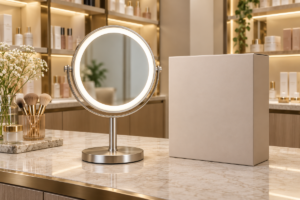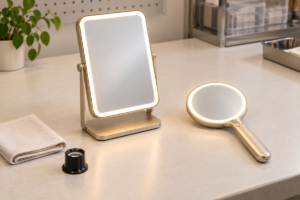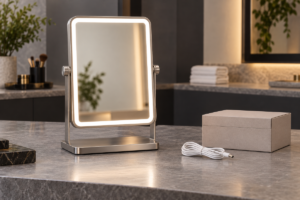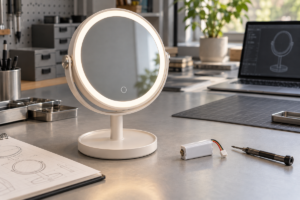

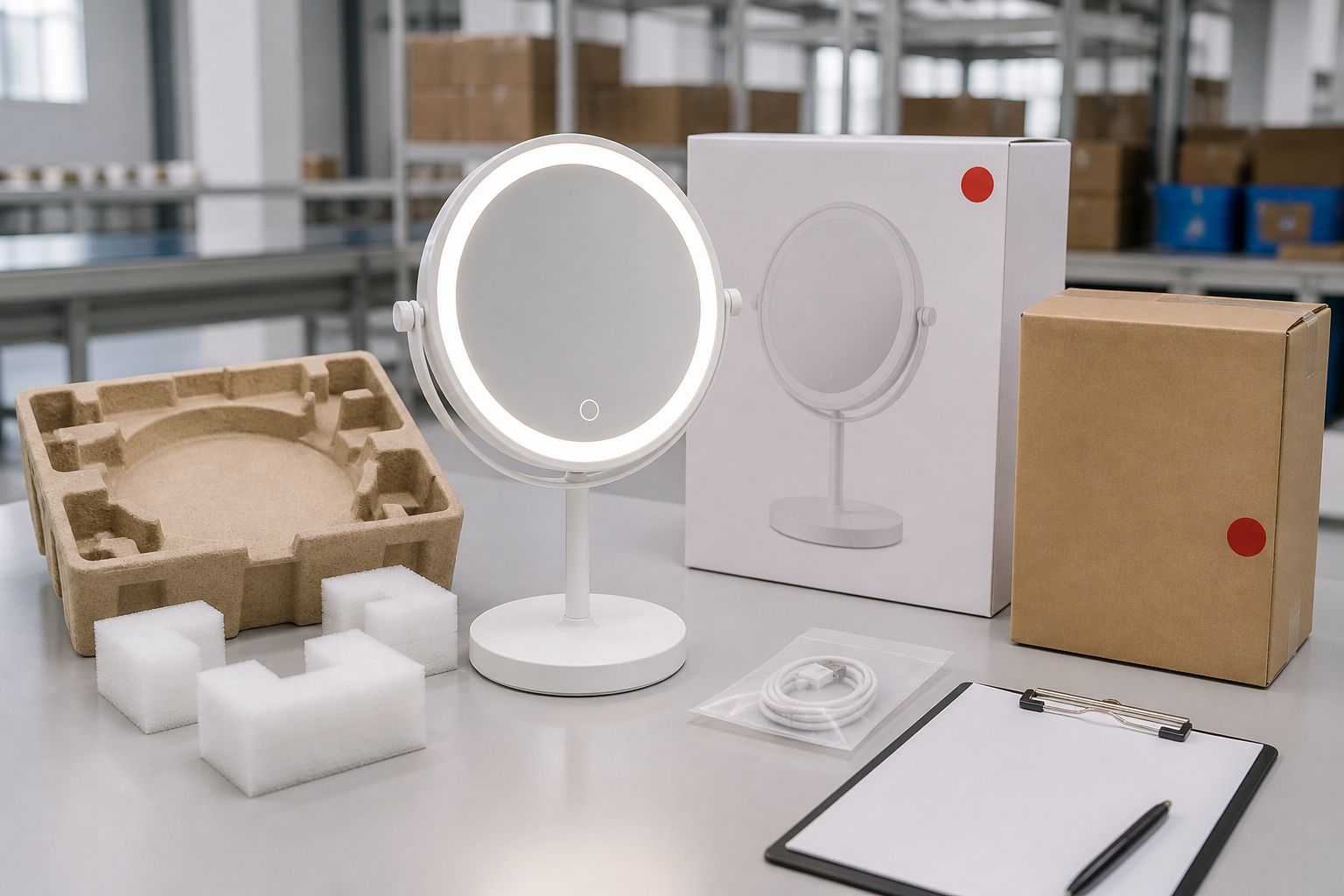
Right-size packaging for LED makeup mirrors should protect the mirror, battery/accessories, retail box, and shipping carton without creating unnecessary dimensional weight or warehouse rejection risk. For e-commerce sellers, retailers, wholesalers, and private-label buyers, the best packaging is not simply the thickest carton. It is a tested system: fitted inner support, verified drop and compression resistance, clear labels, stable carton dimensions, and packaging artwork that matches the actual SKU. Buyers should approve this system before bulk production, not after the first damage claims arrive.
Why Right-Size Packaging Matters for LED Makeup Mirror Buyers
LED makeup mirrors are visually attractive but operationally sensitive. A tabletop or compact mirror may include glass, an LED ring, a hinge, a base, a rechargeable battery, a USB-C cable, instruction sheet, and retail packaging. If the packaging is too loose, the mirror can move inside the carton. If it is too tight, pressure can transfer directly to the LED frame or mirror surface. If it is too large, buyers pay higher freight and storage costs.
This matters most for buyers selling through Amazon, TikTok Shop, Walmart Marketplace, DTC stores, retail chains, distributors, gift programs, and beauty accessory wholesalers. In these channels, packaging affects reviews, returns, warehouse receiving, shelf display, carton efficiency, and reorder margins. A lower unit price can quickly disappear if the package creates breakage, excess dimensional weight, barcode errors, or accessory loss.
Mingda Mirror recommends treating packaging as part of the product specification. When buyers request a quotation for LED makeup mirrors, they should confirm the product structure, packaging channel, carton limits, label needs, and sample-test method together.
Right-Size Does Not Mean Minimal Packaging
Right-size packaging means matching protection to the mirror’s real risk. A lightweight foldable travel mirror needs different support from a larger rechargeable tabletop mirror with a metal stand. A premium gift box for retail display needs different testing from a plain e-commerce mailer. A distributor pallet program needs different carton logic from single-parcel delivery.
| Packaging decision | Too small or weak | Too large or overbuilt | Right-size target |
|---|---|---|---|
| Inner support | Mirror shifts, scratches, hinge stress | Wasted material and difficult packing | Fitted pulp, EPE, EVA, or paper insert that locks the mirror |
| Retail box | Product pressure, crushed corners | Shelf inefficiency and higher gift-box cost | Clear product fit with accessory space and claim accuracy |
| Shipping carton | Parcel damage and return risk | Higher dimensional weight and storage cost | Carton size matched to channel and drop/compression needs |
| Accessory packing | Cable, adapter, manual, or pouch missing | Slow packing and excess plastic | Dedicated accessory slot or pouch |
| Label position | Warehouse scan failure or marketplace issue | Rework before shipment | Barcode and carton marks checked on packed sample |
The goal is a repeatable packed sample that a buyer can approve, photograph, test, and use as the standard for bulk shipment.
Match the Packaging System to the Sales Channel
Amazon and e-commerce shipments
For e-commerce, the packed LED makeup mirror may travel as a single parcel through multiple handling points. Buyers should pay special attention to corner protection, mirror-face pressure, hinge movement, battery/accessory separation, and carton closure. If the product includes a rechargeable battery, the cable and instruction sheet should be packed consistently so the buyer can support accurate product listings and customer service.
The packaging should also be easy to inspect. A warehouse team should be able to confirm SKU, barcode, carton quantity, and accessory placement without opening every retail box after arrival.
Retail and gift packaging
Retail packaging needs visual value, but it still needs protection. A premium box that looks good on the shelf can fail if it does not control mirror movement. Buyers should confirm the printed box size, product image, feature claims, barcode, language, warning labels, insert material, and shelf presentation before mass printing.
Gift packaging is especially important for LED compact mirrors and portable rechargeable mirrors. If the box is meant to support holiday programs, beauty gift sets, influencer kits, or retail promotions, the packaging sample should be approved with the final pouch, USB cable, manual, and any logo or color finish.
Wholesale and distributor cartons
Wholesale buyers usually care about repeatable carton efficiency. The carton should protect the mirror while staying easy to palletize, count, and replenish. Carton dimensions, gross weight, units per master carton, and replacement-part policy should be confirmed before price comparison. A mirror with slightly stronger packaging may be the better commercial choice if it reduces claims and protects distributor relationships.
What Buyers Should Confirm Before Approving Packaging
Packaging approval should be based on a complete packed sample, not only box artwork. For LED makeup mirrors, the buyer should confirm both visual and functional protection.
| Checkpoint | Buyer question | Why it affects cost or risk |
|---|---|---|
| Product lock-in | Does the insert stop mirror movement during handling? | Reduces scratches, hinge stress, LED frame damage, and glass pressure |
| Face protection | Is the mirror surface protected without pressure marks? | Prevents returns caused by scratches or distorted mirror appearance |
| Battery/accessory packing | Are USB-C cable, pouch, manual, and accessories fixed in the same position? | Prevents missing-item claims and improves customer support |
| Carton strength | Has the carton been checked for parcel or export handling? | Reduces breakage and warehouse complaint risk |
| Dimensional weight | Is the carton larger than necessary for the channel? | Controls freight, fulfillment, and storage cost |
| Barcode and labels | Are retail and outer-carton labels scan-ready? | Prevents warehouse receiving delays or relabeling |
| Artwork accuracy | Do packaging claims match the approved sample? | Reduces marketplace listing and customer complaint risk |
This checklist should be included in the RFQ package along with target sales channel, destination market, quantity, packaging type, and required inspection standard.
Control Dimensional Weight Without Increasing Damage
Many buyers focus only on product unit price. For e-commerce and import programs, carton size can be just as important. A carton that is several centimeters larger than needed can increase dimensional weight, shipping cost, fulfillment fees, and warehouse storage pressure. At the same time, reducing carton size without redesigning the inner support can increase breakage.
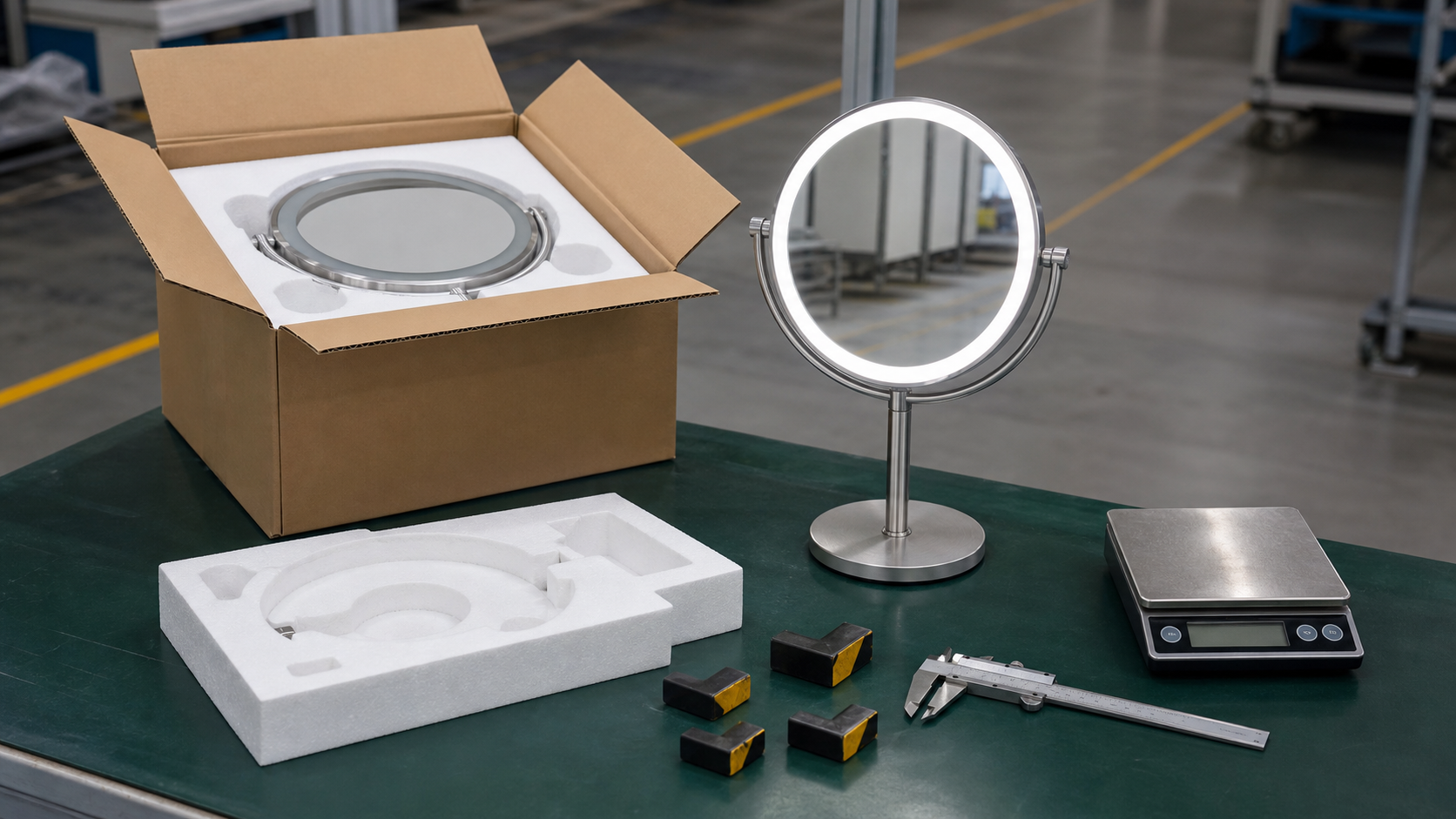
The practical approach is to test several packaging layouts during sampling. Buyers can compare molded pulp, EPE foam, EVA, paper corner supports, retail box thickness, and master carton size. The best option is the one that protects the LED mirror while keeping carton dimensions stable for the buyer’s channel.
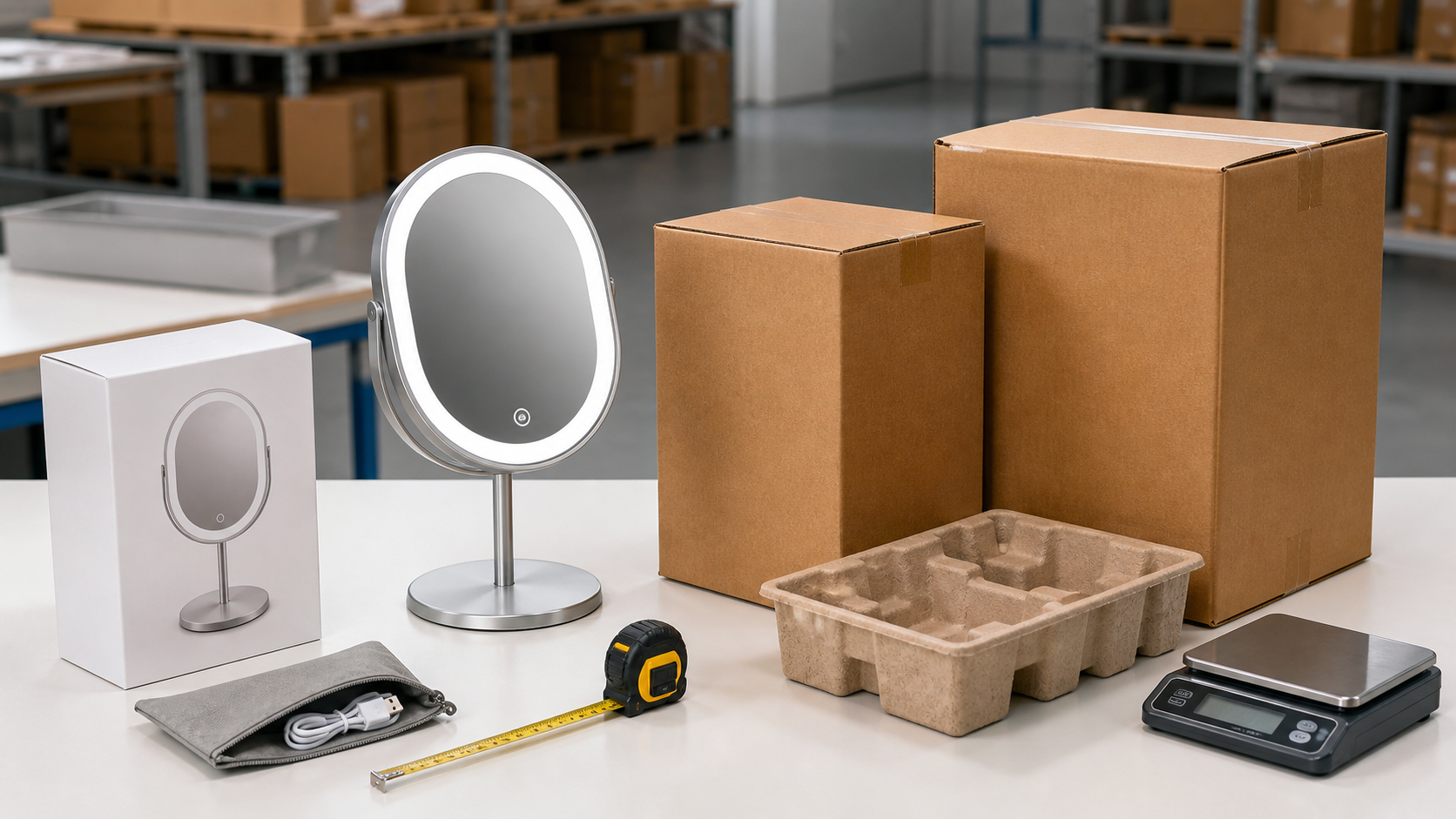
For private-label orders, carton planning should happen before artwork is finalized. Once printed packaging is approved and ordered, changes to insert shape or box size may affect MOQ, lead time, and cost.
Common Packaging Mistakes Buyers Should Avoid
The first mistake is approving only the product sample and leaving packaging decisions until production. This creates late-stage changes, rush printing, and inconsistent packing.
The second mistake is copying packaging from a different mirror size. A 5x or 10x magnifying mirror, a larger tabletop LED mirror, and a foldable travel mirror may have very different balance points and pressure risks.
The third mistake is using attractive gift packaging without testing shipping protection. A retail box can look premium but still fail in parcel handling.
The fourth mistake is ignoring accessory control. USB-C cables, manuals, cleaning cloths, pouches, adapters, and spare parts should have a defined position. Loose accessories can scratch the mirror or create missing-item complaints.
The fifth mistake is treating labels as an afterthought. Barcode, carton mark, country-specific warnings, battery-related marks when applicable, and marketplace labels should be checked on the final packed sample.
RFQ-Ready Packaging Details to Send Mingda Mirror
When requesting a quote, buyers can get a more accurate recommendation by sending clear packaging requirements instead of asking only for the lowest price.
- Product type: tabletop LED makeup mirror, compact mirror, wall-mounted mirror, handheld mirror, or Hollywood mirror.
- Sales channel: Amazon, DTC, retail shelf, gift set, distributor, wholesale, salon, hotel/project, or mixed channel.
- Target market and delivery method: parcel, FBA/marketplace warehouse, retail DC, ocean export carton, or project shipment.
- Packaging type: color box, gift box, kraft box, mailer carton, master carton, molded pulp, EPE, EVA, paper insert, or custom structure.
- Accessory list: USB-C cable, pouch, manual, adapter, screws, cleaning cloth, or spare parts.
- Label needs: retail barcode, outer-carton mark, warning label, country language, battery-related handling information, or marketplace label.
- MOQ and launch timing: sample date, artwork deadline, bulk production date, shipment window, and reorder plan.
For custom packaging projects, buyers can also review Mingda Mirror’s OEM/ODM services and QC process before finalizing packaging samples.
Packaging Approval Workflow Before Bulk Production
| Step | What to approve | Practical output |
|---|---|---|
| 1. Product sample | Mirror size, light, hinge, charging, finish, and accessories | Approved product structure |
| 2. Insert and box sample | Fit, movement, accessory position, and surface protection | Approved inner packaging |
| 3. Carton test | Carton size, units per carton, gross weight, closure, and handling resistance | Approved shipment carton |
| 4. Label and artwork check | Barcode, claims, language, model number, carton mark, and warnings | Approved printing files |
| 5. Pre-shipment inspection | Packed sample, random cartons, accessories, labels, and photos | Release decision before shipment |
This workflow helps sourcing teams avoid the common gap between a good product sample and a risky bulk shipment.
Bottom-Line Recommendation
For LED makeup mirror buyers, the safest packaging decision is a balanced system: fitted inner protection, channel-appropriate retail box, right-size shipping carton, verified accessory placement, clear labels, and sample-based approval before mass production. Do not choose packaging only by unit price or appearance. Choose the structure that protects reviews, reduces damage claims, controls dimensional weight, and can be repeated in every reorder.
FAQ: LED Makeup Mirror Packaging for B2B Orders
What is right-size packaging for LED makeup mirrors?
Right-size packaging is a tested packaging structure that protects the complete LED makeup mirror and accessories while avoiding unnecessary carton volume, material waste, and dimensional weight cost.
Should e-commerce sellers use stronger packaging than retail buyers?
Usually yes. E-commerce parcels face more individual handling, so buyers often need stronger corner protection, tighter insert fit, and better accessory control than a shelf-only retail program.
Can Mingda Mirror help with private-label packaging?
Yes. Mingda Mirror can support logo placement, color box, gift box, mailer carton, molded insert, accessory packing, barcode position, and packed-sample approval for private-label mirror orders.
When should packaging be approved?
Packaging should be approved after the product sample is confirmed but before bulk material purchase and printing. Buyers should check the complete packed sample, not only the artwork file.
What packaging details should buyers include in an RFQ?
Buyers should include mirror type, target channel, destination market, packaging type, accessory list, carton limits, label needs, MOQ, sample deadline, and shipment plan.
Social Media Content Ideas
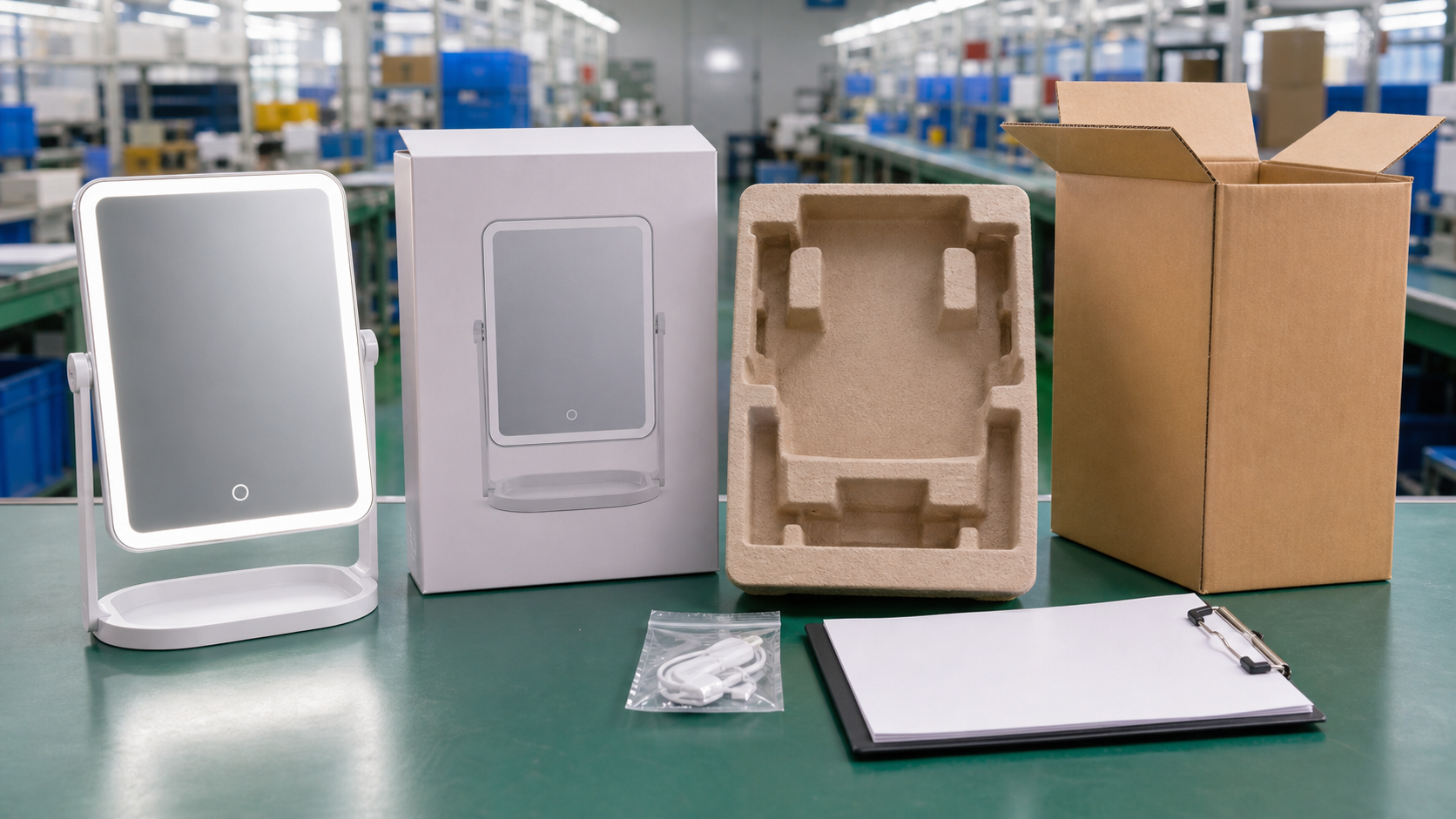
LinkedIn: Share the packaging decision matrix and explain why dimensional weight, damage risk, and barcode readiness should be reviewed before bulk LED makeup mirror production. Facebook: Educate retailers and e-commerce sellers on approving the complete packed sample, not only the product sample. Instagram: Use the packaging release image to show a clean complete mirror, insert, retail box, cable pouch, and carton. CTA: Invite buyers to read the full article and send their target channel, mirror type, quantity, and packaging needs for RFQ.
Send a Packaging-Ready RFQ
If you are preparing LED makeup mirror orders for e-commerce, retail, wholesale, or private label, contact Mingda Mirror with your mirror type, target market, sales channel, packaging preference, quantity, label requirements, and shipment method. Our team can help compare packaging structures and prepare a practical quotation for your launch or replenishment plan.