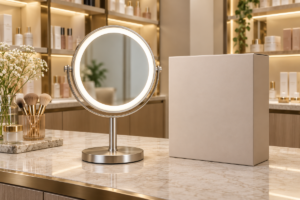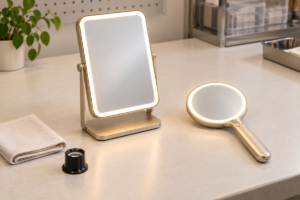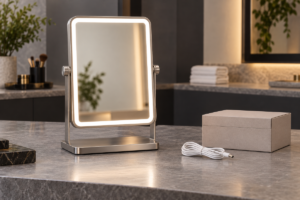

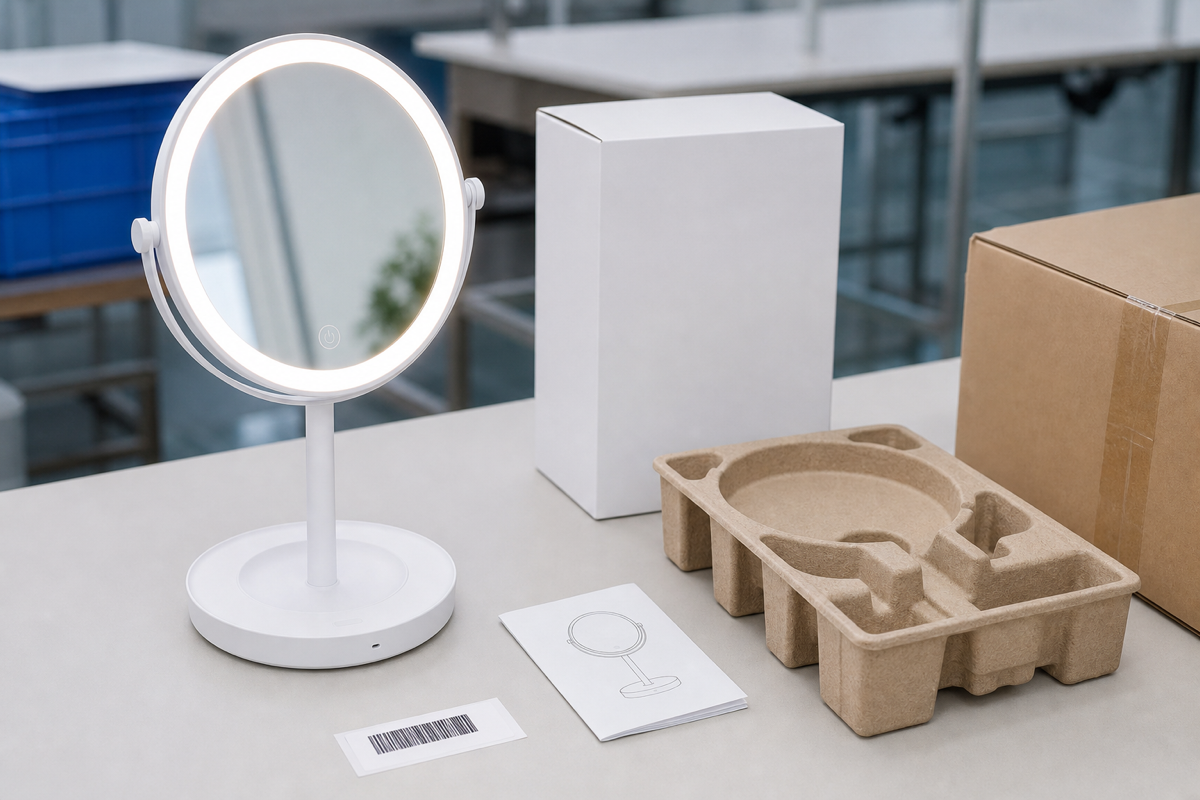
For LED makeup mirror private-label orders, custom packaging should be approved as a complete selling, protection, and compliance system, not only as a printed color box. Buyers should confirm the box structure, insert material, accessory placement, barcode position, instruction copy, drop protection, and channel rules before mass production. The safest approach is to approve one physical packaging set with the mirror, cable, manual, label, inner box, and export carton packed exactly as the bulk order will ship.
This matters because a rechargeable LED makeup mirror is fragile, visual, and often sold through review-sensitive channels. If the packaging looks premium but fails a drop test, hides the barcode, confuses charging instructions, or creates oversized freight cost, the buyer pays for the mistake after production.
Why Packaging Approval Is a Procurement Decision
For beauty brands, Amazon sellers, retail chains, wholesalers, and distributors, packaging is part of the product specification. It affects shelf presentation, listing photos, unboxing experience, warehouse handling, return rate, and buyer confidence. A lighted mirror may pass function testing but still fail commercially if the package arrives crushed, looks generic, or does not explain the charging and lighting features clearly.
Current e-commerce and retail requirements make this more important. Amazon packaging guidance emphasizes that required barcodes must remain scannable and that some packaging formats need warning labels when used. In Europe, packaging regulation is also moving toward clearer labeling, waste reduction, and recyclability expectations. Buyers do not need to turn every mirror RFQ into a legal project, but they should make packaging materials, labels, and carton design part of sample approval from the beginning.
If the order is for a new private-label SKU, approve packaging after the mirror structure is stable but before mass printing. Late packaging changes can affect dielines, MOQ, unit cost, carton quantity, pallet loading, instruction text, and production lead time.
Packaging Options for Different Sales Channels
The right packaging depends on where the LED makeup mirror will be sold. A retail shelf box, Amazon/FBA-ready unit, DTC mailer, and wholesale carton do not have the same priorities.
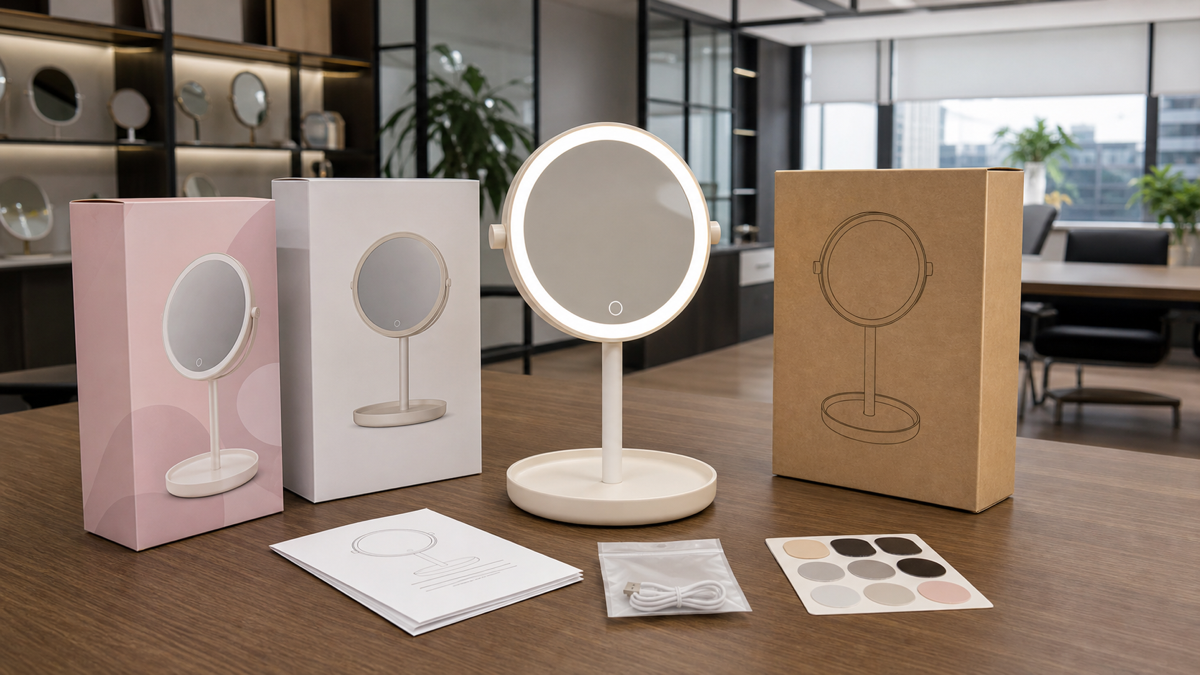
| Sales Channel | Packaging Priority | Common Structure | Buyer Risk to Control |
|---|---|---|---|
| Retail shelf | Strong visual presentation and clear product benefit | Printed color box with molded insert | Weak shelf image, unclear feature copy, crushed corners |
| Amazon / marketplace | Scannable label, drop protection, compact size | Inner box plus protective mailer or ship-ready carton | Hidden barcode, oversized shipping cost, return complaints |
| DTC brand store | Unboxing quality and brand consistency | Branded mailer, insert card, clean accessory packing | Premium look without enough protection |
| Distributor / wholesale | Efficient carton loading and easy SKU identification | Neutral inner box, master carton, outer carton label | Mixed SKUs, carton damage, slow warehouse sorting |
| Gift / beauty set | Attractive finish and accessory organization | Color box, tray, pouch or gift sleeve | Higher cost without stronger perceived value |
For a first order, avoid overdesigning the packaging before the channel is clear. A buyer selling through Amazon may need right-size protection and barcode discipline more than expensive finishes. A beauty brand launching in boutiques may need a stronger color box, cleaner copy, and better shelf presence.
What Buyers Should Approve Before Printing
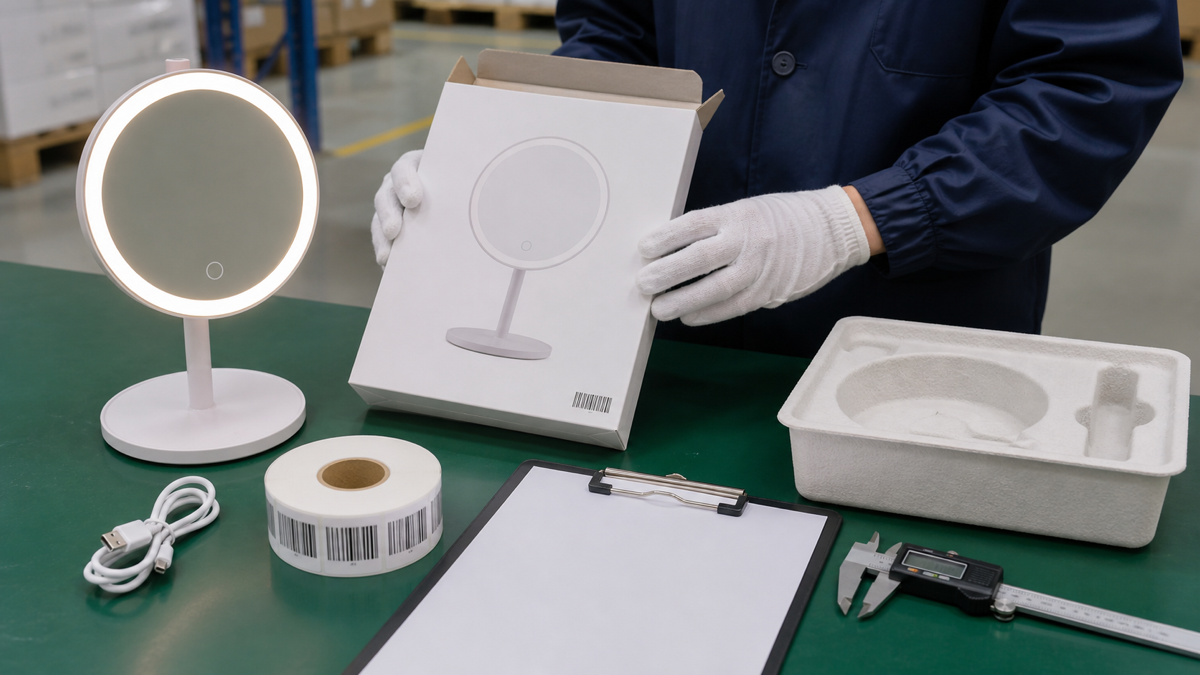
Before approving mass printing, the buyer should review a complete packaging sample with the real mirror inside. Do not approve only a PDF dieline or a flat color proof. Paper color, box stiffness, insert fit, and accessory placement can look different after assembly.
Confirm these items during sample approval:
- mirror model, finish, magnification, LED lighting, and charging port shown correctly
- product name, SKU, barcode, country of origin, warning text, and importer details placed where required
- instruction copy matches the real cable, battery, light modes, charging time, and runtime claim
- box size supports the mirror without forcing pressure on the hinge, stand, LED ring, or charging port
- molded insert, pulp tray, EVA, foam, or paperboard support holds the product during shaking and transit
- accessories are separated so the cable, adapter, manual, or magnifying lens does not scratch the mirror
- outer carton mark, carton quantity, gross weight, and dimensions match the shipping plan
For rechargeable models, make the battery and charging information consistent across the manual, color box, listing copy, and any compliance file. A mismatch between the USB-C cable, runtime claim, and packaging copy can create avoidable customer-service issues.
Inner Protection: Pulp Tray, Foam, EVA, or Paperboard?
The insert material should match product value, fragility, destination market, and sustainability expectations. There is no single best material for every LED makeup mirror order.
| Insert Type | Best Use | Advantage | Watch Point |
|---|---|---|---|
| Molded pulp tray | E-commerce and sustainability-focused retail | Good protection, recyclable positioning, strong fit | Tooling and moisture control should be reviewed |
| Paperboard insert | Lightweight retail boxes and lower-cost SKUs | Lower cost and easier recycling message | May need extra support for heavier mirrors |
| EVA or foam | Premium mirrors or high-risk shipping routes | Strong cushioning and clean appearance | Cost and material policy may be less attractive for some markets |
| Bubble sleeve plus carton | DTC or warehouse protection layer | Flexible and fast for small runs | Can look low-end if used as the main retail presentation |
| Custom molded plastic tray | Precise display and accessory layout | Good presentation for gift sets | Recyclability and cracking risk should be checked |
For most LED tabletop makeup mirrors, a molded insert that locks the mirror head, stand, base, and cable position is safer than a loose box with basic padding. The insert should protect the LED ring and hinge from pressure because these are common points where damage or wobble becomes visible to the customer.
Label, Barcode, and Instruction Details That Cause Delays
Many packaging problems are not caused by bad artwork. They come from small operational details that are easy to miss before bulk production.
Amazon and marketplace buyers should confirm that the barcode is visible, flat, scannable, and not placed over a seam, curve, glossy reflection, or shrink wrap wrinkle. If a poly bag or protective sleeve is used, the marketplace’s bagging and warning-label rules should be checked before production. Retail buyers should also confirm that shelf labels, carton marks, and product images align with the purchase order and warehouse system.
Instruction copy should be short but accurate. For LED makeup mirrors, buyers should verify:
- how to turn on, dim, and switch light color modes
- charging cable type and compatible adapter range
- expected charging time and realistic runtime by light mode
- battery care and safe charging reminders
- how to clean the mirror surface without damaging the LED ring or coating
- warranty, after-sales contact, and replacement-part policy when applicable
Do not let the factory print final packaging from an early sample description. If the mirror changes from Micro-USB to USB-C, from dry battery to rechargeable, or from one CCT to three CCT modes, packaging and manual copy must be updated before printing.
Drop Protection and Carton Planning
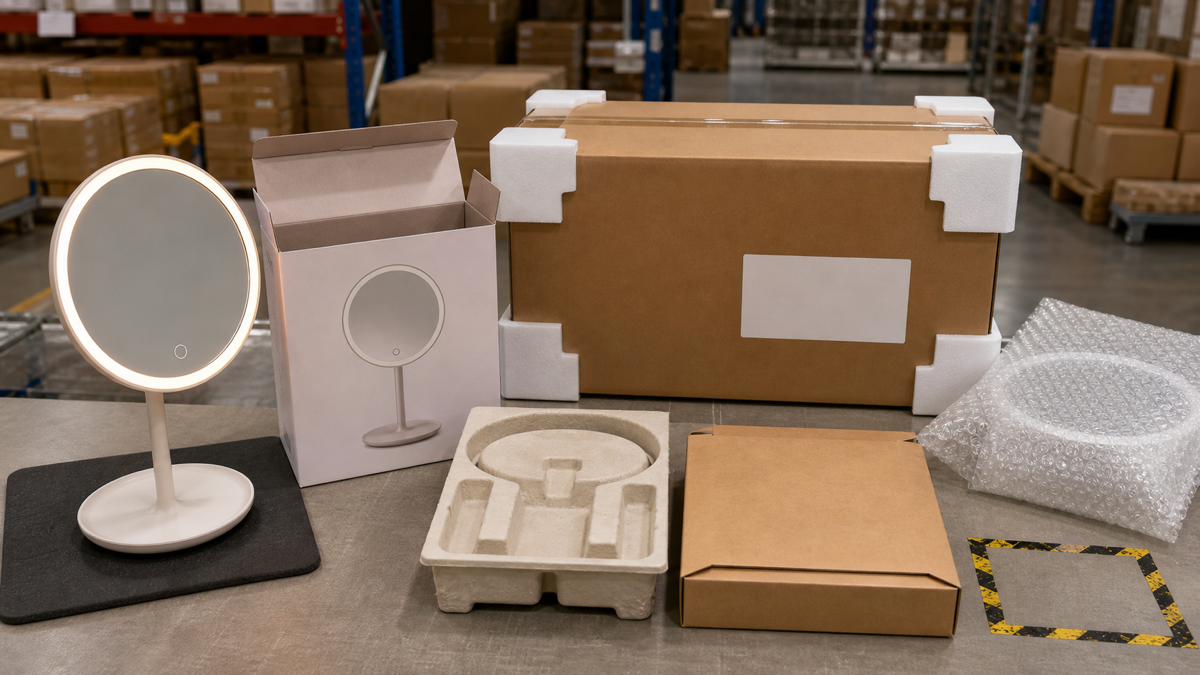
A LED makeup mirror package has to survive more than the first impression. It must protect the mirror through factory handling, export carton loading, container movement, courier sorting, and final delivery. This is especially important for mirrors with a tall stand, adjustable hinge, rechargeable base, magnifying lens, or glass surface.
Ask the supplier to test the packed unit, not only the outer carton. The buyer should review whether the product moves inside the box, whether the LED ring touches the box wall, whether the hinge receives pressure, and whether the cable or accessory bag can rub against the mirror surface.
For carton planning, confirm:
- units per inner carton and master carton
- carton dimensions, gross weight, and volumetric weight
- corner protection and carton board strength
- shipping mark format for SKU, color, destination, and PO number
- pallet loading or container loading estimate when relevant
- spare packaging quantity for replacement or after-sales support
Right-size packaging is not only about reducing freight cost. If the box is too tight, breakage risk increases. If it is too large, freight cost, shelf space, and storage cost increase. Buyers should ask for a packed sample measurement and compare it with the target channel’s logistics cost model before approving the order.
RFQ-Ready Packaging Information to Send Your Supplier
The fastest way to get a useful quotation is to send packaging requirements together with the product specification. If the buyer only asks for “custom box,” the quotation may omit printing, insert tooling, barcode label, manual, carton strength, or accessory packing.
Include these details in the RFQ:
- target product model, size, color, lighting modes, magnification, and charging type
- sales channel: retail, Amazon/FBA, DTC, wholesale, distributor, gift set, or project supply
- packaging structure: color box, mailer, molded insert, paperboard insert, sleeve, pouch, or master carton
- artwork status: existing dieline, need design support, need logo placement, or blank sample first
- label requirements: barcode, SKU, warning, importer information, country of origin, and carton marks
- packaging material preference: paperboard, molded pulp, EVA, foam, plastic tray, or mixed structure
- test expectation: sample review, shaking test, drop test, carton compression, or pre-shipment inspection
- order quantity, destination market, shipping method, and required delivery window
For private-label buyers, also ask whether the packaging MOQ is different from the mirror MOQ. Printed boxes, inserts, and cartons may have separate minimums and lead times. This can affect first-order planning, especially when the buyer wants several colors or multiple SKU names.
Common Mistakes Buyers Should Avoid
The most common mistake is approving beautiful artwork before approving protection. A premium color box is useful only if it holds the mirror safely and supports the channel’s handling requirements.
Other mistakes include:
- using the same packaging for retail shelf, Amazon, and wholesale without checking logistics differences
- placing the barcode where shrink wrap, box seams, or curves reduce scannability
- printing a runtime or charging claim before battery QC is finalized
- leaving the cable loose inside the box where it can scratch the mirror surface
- choosing oversized packaging that raises freight cost without improving protection
- forgetting spare packaging for replacement parts, after-sales support, or damaged-box claims
- approving the color box but not the master carton, carton mark, and pallet plan
Packaging should be treated as a controlled sample item. Once it is approved, the buyer should keep a photo record, final artwork file, packed sample dimensions, carton specification, and pre-shipment inspection checklist.
Bottom-Line Recommendation
For LED makeup mirror private-label orders, approve packaging in this order: channel requirement, product fit, protection structure, label and instruction accuracy, carton logistics, then final artwork. Do not start with decoration. A package that protects the LED ring, keeps accessories organized, supports barcode scanning, matches current compliance expectations, and controls shipping cost will create more value than a box that only looks attractive in a mockup.
If you are preparing a private-label LED makeup mirror order, send Mingda Mirror your target channel, mirror model, charging type, packaging style, label requirements, destination market, and estimated order quantity. Our team can help you review packaging structure, sample approval, carton planning, and RFQ details through our OEM/ODM mirror services and contact page. You can also review related mirror options in our makeup mirror range and our quality control process.
FAQ
What is the best packaging for private-label LED makeup mirrors?
For most retail and e-commerce orders, the best packaging is a printed inner box with a molded insert, organized accessory placement, clear instruction copy, and a tested export carton. The exact material should depend on mirror size, weight, destination market, and sales channel.
Should buyers approve packaging artwork or physical samples first?
Buyers should approve a physical packed sample before mass printing. Artwork confirms the design, but the physical sample confirms box strength, insert fit, accessory placement, barcode position, and whether the mirror is protected during transit.
Can the same package work for Amazon and retail stores?
Sometimes, but it should not be assumed. Amazon and e-commerce programs often need stronger drop protection, scannable labels, and compact shipping size, while retail stores may prioritize shelf presentation and product explanation. Many buyers use a shared inner box plus channel-specific outer protection.
What packaging information should be included in an RFQ?
Include product model, size, color, charging type, target channel, packaging structure, material preference, barcode and label needs, manual language, carton requirement, test expectation, order quantity, and destination market. This helps the supplier quote the real landed packaging plan.
How does packaging affect MOQ and lead time?
Custom printed boxes, molded inserts, labels, manuals, and cartons may each have their own MOQ and production lead time. Buyers should confirm packaging MOQ separately from mirror MOQ, especially for multi-color launches or first trial orders.
Test the packed unit, confirm the mirror does not move inside the insert, keep accessories separated from the mirror surface, verify label scannability, align packaging copy with real product functions, and inspect carton strength before shipment.
Social Media Content Ideas
LinkedIn angle: packaging is not decoration; it is a risk-control step before bulk LED makeup mirror production.
Facebook angle: explain why private-label beauty brands should approve a complete packed sample before printing boxes.
Instagram visual angle: use the packaging approval table with a complete LED makeup mirror, retail box, molded insert, and export carton scene.
CTA: read the full packaging approval checklist, then send your target channel and packaging plan to Mingda Mirror for RFQ support.