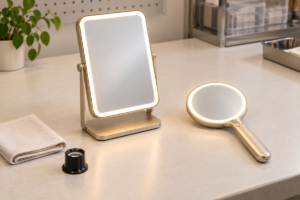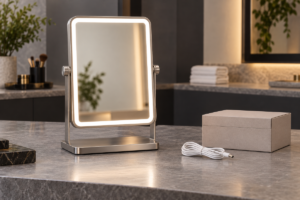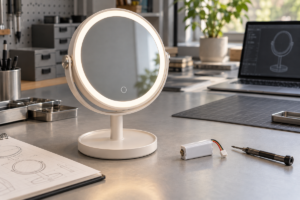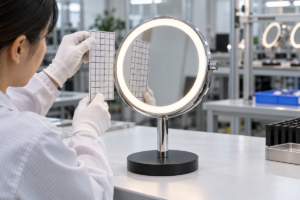

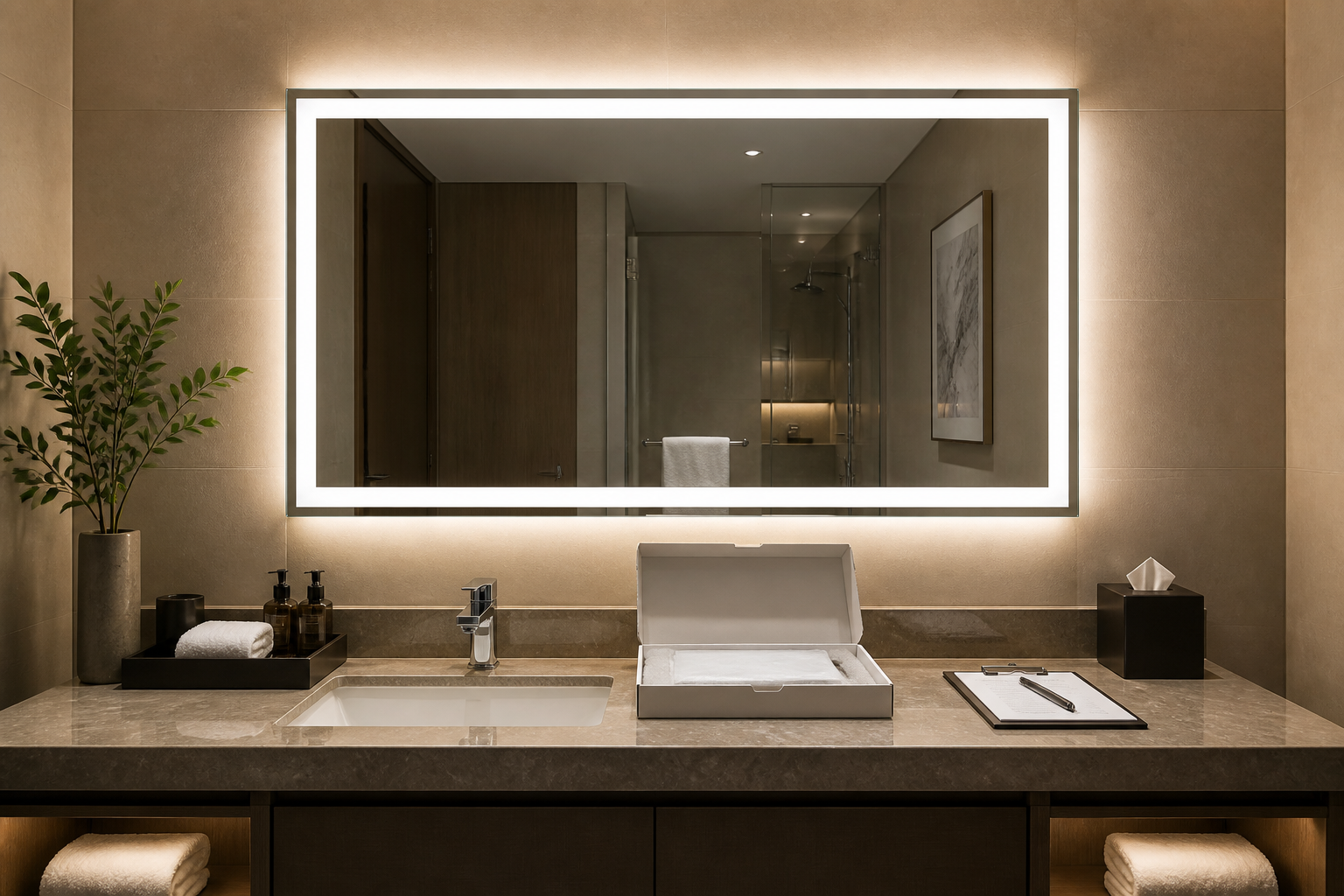
For hotel projects, an LED bathroom mirror should be sourced as a long-life installed product, not as a decorative mirror with lights. Buyers should confirm anti-fog performance, bathroom-safe electrical design, suitable IP rating, warm and comfortable lighting, installation compatibility, carton protection, and replacement support before approving bulk production. The safest project specification is usually a complete LED bathroom mirror with tested demister pad, stable driver, clear mounting method, practical CCT, serviceable spare parts, and project packaging approved before shipment.
This guide is for hotel developers, contractors, distributors, procurement teams, and bathroom fixture brands sourcing LED bathroom mirrors for guest rooms, serviced apartments, resorts, and renovation projects.
Why Hotel LED Bathroom Mirrors Need Project-Level Approval
Hotel bathrooms are moving toward a warmer, spa-like guest experience with layered lighting and easier maintenance. A mirror can support that experience only if it performs reliably after installation. In a hotel room, the buyer is not dealing with one consumer complaint. A weak specification can become repeated room downtime, contractor rework, freight claims, and after-sales pressure across dozens or hundreds of rooms.
For project buyers, the mirror must match the wall structure, power location, bathroom humidity, room lighting plan, and maintenance process. A product that looks acceptable in a showroom can still fail if the demister area is too small, the light is uncomfortable, the bracket does not match the wall, or the carton cannot protect the mirror during site delivery.
Mingda Mirror can support project buyers through bathroom mirror sourcing, OEM/ODM customization, quality control, and project quotation review.
Buyer Scenario: New Hotel Project vs Renovation Order
A new hotel project usually allows earlier coordination between mirror size, wall reinforcement, wiring route, vanity width, lighting design, and installation sequence. Buyers can approve a mirror around the room concept and project drawing.
A renovation order is different. The mirror must often fit existing wall tiles, electrical outlets, vanity depth, and room maintenance limits. In that case, the buyer should avoid oversize custom mirrors unless wall measurement, bracket position, and wiring location are verified carefully. A mirror that requires wall changes may look premium but create installation delay.
Distributors and contractors should also separate guest-room projects from apartment or retail orders. Hotel buyers often care more about repeatable installation, easy replacement, consistent lighting, spare parts, and carton labeling. Residential buyers may prioritize design variation and smart features. The RFQ should reflect the project type.
Hotel LED Bathroom Mirror Specification Matrix
| Project decision | Recommended sourcing check | Why it matters in hotels | RFQ point to confirm |
|---|---|---|---|
| Anti-fog function | Demister pad matched to usable viewing area | Guests expect a clear mirror after shower use | Demister size, wattage, heating time, switch control, test condition |
| Bathroom safety | Moisture-resistant electrical design and suitable IP rating | Reduces risk in humid rooms and protects brand reputation | IP rating target, driver position, wiring method, destination standard |
| Guest comfort | Warm or neutral CCT with glare control | Supports spa-like bathroom design without harsh face lighting | CCT, CRI target, diffuser, brightness level, dimming option |
| Installation | Stable bracket, clear power outlet plan, service access | Prevents contractor delay and repeated wall drilling | Bracket drawing, cable exit, mirror weight, wall fixing method |
| Logistics | Project packaging with foam, corner guards, and carton/crate plan | Controls breakage during export, warehouse handling, and site delivery | Inner protection, master carton, wooden crate option, drop-test plan |
| After-sales | Spare drivers, demister pads, switches, and replacement policy | Reduces room downtime after installation | Spare parts list, warranty process, batch traceability, lead time |
Use this matrix before sampling. If the supplier cannot answer these details, the buyer may be approving a product image rather than a project-ready specification.
Anti-Fog Performance: Do Not Approve Only the Feature Name
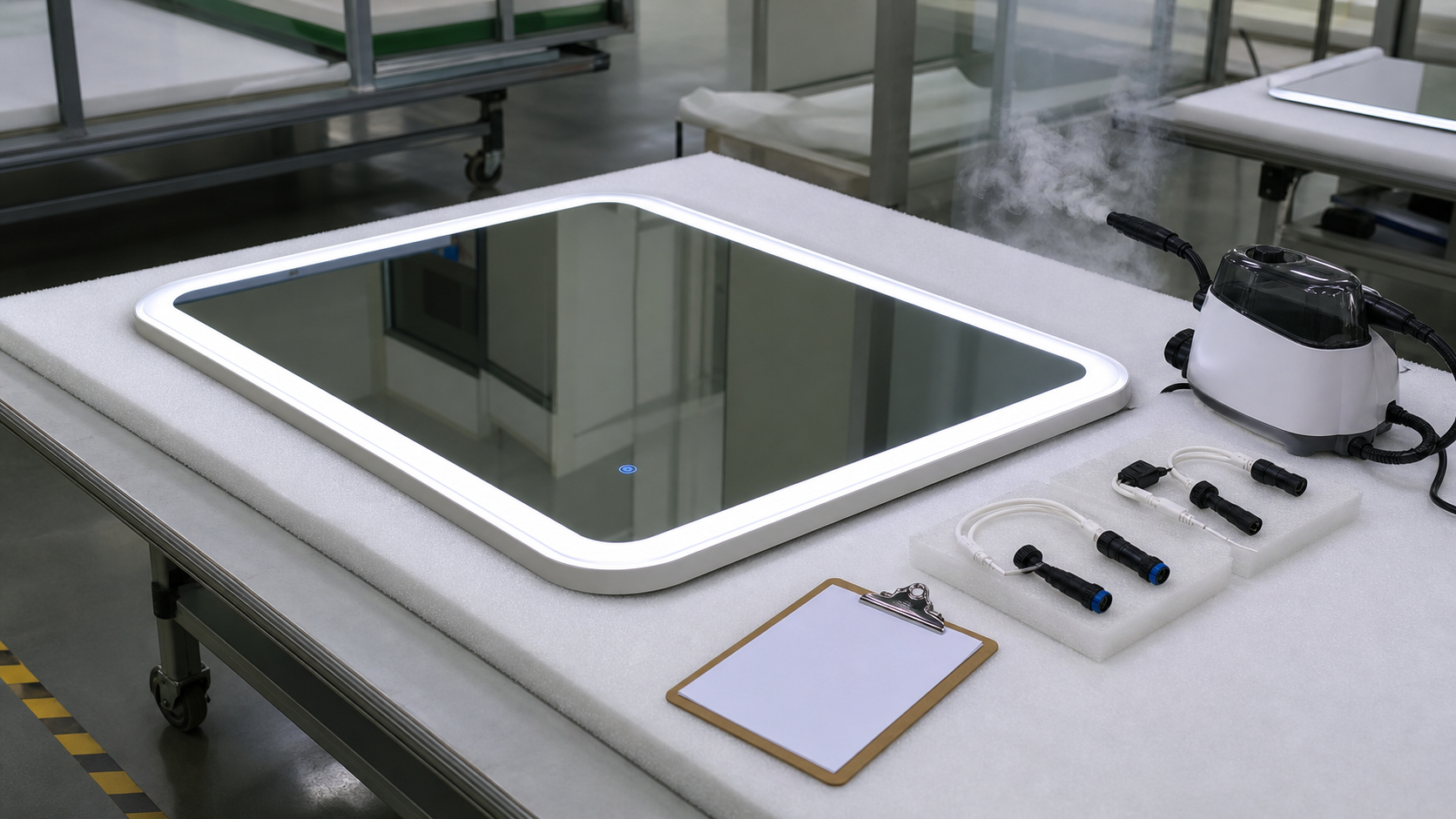
Anti-fog is one of the most common hotel LED bathroom mirror requests, but the word alone is not enough. Buyers should confirm the demister pad size, heating area, warm-up time, control method, and power consumption. A small demister pad may clear only the center of the mirror while the surrounding area remains foggy.
For guest rooms, the demister area should match how the mirror will actually be used. If the mirror is wide, confirm whether one pad is enough or whether a larger pad is needed. Also confirm whether the anti-fog function shares a switch with the LED light or uses separate control. Separate control can reduce unnecessary power use, while combined control may be easier for guests.
Ask for sample testing under realistic bathroom humidity, not only a quick factory demonstration. The buyer should see how fast the usable viewing area clears and whether the mirror surface remains safe and stable during repeated operation.
IP Rating and Electrical Design: Match the Bathroom Zone
IP rating should be selected according to the project bathroom layout and local electrical requirements. Buyers should not request the highest-looking number without understanding the installation area, because cost and structure can change. The practical goal is to match the mirror to the humidity, splash risk, power connection, and destination market.
Confirm driver location, wire routing, connector protection, switch type, grounding if required, and whether the mirror is hardwired or plug-in. For hotel projects, hardwired installation is common, but the final decision depends on the contractor and local code.
Documentation also matters. Ask what test reports, electrical documents, labels, and packaging marks can be supplied for the destination market. If the mirror includes smart functions, sensors, Bluetooth, or other electronics, the documentation scope may expand.
Lighting: Comfortable Guest Experience Beats Maximum Brightness
Hotel bathroom lighting should help guests feel comfortable and look natural. Maximum brightness is not always the best specification. Harsh front light, visible LED dots, uneven diffusion, or cold color temperature can make the room feel less premium.
For many hotel projects, warm or neutral light works better than very cold light. Buyers should confirm CCT, CRI target, diffuser design, light uniformity, and whether dimming is required. If the mirror is the main face-lighting source, the LED strip or frontlit design needs more careful approval. If the room already has strong ceiling or vanity lighting, a softer backlit mirror may be enough.
Before bulk order, review the mirror sample in a room-like setting with the vanity, wall color, and other light sources. A mirror that looks bright on a white factory wall may feel different in a darker hotel bathroom.
Installation Details That Affect Project Cost
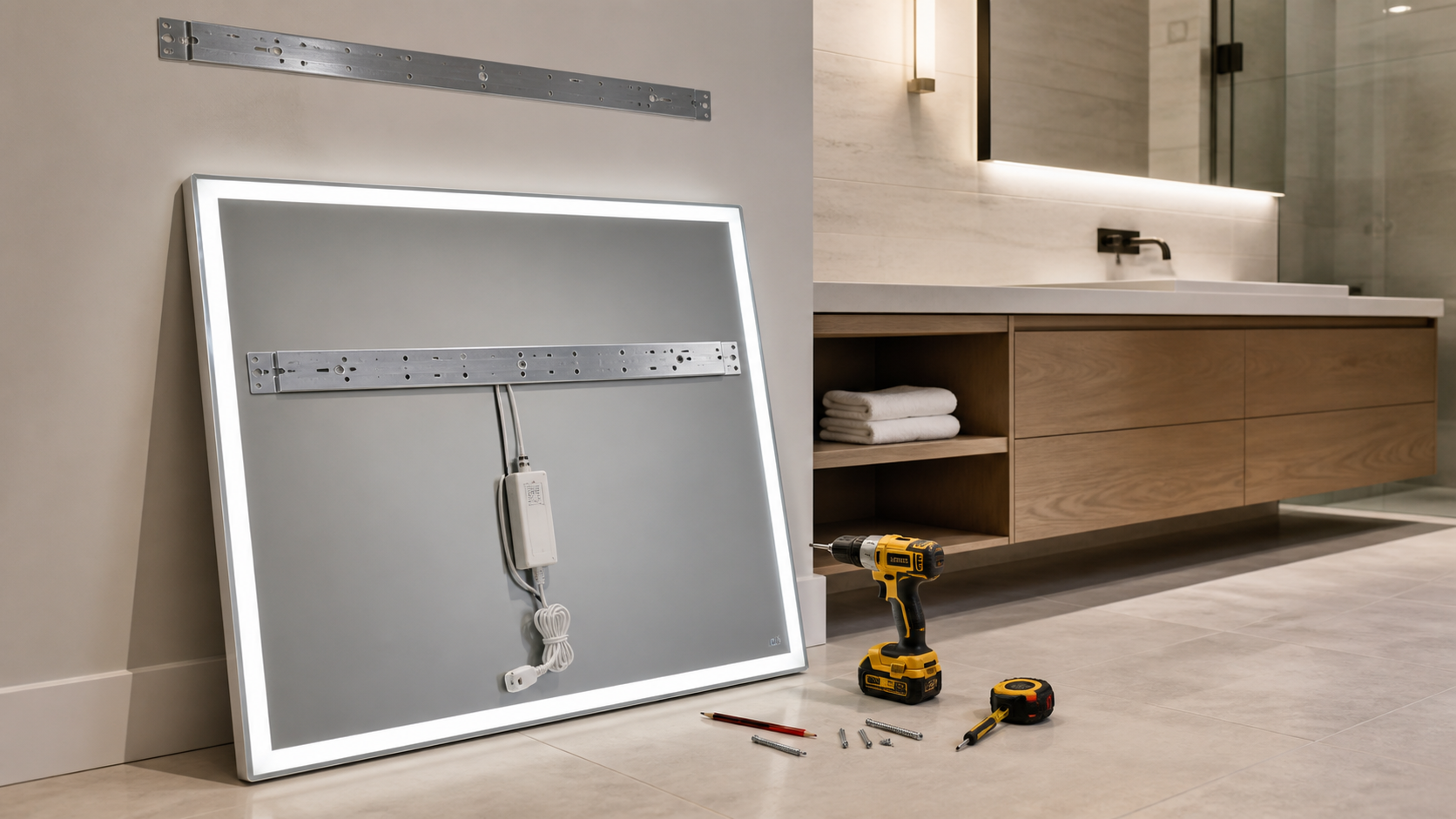
Installation mistakes are expensive in hotel projects because they repeat across rooms. Buyers should confirm mirror dimensions, weight, bracket structure, hanging direction, cable exit position, transformer/driver placement, and service access before production.
For wall-mounted LED bathroom mirrors, the bracket must be stable and easy for installers to understand. If the mirror is too heavy or the bracket position is unclear, installation can slow down. If the cable exit does not match the reserved power point, the contractor may need additional work.
Ask the supplier for a drawing or installation sheet before confirming the order. For renovation projects, compare the drawing with existing wall conditions. For new hotel projects, share the bathroom drawing early so the supplier can recommend size, bracket, and wiring details before samples are built.
Packaging and Site Delivery Risk
LED bathroom mirrors combine glass, frame or backing, LEDs, driver, demister pad, switch, and wiring. They need stronger packaging than ordinary decorative mirrors. Breakage may happen not only during sea freight but also during warehouse unloading, local delivery, and site movement between floors.
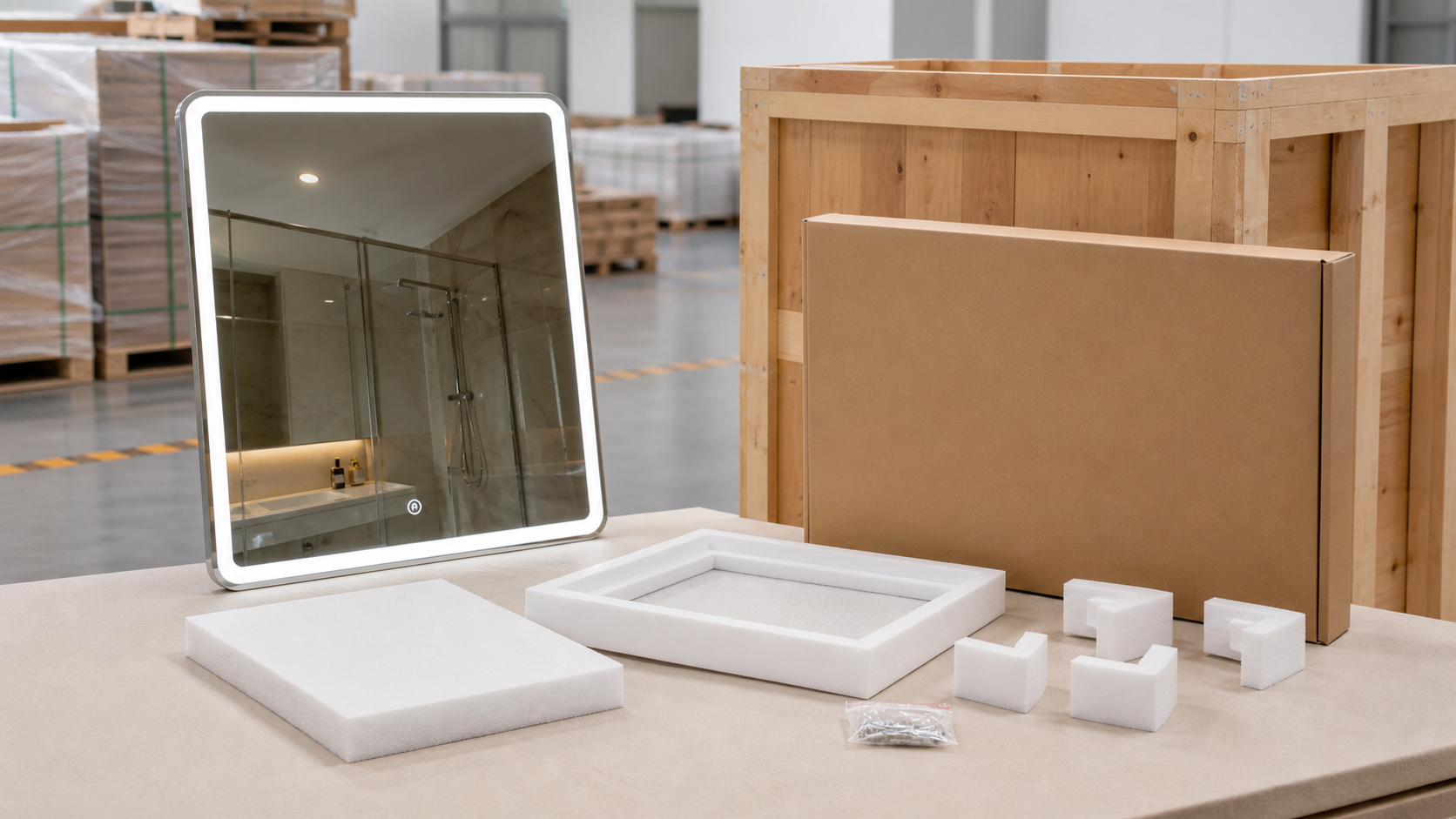
Buyers should approve inner foam, corner guards, carton thickness, accessory placement, and master carton or wooden crate plan. For large project mirrors, wooden crate or palletized delivery may be worth the extra cost because it reduces repeated replacement and installation delays.
Also confirm carton labeling and batch traceability. Even if visible shipping labels are added later, the internal packing method should help the warehouse team identify model, room batch, and replacement parts quickly.
Pre-RFQ Checklist for Hotel Project Buyers
- Define the project type: new hotel, renovation, serviced apartment, resort, distributor stock, or contractor supply.
- Confirm room quantity, mirror size range, vanity width, wall material, and target installation date.
- Confirm lighting requirements: frontlit, backlit, combined lighting, CCT, CRI target, brightness, dimming, and glare control.
- Confirm anti-fog details: demister pad area, heating time, switch method, wattage, and repeated-use test.
- Confirm electrical details: IP rating target, voltage, plug or hardwire, driver position, wire exit, certification documents, and label requirements.
- Confirm installation details: bracket drawing, mirror weight, mounting direction, power outlet location, service access, and spare parts.
- Confirm packaging details: foam, corner guards, carton, crate or pallet option, drop-test plan, and room-batch handling.
- Confirm commercial terms: sample lead time, MOQ, production lead time, inspection standard, replacement policy, and after-sales support.
Common Mistakes to Avoid
Do not approve the mirror only from a front-view photo. For project orders, the back structure, driver placement, mounting bracket, and power lead are just as important as the visible design.
Do not treat anti-fog as a standard checkbox. Confirm the actual heated area and test condition. A small demister pad can still create guest complaints.
Do not choose cold high-output light only because it looks bright in sample photos. Hotel bathrooms need comfortable, repeatable lighting that works with wall color, vanity material, and guest expectations.
Do not leave packaging approval until after mass production. Once the mirror size and carton size are fixed, packaging changes can affect cost, lead time, and freight planning.
Bottom-Line Recommendation
For hotel and serviced-apartment projects, choose a LED bathroom mirror by project reliability first: anti-fog area, IP and electrical design, comfortable lighting, installation compatibility, packaging protection, and spare-parts support. Approve the sample with a bathroom-like lighting test, bracket and wiring review, fog test, and packaging check before bulk production.
FAQ
What IP rating should buyers request for hotel LED bathroom mirrors?
The correct IP rating depends on the bathroom layout, splash risk, wiring method, and local electrical requirements. Share the installation position and destination market so the supplier can recommend a practical target.
Is anti-fog necessary for hotel bathroom mirrors?
Anti-fog is strongly recommended for guest bathrooms where showers create steam. Buyers should confirm demister pad size, heating time, control method, and test result before approving the feature.
Should hotel buyers choose frontlit or backlit LED bathroom mirrors?
Frontlit mirrors provide stronger face lighting, while backlit mirrors create softer ambient light. Many hotel projects use one or both depending on vanity lighting, room style, and guest-use expectations.
What should be checked before installing LED bathroom mirrors in a renovation project?
Check wall size, tile condition, reserved power point, bracket position, mirror weight, cable exit, vanity clearance, and service access. Renovation projects need stricter measurement control than new builds.
How should LED bathroom mirrors be packed for hotel projects?
Use protective foam, corner guards, stable accessory packing, strong cartons, and pallet or wooden crate options for larger mirrors. Packaging should be approved before mass production and checked before shipment.
Request a Project Quote
If you are sourcing LED bathroom mirrors for a hotel, serviced apartment, resort, or contractor project, share your room quantity, mirror size, lighting requirement, anti-fog need, installation drawing, destination market, and packaging requirement with the Mingda Mirror team. Mingda can review the specification, prepare samples, confirm packaging, and quote OEM/ODM project options.