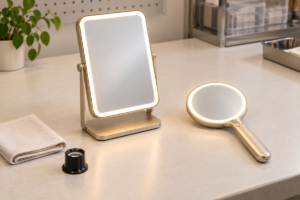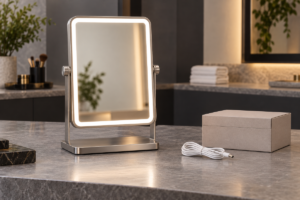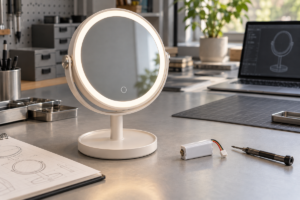

For rechargeable LED makeup mirror buyers, battery capacity and runtime claims should be verified before quotation approval, sample sign-off, and mass production. A higher mAh number does not automatically mean better user experience. The buyer needs to check actual runtime at usable brightness, charging time, battery documentation, heat, LED consistency, USB-C cable quality, packaging labels, and replacement policy. This is especially important for Amazon, DTC, retail, and gift channels where “short battery life” and “does not hold charge” can quickly become return reasons.
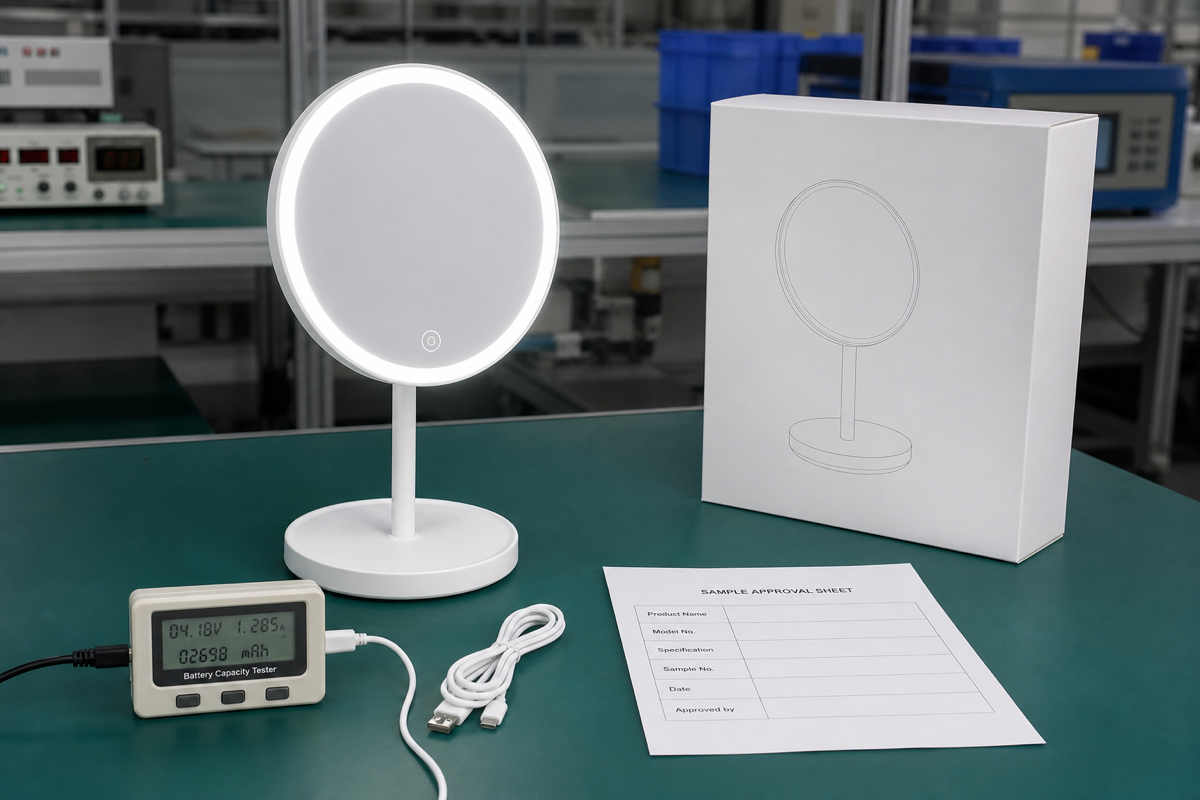
This guide is written for beauty brands, e-commerce sellers, retail buyers, distributors, and OEM/ODM sourcing teams comparing rechargeable LED tabletop makeup mirrors for private-label programs.
Why Battery Claims Need Procurement Control
Rechargeable LED makeup mirrors are now a strong category because buyers want cordless vanity use, cleaner product photography, USB-C charging, and portable convenience. However, the battery is also one of the easiest specifications to misunderstand. A supplier may quote battery capacity, runtime, brightness, and charging time, but those figures can be tested under different conditions.
For a sourcing manager, the practical question is not only “How many mAh is the battery?” The better question is: how long can the mirror deliver comfortable, stable lighting at the brightness level customers actually use, and can the supplier prove that result with repeatable testing?
If the claim is unclear, the buyer may approve a sample that performs well for a short demo but disappoints customers after several weeks. This creates higher return cost, weak product reviews, replacement requests, and customer-service pressure.
Battery Capacity vs Real Runtime
Battery capacity is normally expressed in mAh, but runtime depends on the LED load, brightness setting, battery quality, driver efficiency, touch-control design, and the cutoff point used by the battery protection circuit. Two mirrors with similar capacity can perform differently if one uses more LEDs, brighter output, poor diffusion, or an inefficient circuit.
| Claim buyers see | What it means | What to verify before bulk order |
|---|---|---|
| Battery capacity | Nominal battery storage, usually in mAh | Supplier battery cell spec, sample measurement, battery consistency |
| Runtime | How long the mirror works per charge | Test at normal, medium, and high brightness, not only lowest brightness |
| Charging time | Time to full charge from low battery | USB-C cable, input current, indicator behavior, heat during charging |
| Brightness level | Lighting output during use | Lux or lumen target, dimming range, glare control, brightness drop |
| Battery cycle life | Expected usable charging cycles | Battery supplier data, protection board, charging test plan |
| Standby drain | Power lost when mirror is off | Long storage check for retail warehouse and e-commerce inventory |
For private-label buyers, Mingda Mirror recommends asking for both the claimed battery capacity and the tested runtime condition. A useful quotation should state the mirror size, LED quantity, brightness setting, battery capacity, charging input, and test method.
What Buyers Should Ask in the RFQ
A rechargeable LED makeup mirror RFQ should not only list size, color, and logo. It should define the charging and lighting system in enough detail for accurate pricing and sample approval.
Include these points in the RFQ:
- Mirror format: tabletop, foldable, compact travel, wall-mounted, or salon counter use.
- Battery target: standard capacity, upgraded capacity, or channel-specific runtime requirement.
- Runtime claim: expected runtime at normal brightness and high brightness.
- Lighting: CCT options, CRI target, LED count, diffusion design, dimming range, and glare control.
- Charging: USB-C input, cable length, adapter policy, charging indicator, and low-battery signal.
- Safety documentation: battery specification, transport test documents, destination-market compliance needs.
- Packaging route: Amazon FBA, DTC parcel, retail shelf box, distributor carton, or gift box.
- Inspection standard: battery function, charging, heat, brightness, cosmetic, accessories, and packaging.
- Replacement policy: cables, batteries, charging boards, mirrors, and accessories.
These details make supplier quotations easier to compare. They also reduce the risk of approving a low-cost configuration that cannot support the advertised product claim.
Battery Capacity Test Points for Samples
Sample approval should include real-use charging and discharge checks. A single switch-on test is not enough for a rechargeable LED mirror.
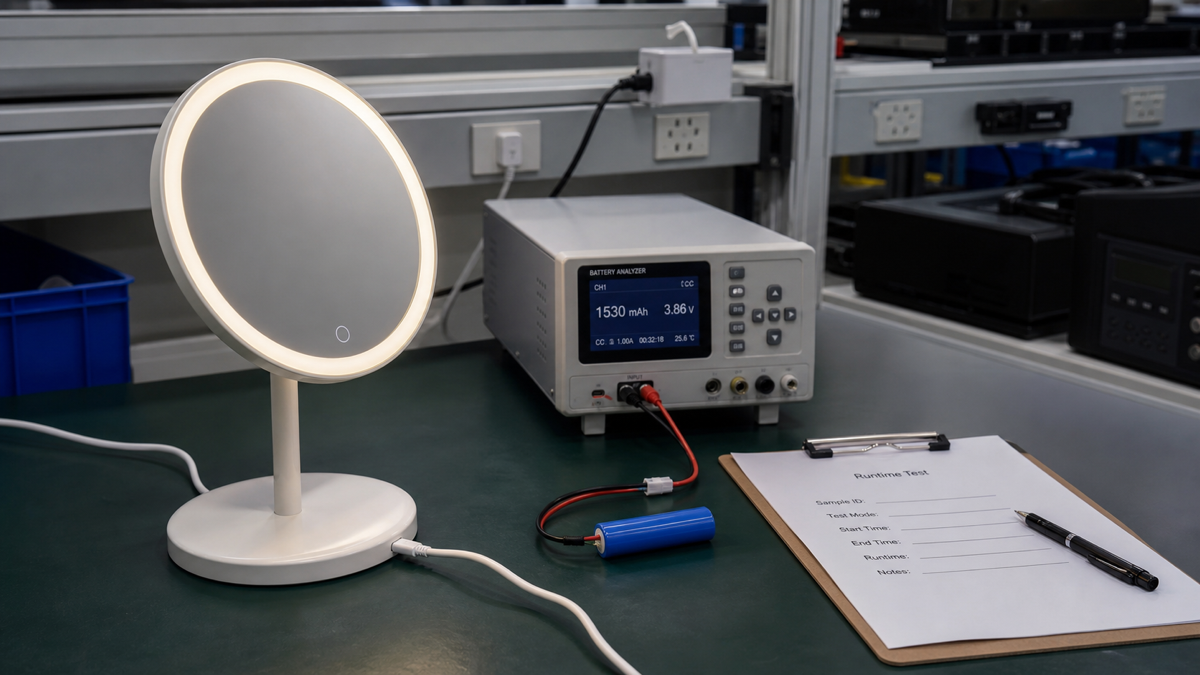
For sample approval, check:
- The actual battery cell specification matches the quotation.
- The mirror charges through the approved USB-C cable without looseness.
- The charging indicator is easy for customers to understand.
- Runtime is measured at practical brightness, not only the lowest dimming level.
- Brightness does not drop too quickly before the mirror shuts off.
- The touch switch works normally while charging and after full charge.
- Heat stays acceptable during charging and continuous LED operation.
- The mirror can be stored, recharged, and used again after warehouse-style idle time.
- The supplier can record changes if battery, cable, LED board, or charging board is updated.
For e-commerce sellers, the repeated-use test matters because customer complaints often appear after several charge cycles. A mirror that passes only the first day of use can still create returns if the port becomes loose, the battery drains during storage, or the LED brightness becomes unstable.
Runtime and Brightness Need to Be Tested Together
Many buyers ask for “long battery life” and “very bright light” at the same time. The tradeoff is that higher brightness consumes more power. If the LED ring is too bright at the maximum setting, the mirror may look impressive in a product video but run for a shorter time than customers expect.
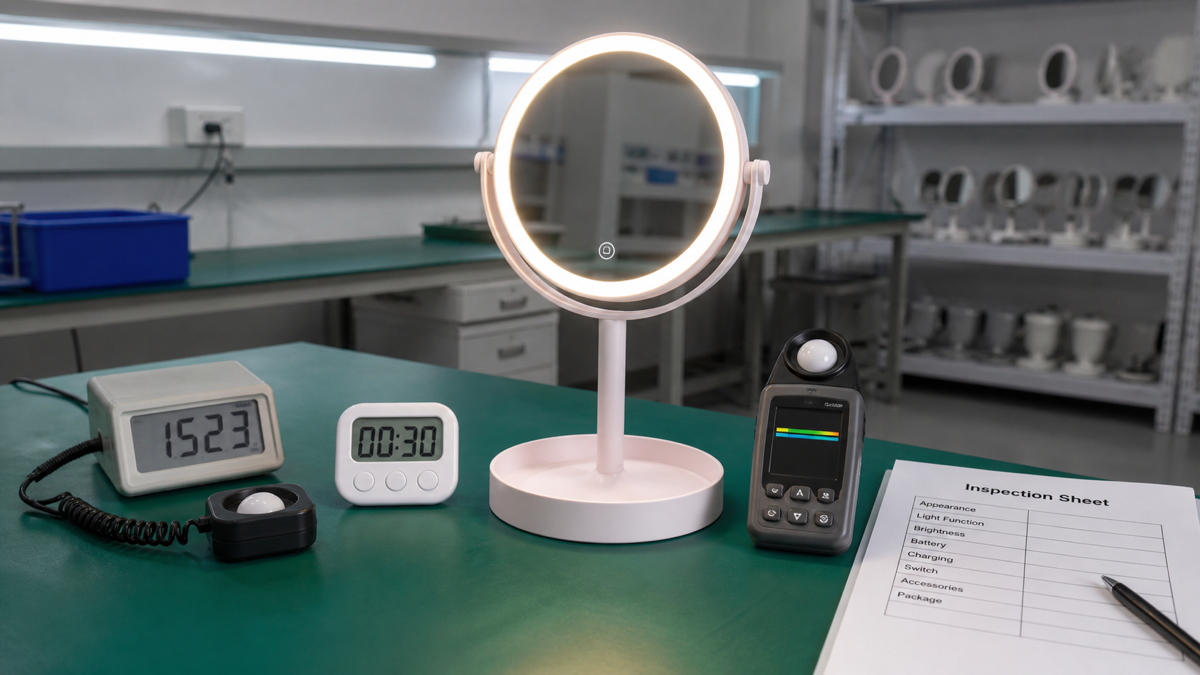
A better approval method is to define three practical lighting states:
- Daily makeup brightness: comfortable light for normal vanity use.
- High brightness: stronger output for close-up makeup, product video, or darker rooms.
- Low brightness: soft light for quick use or longer battery life.
Buyers should ask the supplier to test runtime at the daily-use brightness level and record the result. This is more valuable than advertising a long runtime that only applies to the lowest setting. For product pages and packaging, it is safer to use wording such as “up to” only when the test condition is controlled and documented.
Compliance and Battery Documentation
Rechargeable mirrors may require more documentation than plug-in-only mirrors, depending on the destination market and shipping route. The buyer should confirm battery and electrical requirements before mass production, not after the goods are packed.
Important documents and checks may include:
- Battery cell specification and supplier information.
- UN 38.3 transport test summary or battery transport documentation when required by the shipping route.
- Safety labels, battery warnings, and user manual language for the destination market.
- USB-C cable quality and accessory control.
- Electrical and EMC compliance planning for the target sales region.
- Carton marks and battery-related shipment declarations.
Mingda Mirror recommends confirming these requirements before the final quotation because documentation, packaging labels, and test records can affect cost, lead time, and shipment planning. Buyers should also avoid assuming that one market’s documentation automatically satisfies another market’s requirements.
Packaging and Label Risks
Battery performance is not only an internal product issue. Packaging affects how the rechargeable mirror arrives, stores, and is understood by the end user. If the cable, manual, or battery notice is missing, the customer may think the product is defective even when the mirror works normally.
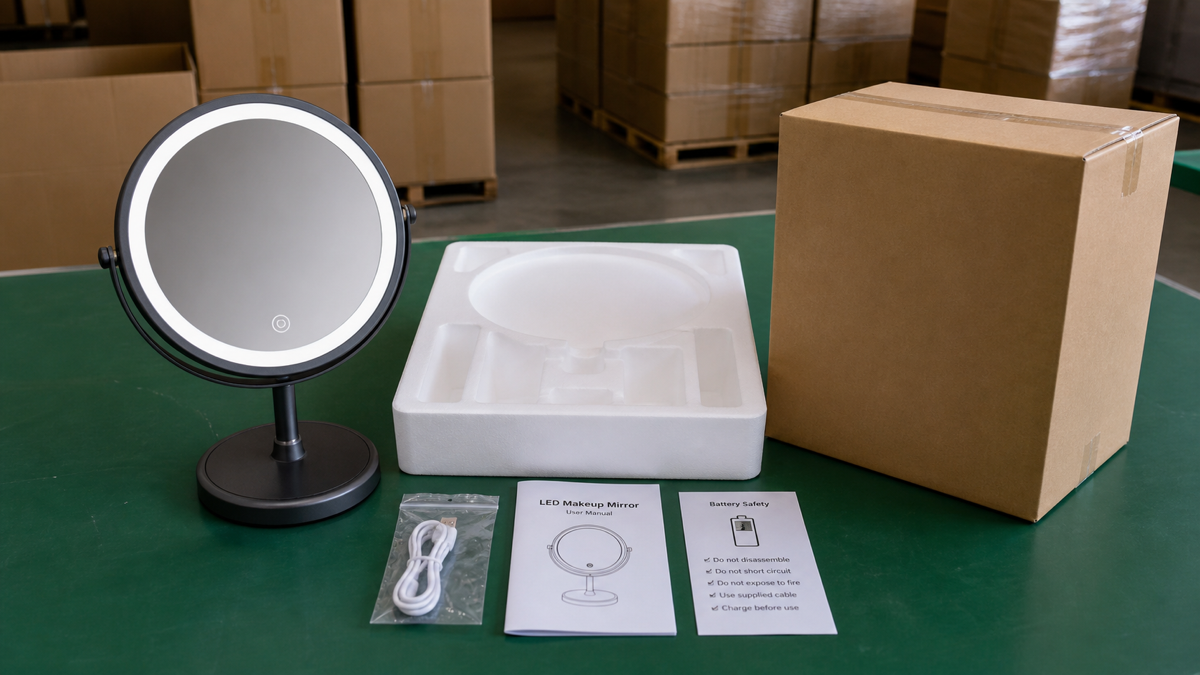
For packaging approval, verify:
- The mirror, USB-C cable, manual, and accessories have fixed positions.
- The LED ring, touch switch, mirror glass, stand, and base are protected from movement.
- Battery warning labels and charging instructions are clear.
- The manual explains charging status, low battery, first charge, and safe use.
- The color box, barcode, carton mark, and accessory count match the purchase order.
- E-commerce packaging can pass the intended drop and delivery route.
- Long storage does not create deep battery drain before sale.
For retail and gift channels, clear charging instructions also reduce returns from user confusion. For Amazon and DTC sellers, better packaging helps avoid negative reviews caused by missing cable, unclear manual, or transit damage.
Common Buyer Mistakes
The first mistake is choosing the largest mAh number without checking mirror size, brightness, cost, weight, and charging time. Bigger is not always better if it makes the product heavier, slower to charge, or harder to ship.
The second mistake is approving runtime at the lowest brightness setting. The tested condition should match how customers use the mirror in daily makeup routines.
The third mistake is changing the LED board or battery after sample approval without repeating the test. Even a small component change can affect runtime, heat, brightness, and charging behavior.
The fourth mistake is using vague packaging claims. “Rechargeable” and “long-lasting” should be supported by controlled testing and careful wording.
The fifth mistake is ignoring storage time. Retailers and e-commerce sellers may keep inventory for weeks or months, so the buyer should ask whether the battery remains usable after storage and whether charging instructions are clear.
Pre-Production QC Checklist
Before approving mass production, buyers should confirm:
- Battery capacity, supplier, and approved specification are recorded.
- Runtime is tested at daily-use and high-brightness levels.
- Charging time and indicator behavior are documented.
- USB-C cable, charging board, and port fit match the approved sample.
- Heat is acceptable during charging and continuous LED operation.
- Brightness, CCT, CRI, and dimming remain stable during use.
- Packaging protects the mirror and separates all accessories.
- Manual, warning label, barcode, and carton marks are approved.
- Pre-shipment inspection includes battery, charging, lighting, appearance, accessories, and packaging.
- The sales claim used in product pages or packaging matches the tested condition.
Bottom-Line Recommendation
For brands, Amazon sellers, and retail buyers, rechargeable LED makeup mirror battery capacity should be treated as a tested product promise, not a simple mAh number. The safest sourcing decision is to approve battery capacity, real runtime, brightness comfort, charging reliability, documentation, packaging, and claim wording together.
Mingda Mirror supports rechargeable LED makeup mirror OEM/ODM development, sample testing, USB-C charging checks, lighting QC, packaging design, and private-label production. Review our Makeup Mirrors, OEM/ODM Services, QC Process, and Product pages, or contact Mingda Mirror with your target runtime, battery capacity, sales channel, packaging route, and order quantity.
FAQ
Is a higher mAh battery always better for LED makeup mirrors?
No. A higher mAh battery can improve runtime, but it may also increase cost, weight, charging time, and documentation needs. Buyers should compare actual runtime at usable brightness, not only the battery capacity number.
How should buyers verify runtime for rechargeable LED makeup mirrors?
Buyers should test runtime at daily-use brightness and high brightness, record the start time, end time, brightness level, charging condition, and sample ID, then compare the result with the claim used in packaging or product listings.
What battery documents should private-label buyers request?
Buyers should request the battery cell specification, supplier information, available transport test documentation, safety label requirements, user manual content, and destination-market compliance plan before mass production.
Common causes include unclear runtime claims, weak battery cells, loose charging ports, poor cable quality, confusing charging indicators, storage drain, missing accessories, and packaging that does not protect the product during shipment.
An RFQ should include mirror size, LED and brightness requirements, battery target, runtime expectation, charging format, cable policy, destination market, packaging route, sample deadline, inspection standard, and claim wording for product pages or packaging.
Social Media Content Ideas
LinkedIn angle: explain why rechargeable LED makeup mirror buyers should verify runtime at usable brightness instead of comparing mAh numbers only.
Facebook angle: show how clearer charging instructions and packaging reduce battery-related customer complaints.
Instagram angle: use the QC bench image to highlight battery capacity, runtime, USB-C charging, and sample approval in one practical scene.
CTA: Read the full buyer QC guide and send Mingda Mirror your target runtime, battery capacity, sales channel, and packaging plan for an OEM recommendation.