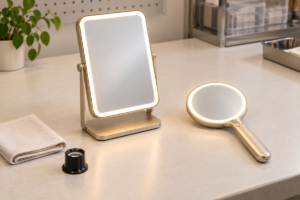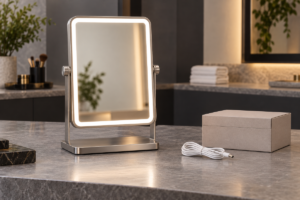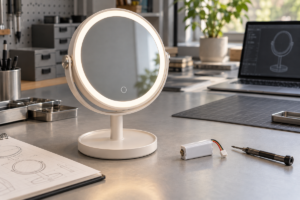

For private-label LED makeup mirror buyers, a USB-C charging dock should be approved as a product system, not as a small accessory. The buyer needs to confirm charging stability, port durability, battery capacity, cable quality, dock fit, packaging protection, user instructions, and after-sales parts before mass production. A mirror that looks premium in photos can still create returns if the dock is loose, the port wears quickly, the cable is weak, or the packaging lets accessories move during shipment.
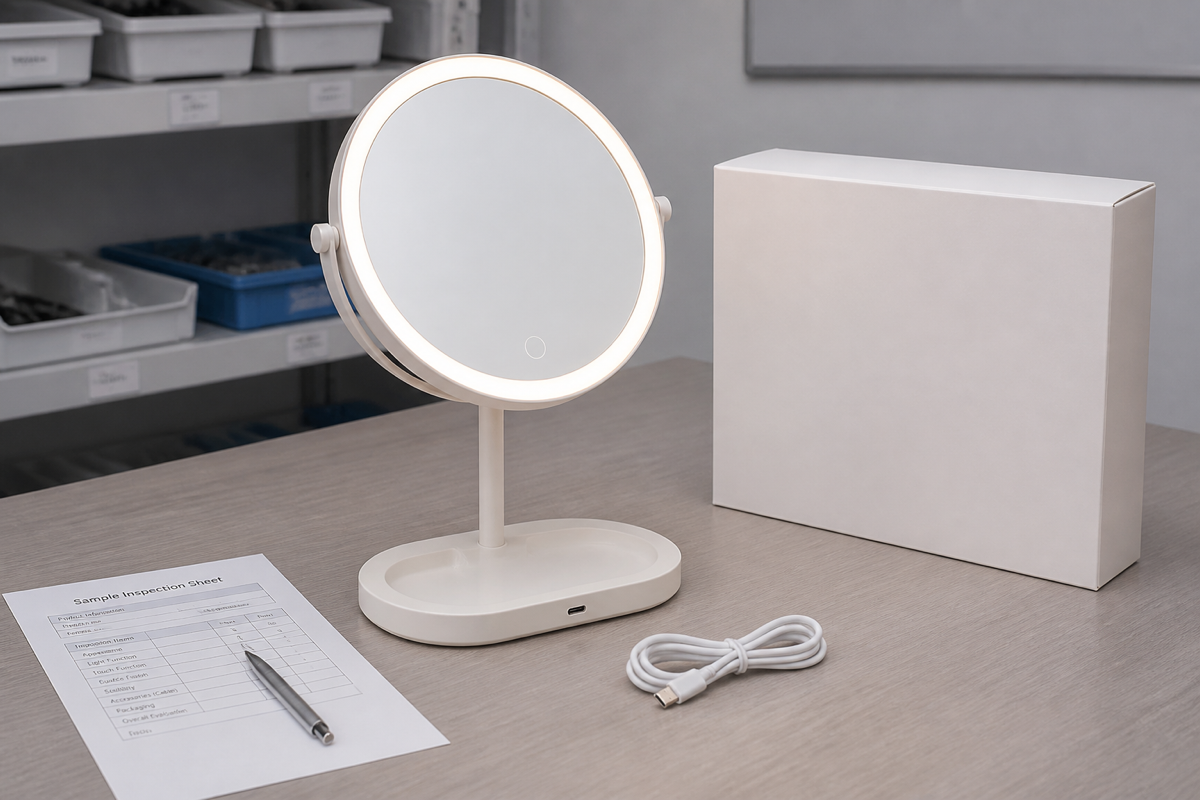
This guide is written for beauty brands, Amazon and e-commerce sellers, retail buyers, distributors, and OEM/ODM sourcing teams preparing a rechargeable LED makeup mirror program with a charging base, dock, or USB-C interface.
Why the Charging Dock Changes the Buying Decision
Rechargeable LED makeup mirrors are attractive because they remove cable clutter and fit modern beauty routines. A charging dock can make the product feel more premium than a basic plug-in cable, but it also adds more quality-control points. The mirror, dock, charging cable, battery, LED board, port, packaging insert, and manual must work together.
For a sourcing manager, the dock is not only a convenience feature. It affects unit cost, tooling, MOQ, carton size, accessory control, product reviews, and replacement policy. If the dock feels unstable or the charging contact is inconsistent, customers may blame the whole mirror even when the LED light and glass quality are acceptable.
Buyers should therefore evaluate the charging system before approving the final sample. The most important question is simple: can an ordinary user place, charge, tilt, clean, pack, and recharge the mirror repeatedly without confusion or failure?
USB-C Cable Charging vs Charging Dock
Many buyers compare a direct USB-C port with a charging dock. Both can work, but they serve different channels and price points.
| Charging format | Best fit | Buyer advantage | Main risk to control |
|---|---|---|---|
| Direct USB-C cable | Amazon, entry retail, travel mirror lines | Lower cost, fewer parts, easier replacement | Port looseness, cable quality, unclear charging indicator |
| USB-C charging dock or base | Beauty brands, premium DTC, gift retail | Cleaner vanity display, stronger product story, higher perceived value | Dock fit, contact stability, extra accessory packaging |
| Magnetic or contact charging base | Premium custom projects and gift programs | Fast user experience and attractive unboxing | Higher tooling cost, alignment tolerance, replacement parts |
| Plug-in power only | Salon or fixed countertop use | No battery transport issue, continuous use | Less portable, cable clutter, weaker e-commerce appeal |
For most private-label buyers, Mingda Mirror recommends starting with a stable USB-C rechargeable mirror and adding a dock when the target channel can support the higher cost and stronger packaging requirement. A dock is most valuable when the buyer wants a premium countertop product, gift positioning, or a cleaner product-photo story.
Specification Points to Confirm Before RFQ
A useful RFQ should define the charging system clearly. If the buyer only asks for a “USB-C rechargeable LED makeup mirror,” the supplier may quote a basic version that does not match the final channel requirement.
Before requesting a final quotation, confirm:
- Mirror type: tabletop, foldable, wall-mounted, compact travel, or salon counter use.
- Charging format: direct USB-C port, charging dock, magnetic base, or plug-in only.
- Battery capacity: expected runtime at normal and high brightness.
- Charging input: cable type, adapter inclusion or exclusion, destination-market expectations.
- Port durability: insertion cycles, cable fit, port reinforcement, and connector alignment.
- Dock structure: base weight, contact position, anti-slip pad, tilt clearance, and accessory tolerance.
- Lighting: CCT options, CRI target, brightness range, dimming control, and glare diffusion.
- User interface: charging indicator, low-battery signal, memory function, and touch switch behavior.
- Finish and branding: standard color, custom finish, logo position, manual, color box, and carton mark.
- Packaging route: e-commerce drop protection, retail shelf box, distributor carton, or gift packaging.
These details affect quotation, sample lead time, testing, packaging design, and production control. Buyers who define them early usually avoid expensive sample revisions.
Charging Port and Dock QC Checks
The charging system should be tested with repeated real-use motions, not only checked once after assembly. A stable sample should charge reliably when the mirror is placed on the dock, when the cable is plugged in, and after the mirror has been tilted or moved.
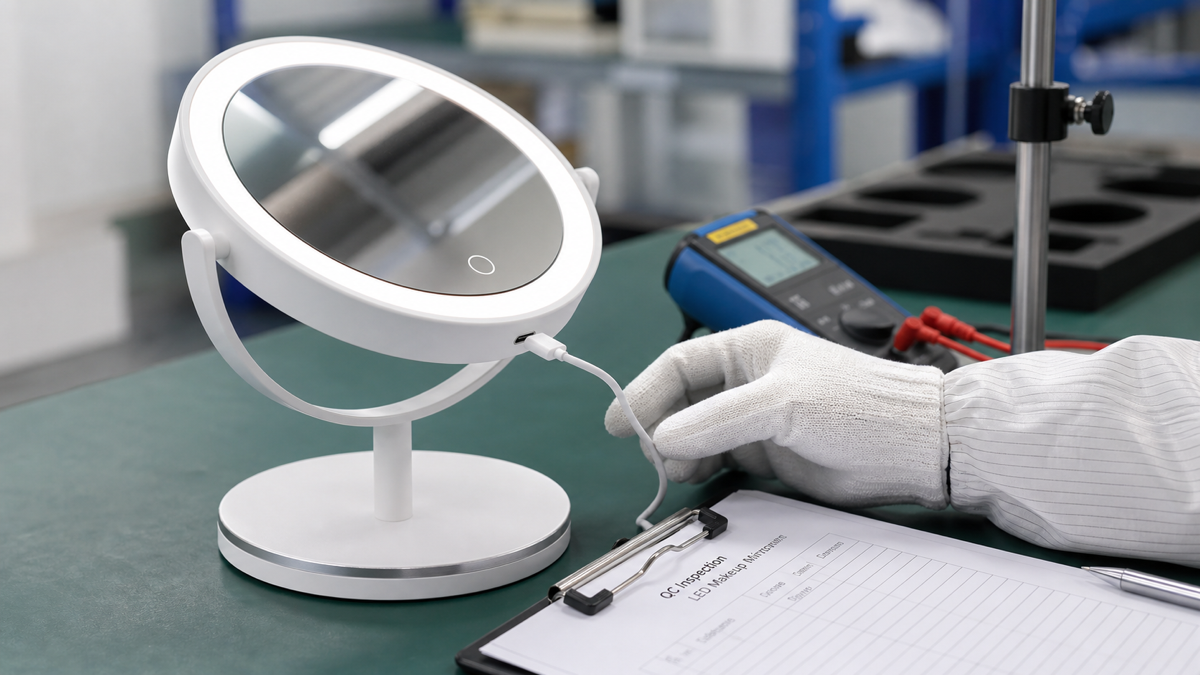
For sample approval and pre-shipment inspection, check:
- USB-C connector fit with the approved cable.
- Port alignment with the mirror shell or base opening.
- Charging indicator behavior when the battery is empty, charging, and full.
- Cable strain when the mirror is used on a normal vanity table.
- Dock contact stability after repeated placement and removal.
- Base stability when the mirror is tilted while charging.
- Heat during charging and continuous LED operation.
- LED brightness drop as battery level decreases.
- Touch dimming response while the mirror is charging.
- Cosmetic scratches or looseness around the port after repeated tests.
For e-commerce sellers, charging failure is especially risky because it leads to customer reviews that mention “does not charge” or “stopped working.” Those reviews can damage the listing even when the defect rate is limited. A better approach is to approve the cable, port, battery, and dock as one controlled system.
Battery, Runtime, and Lighting Tradeoffs
Buyers often ask for stronger brightness and longer runtime at the same time. In practice, battery capacity, LED brightness, mirror size, product weight, and charging cost need to be balanced.
A higher-capacity battery can support a stronger product story, but it may increase cost, weight, charging time, battery documentation needs, and transport considerations. A very bright LED ring may look impressive in a short video, but if diffusion is poor it can create glare, eye discomfort, or fast battery drain.
For most beauty and retail channels, a better specification is not simply “maximum brightness.” The buyer should request comfortable lighting, smooth dimming, consistent CCT, acceptable runtime at common brightness, and clear charging feedback. This makes the product easier to use and easier to explain in product listings, retail packaging, and customer service scripts.
Packaging Must Hold the Mirror and Accessories Separately
A charging dock or cable creates an accessory-management problem. If the cable, dock, manual, or adapter moves freely inside the box, the mirror surface, LED ring, shell, or touch area can be scratched during freight. Missing accessories also create immediate complaints.
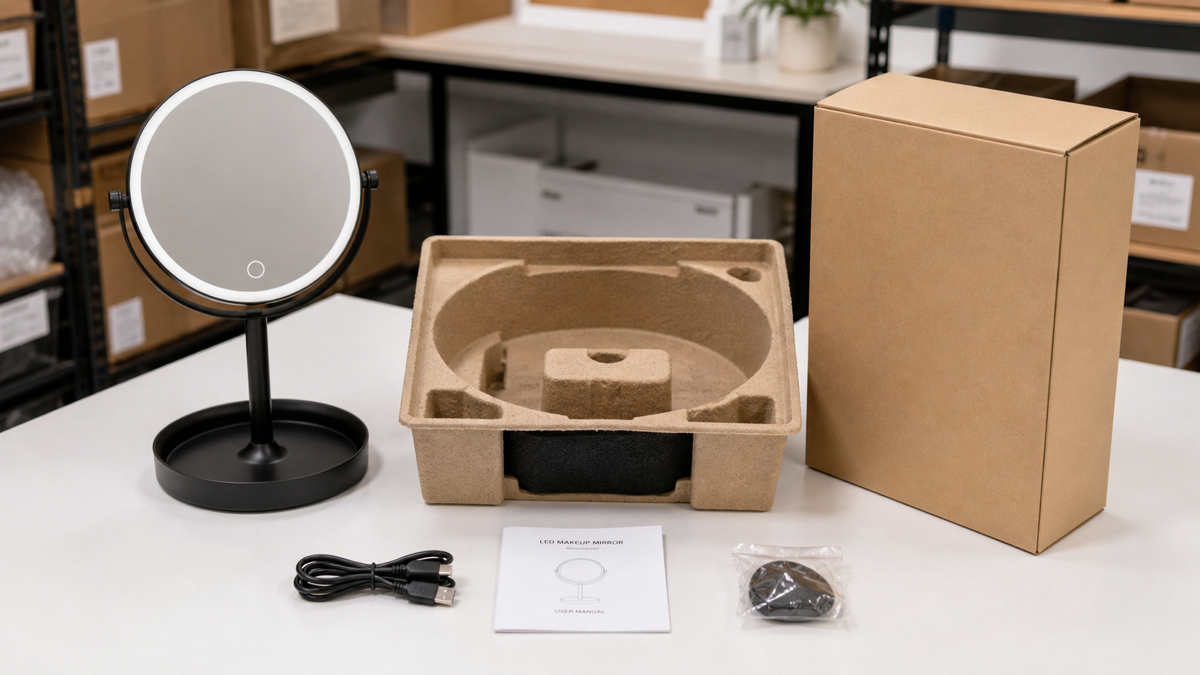
For Amazon, DTC, and retail buyers, packaging approval should include:
- Fixed position for mirror head, stand, base or dock, cable, manual, and accessory bag.
- Insert material suitable for the mirror weight and shipping route.
- Protection between the mirror glass and hard carton surfaces.
- Clear accessory count before sealing the color box.
- Drop-test or transit-simulation expectations for e-commerce delivery.
- Barcode, warning label, battery notice, and destination language planning.
- Master carton stacking strength and warehouse identification.
- Replacement accessory policy for cables, docks, and manuals.
Packaging should be reviewed with a complete sample set, not only a product sample. The buyer should ask for photos of the packed product, open box, accessory placement, inner protection, color box, and master carton before mass production.
OEM/ODM Customization Options
A USB-C rechargeable LED makeup mirror program can be customized in several ways, but the first order should focus on the details that affect conversion and reliability.
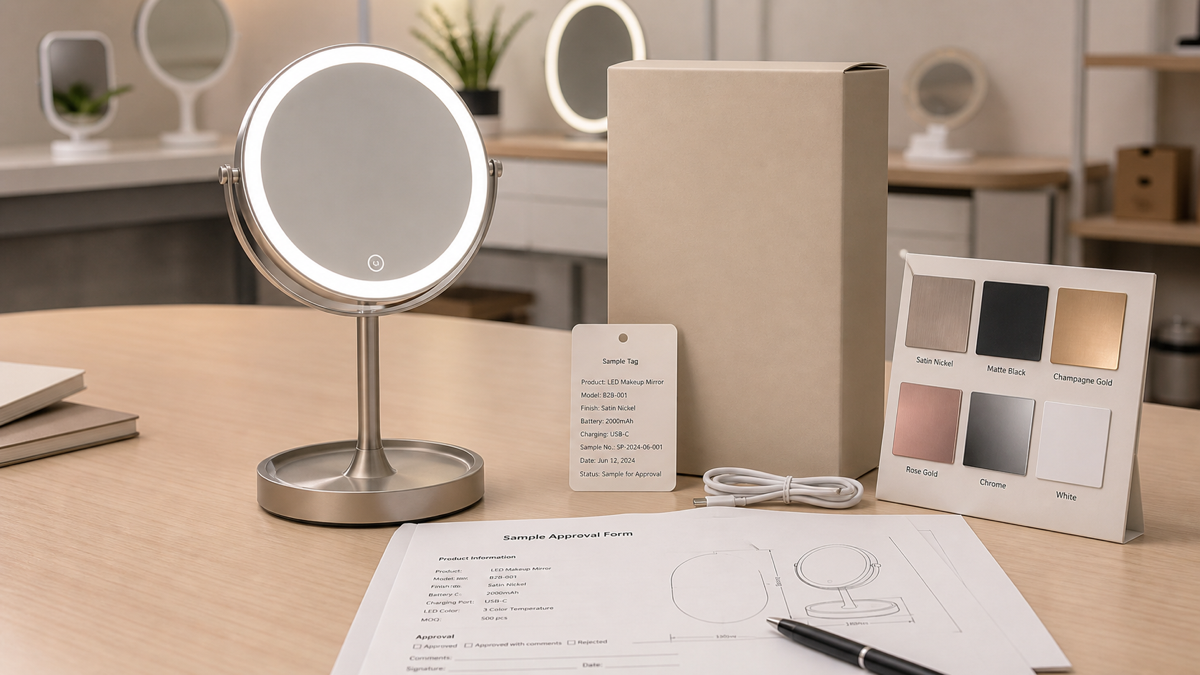
Common OEM/ODM options include:
- Shell color: white, black, chrome, rose gold, champagne gold, brushed nickel, or custom finish.
- Lighting: single CCT, three-color temperature, memory function, or dimming range.
- Charging: direct USB-C, charging dock, magnetic contact, cable length, and adapter policy.
- Branding: logo on base, back shell, manual, color box, carton, or product label.
- Packaging: standard box, gift box, e-commerce protection, molded insert, or retail-ready sleeve.
- Documentation: user manual, warning card, battery notice, compliance label, and after-sales insert.
- Accessory set: USB-C cable, adapter if required, cleaning cloth, storage bag, spare part kit, or display card.
The tradeoff is complexity. More customization can help brand positioning, but it can also increase MOQ, sample time, packaging proof cost, and production risk. For first-time buyers, Mingda usually recommends customizing the brand presentation and packaging while keeping the core electrical structure close to a proven production model.
Commercial Questions Buyers Should Ask
Before confirming a rechargeable LED makeup mirror with a charging dock, buyers should ask the supplier direct commercial questions:
- What is the MOQ for standard color and custom color?
- Does the dock require new tooling or can it use an existing structure?
- What is the sample lead time with private-label packaging?
- What battery and charging documents are available for the destination market?
- Can the supplier provide charging-port and runtime test records?
- How are cables, docks, manuals, and accessory bags counted before packing?
- What inspection standard is used for charging failure, dimming failure, scratches, and loose parts?
- Can replacement cables or docks be supplied with the order?
- What packaging change is needed for Amazon, retail, or distributor shipments?
- How will approved sample changes be recorded before mass production?
These questions help buyers compare suppliers beyond the lowest unit price. A low quotation can become expensive if the first shipment creates charging complaints, accessory shortages, or packaging damage.
Common Mistakes to Avoid
The first mistake is treating USB-C as a generic label. Buyers should check the physical connector, cable quality, charging indicator, and port reinforcement, not only the product description.
The second mistake is adding a charging dock without adjusting packaging. A dock increases perceived value only when it arrives undamaged and is easy for the user to identify.
The third mistake is requesting excessive brightness without checking runtime and heat. Beauty customers need comfortable, stable light more than an extreme brightness claim.
The fourth mistake is approving a sample without a repeated-use test. Charging issues often appear after many plug-in, placement, tilt, and movement cycles.
The fifth mistake is customizing too much in the first order. For a new product line, prove one reliable SKU first, then expand finish, packaging, accessory bundle, or charging style after sales data is available.
Pre-Production Checklist
Use this checklist before signing off mass production:
- The approved sample charges reliably through the selected USB-C cable or dock.
- Battery runtime, charging time, and brightness levels match the product claim.
- The LED ring has even diffusion with no obvious dark zones or harsh glare.
- The base or dock remains stable when the mirror is tilted and touched.
- The USB-C port shows no looseness after repeated insertion testing.
- Packaging holds mirror, dock, cable, manual, and accessories separately.
- Logo, color, manual, box, barcode, and carton mark are approved in writing.
- Battery and electrical documentation match the destination market.
- Pre-shipment inspection includes charging, lighting, cosmetic, accessory, and packaging checks.
- The RFQ includes MOQ, lead time, sample correction path, replacement parts, and shipment plan.
Bottom-Line Recommendation
For private-label buyers, a USB-C rechargeable LED makeup mirror with a charging dock is a strong product direction when the sales channel values premium countertop use, gift presentation, and clean e-commerce storytelling. The buyer should not approve it only by appearance. Approve the charging system, dock fit, battery runtime, LED comfort, accessory packaging, and inspection plan together.
Mingda Mirror supports LED makeup mirror OEM/ODM development, rechargeable mirror sample approval, USB-C charging and lighting QC, packaging design, and private-label production. Review our Makeup Mirrors, OEM/ODM Services, QC Process, and Product pages, or contact Mingda Mirror with your target channel, quantity, charging format, packaging route, and launch timeline.
FAQ
Is a USB-C charging dock better than a direct cable for LED makeup mirrors?
A charging dock is better for premium private-label, gift, and countertop programs because it improves the user experience and product presentation. A direct USB-C cable is usually better for lower-cost, travel, or simple e-commerce SKUs. The right choice depends on sales channel, target price, packaging budget, and after-sales plan.
What should buyers test before approving a rechargeable LED makeup mirror?
Buyers should test charging stability, USB-C port fit, dock alignment, battery runtime, heat, dimming, CCT consistency, LED diffusion, base stability, accessory completeness, packaging protection, and repeated-use durability before approving bulk production.
Can a LED makeup mirror charging dock be customized for private label?
Yes. Buyers can customize finish, logo position, color box, manual, accessory set, cable policy, packaging insert, and sometimes dock structure. For first orders, it is usually safer to keep the electrical structure close to a proven design and customize brand-facing details.
What packaging is needed for USB-C rechargeable makeup mirrors?
The packaging should separate the mirror, dock or base, USB-C cable, manual, and accessory bag. E-commerce orders need stronger drop protection and fixed insert positions, while retail orders need clearer shelf presentation, barcode planning, and consistent unboxing.
What information should be included in an RFQ for this product?
An RFQ should include mirror size, charging format, battery capacity target, lighting requirements, finish, logo, packaging route, destination market, order quantity, sample deadline, compliance needs, inspection standard, and expected shipment window.
Social Media Content Ideas
LinkedIn angle: explain why USB-C charging docks should be approved as a complete product system, not a loose accessory.
Facebook angle: show how charging stability and accessory packaging reduce customer complaints for rechargeable LED makeup mirrors.
Instagram angle: use the sample approval scene to highlight complete mirror, charging dock, cable, packaging, and finish swatches.
CTA: Read the full sourcing guide and send Mingda Mirror your target channel, quantity, charging format, and packaging route for a private-label recommendation.