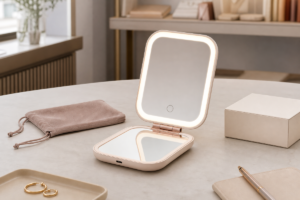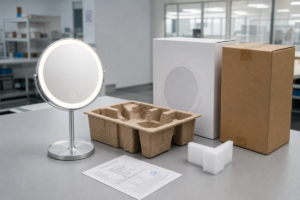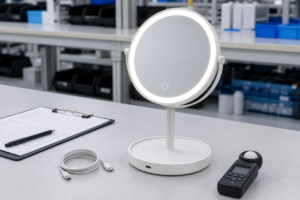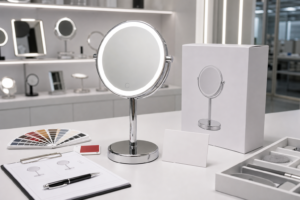

For Amazon FBA and retail channels, rechargeable LED makeup mirror packaging should protect the mirror, battery, stand, cable, retail box, and outer carton as one system. The best package is not only attractive on a shelf; it must pass handling, reduce breakage, support lithium battery documentation, fit marketplace carton rules, and still leave room for private-label branding. Buyers should approve the inner tray, retail box, master carton, drop-test method, labeling, and replacement policy before bulk production, not after the first shipment receives damage complaints.
Why Packaging Is a Buying Decision, Not a Final Decoration
Rechargeable makeup mirrors are high-return-risk products because they combine a glass mirror surface, LED lighting, a hinge or stand, charging components, and a lithium battery. A weak package can make a technically good mirror look unreliable after one courier route or warehouse transfer.
For e-commerce buyers, the package also affects margin. Oversized cartons increase fulfillment cost. Thin retail boxes increase breakage. Poor labeling can delay inbound receiving. A beautiful gift box that cannot survive parcel delivery may create more one-star reviews than a slightly simpler box with a better inner structure.
For retail chains, the package has a different job. It must look credible on shelf, protect the mirror during container shipment and store handling, show the product clearly enough for shoppers, and support barcode, country-of-origin, warning, and private-label requirements.
The sourcing question is simple: will this packaging protect the mirror through the real sales channel, or only look acceptable in a sample room?
Packaging Structure Buyers Should Specify
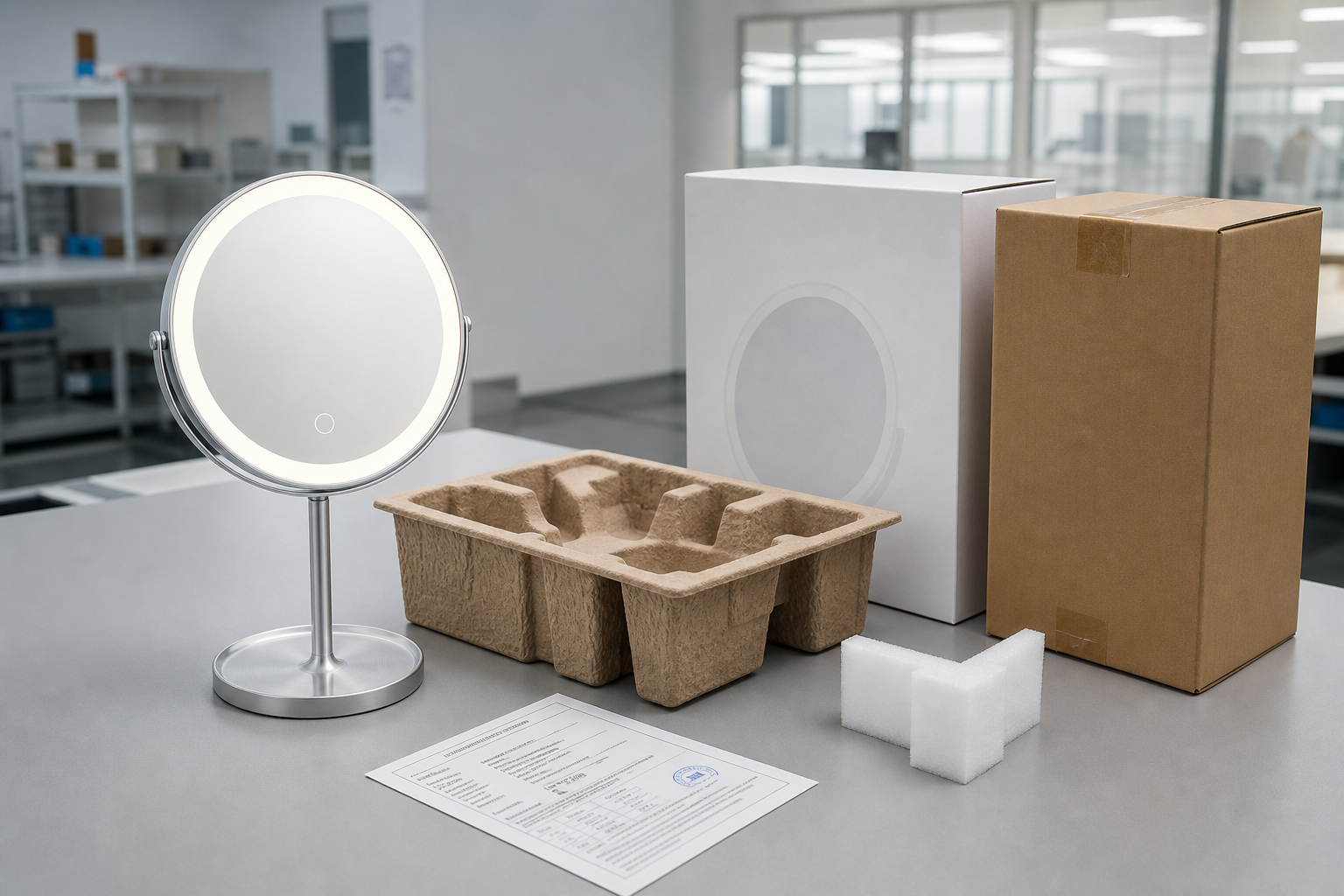
Most rechargeable LED tabletop makeup mirrors need three layers: an inner protective structure, a retail box, and a master carton. The exact material depends on price point, sales channel, sustainability target, and damage tolerance.
| Packaging layer | Main function | What buyers should confirm |
|---|---|---|
| Inner tray or insert | Holds mirror head, stand, charging cable, and accessories in fixed positions | Molded pulp, EPE, EVA, paper card, or mixed structure; no pressure on LED ring or hinge |
| Retail box | Supports shelf display, branding, barcode, and user instructions | Box thickness, surface finish, window or no window, print tolerance, opening direction |
| Master carton | Protects multiple retail boxes in export and parcel handling | Carton grade, quantity per carton, corner protection, compression strength, gross weight |
| Documentation pack | Reduces receiving, compliance, and after-sales confusion | Manual, charging instructions, warranty card, battery documents, carton marks |
Molded pulp is increasingly attractive for buyers who want a cleaner packaging story, but it must still hold the mirror tightly. EPE or EVA can absorb shock well, but some retailers prefer paper-based materials for sustainability positioning. Paper card inserts can work for lighter mirrors, but they are usually weaker for heavy rechargeable tabletop designs.
Amazon FBA vs Retail Shelf Packaging
Amazon and retail buyers should not approve the same package automatically. The channel changes the failure mode.
Amazon FBA and E-Commerce
For FBA and parcel delivery, the first priority is damage reduction after multiple handling points. Buyers should ask whether the product can ship in its own retail package, needs an additional corrugated mailer, or should be packed in a stronger single-unit carton. If the retail box is also the shipping box, its surface must resist scuffs, tape, pressure, and label placement.
E-commerce packaging should also reduce customer confusion. Charging cable placement, manual visibility, protective film instructions, and switch-locking during transit can all affect return rate. For rechargeable models, the battery state, charging port, cable type, and warning information should be consistent across the product, manual, and carton documentation.
Retail and Distributor Channels
Retail packaging must balance protection with shelf presentation. A box that hides the product completely may need stronger product photography and clearer feature icons. A window box can help sell the mirror visually, but it may reduce structural strength if the window is too large or poorly supported.
Distributors should also confirm how boxes stack in a warehouse and how easy it is to inspect mixed SKUs. Similar-looking makeup mirror boxes can create picking errors when magnification, color, light temperature, or plug type changes across SKUs.
Lithium Battery and Shipping Documentation
Rechargeable LED makeup mirrors usually contain lithium batteries, so buyers should treat battery paperwork as part of the packaging package. Before mass production, confirm the battery type, rated capacity, UN 38.3 test summary, MSDS or SDS, transport declaration needs, and any forwarder-specific document format.
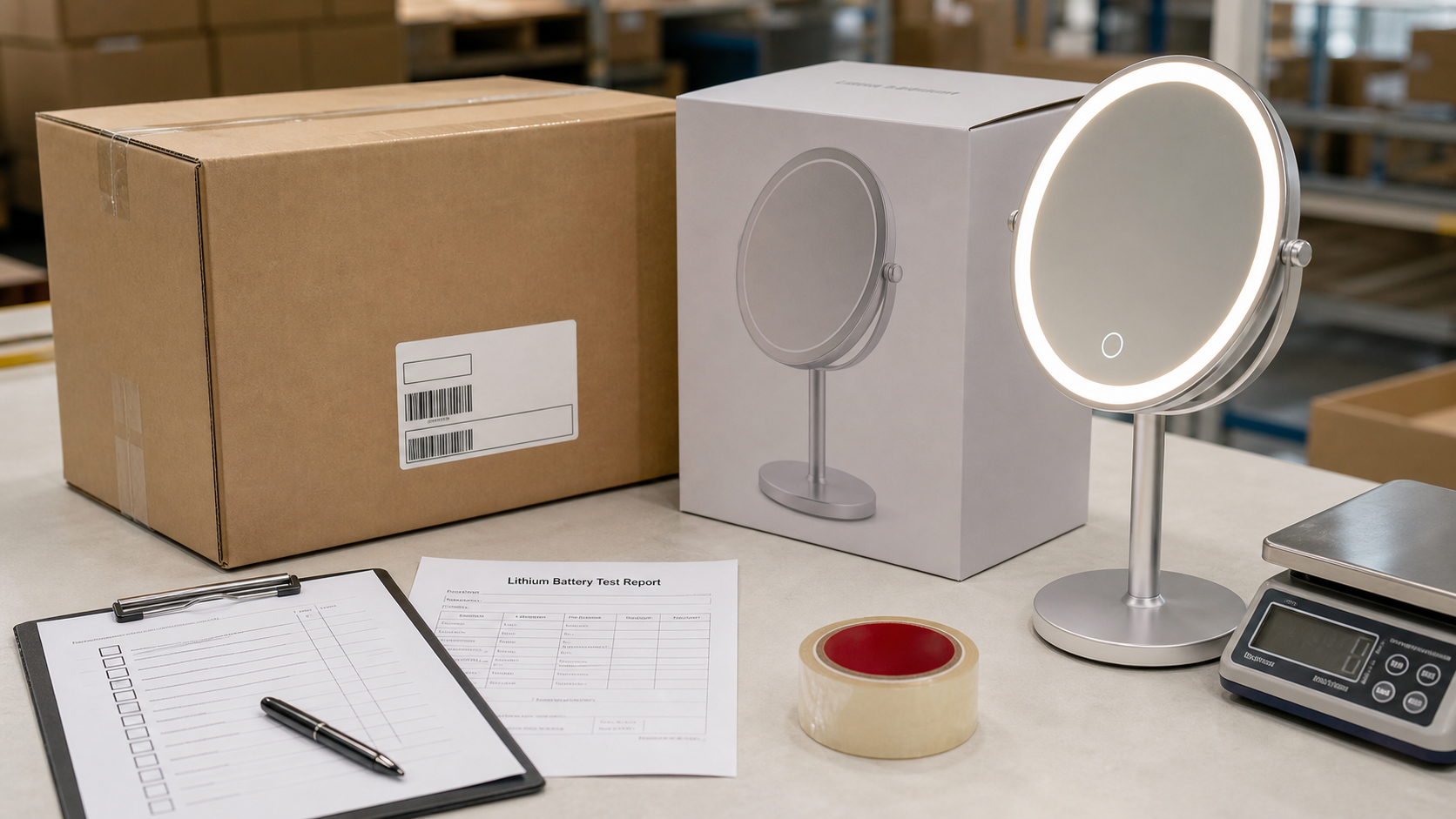
The supplier should also align the manual, rating label, retail box, and carton marks. Problems often happen when one file is updated but another file still shows an old battery capacity, old charging specification, or wrong model number.
Buyers shipping to the EU should also discuss packaging material declarations and recyclability expectations with their importer or compliance consultant. Packaging rules are becoming more detailed, and the supplier should be able to separate practical packaging choices from unsupported marketing claims such as “eco-friendly” without material evidence.
Drop-Test and Carton Approval Checklist
Do not approve packaging only from photos. A sample package should be tested with the real mirror, real accessories, real retail box, and intended master carton quantity.
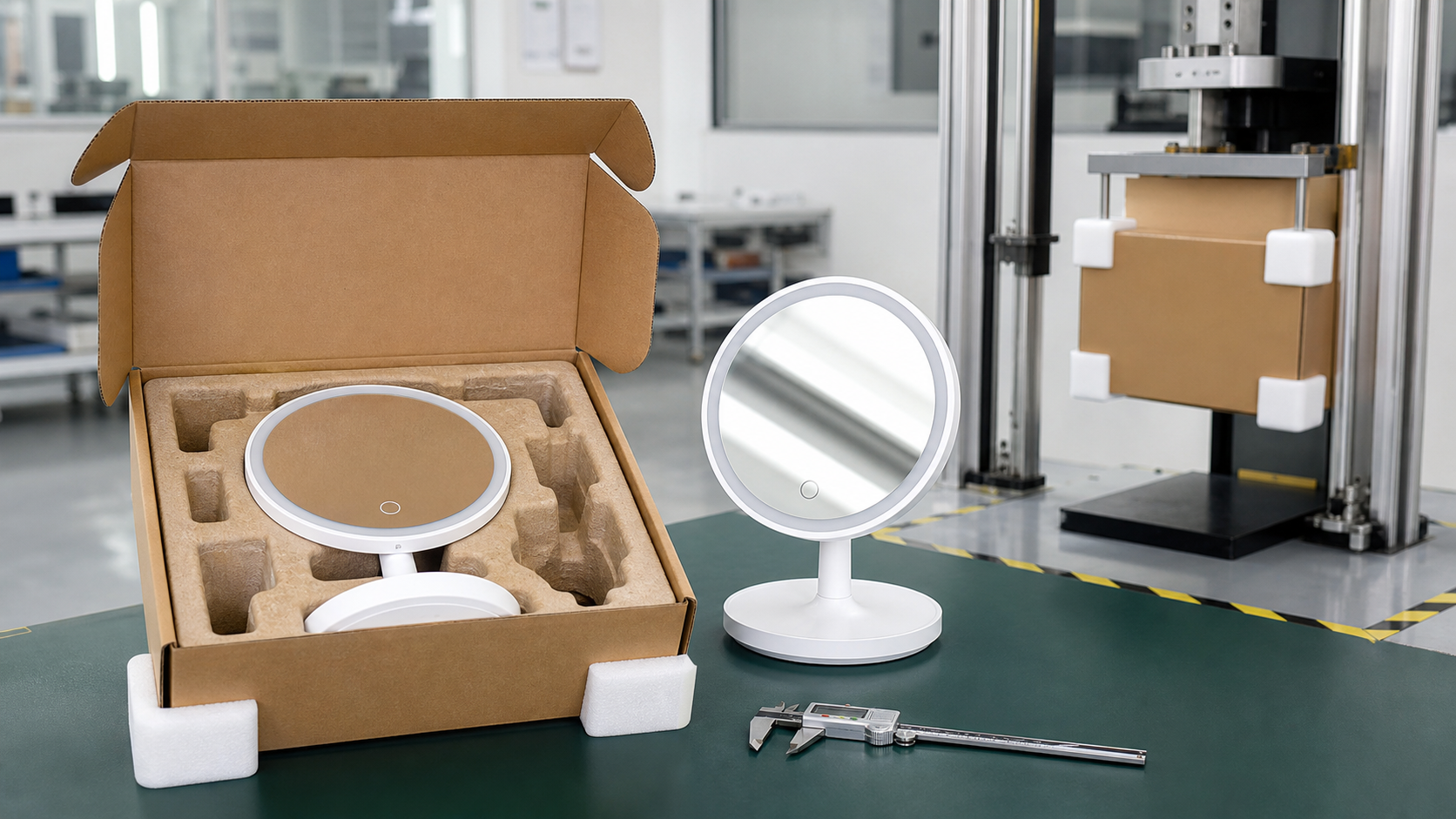
Before bulk order confirmation, ask the supplier to verify:
- Mirror head does not press directly against the retail box wall.
- LED ring, touch sensor, charging port, hinge, and stand are not under tray pressure.
- Cable and manual have fixed positions and cannot scratch the mirror surface.
- Retail box corners remain acceptable after drop and compression simulation.
- Master carton can protect the planned quantity without overweight handling risk.
- Barcode, model number, color, plug type, battery information, and carton marks match the PO.
- Inner tray material is stable enough for container temperature and humidity changes.
- Replacement parts and after-sales policy are clear if mirrors arrive damaged.
For high-value models, buyers can request pre-shipment carton photos, short drop-test videos, and random carton opening checks. These records are useful when a marketplace, retailer, or logistics provider investigates damage.
Common Mistakes That Increase Return Risk
The most common mistake is approving a premium-looking retail box while ignoring the inner tray. If the tray allows the mirror head to move, the LED ring or hinge can be damaged even when the outside box looks fine.
Another mistake is using one packaging structure for several mirror sizes. A 6-inch rechargeable mirror, 8-inch mirror, and double-sided magnifying model may need different tray depth, cable position, and stand protection.
Buyers also overlook carton weight. A carton that is too heavy is more likely to be dropped, pushed, or mishandled during warehouse movement. For e-commerce sellers, a slightly smaller quantity per master carton may reduce damage and speed inbound checking.
The final mistake is late artwork approval. Private-label packaging should be confirmed before mass production tooling or carton ordering. Changing the barcode, warning copy, color box size, or print finish late can delay shipment more than buyers expect.
RFQ-Ready Packaging Questions
When requesting a quote for rechargeable LED makeup mirrors, include these packaging details:
- Target channel: Amazon FBA, DTC parcel, retail shelf, distributor warehouse, or mixed channel.
- Mirror size, weight, stand type, magnification, charging cable, and accessory list.
- Preferred inner protection: molded pulp, paper card, EPE, EVA, or supplier recommendation.
- Retail box style: color box, kraft box, window box, sleeve, or gift box.
- Required labels: barcode, SKU, country of origin, battery information, warning text, and carton marks.
- Sustainability target: paper-based packaging, reduced plastic, recyclable materials, or retailer-specific rules.
- Test requirement: drop test, carton compression, vibration, or pre-shipment random opening check.
- Expected order quantity, sample approval timing, and replacement policy for transit damage.
Mingda Mirror can prepare packaging samples for rechargeable LED makeup mirrors based on the buyer’s sales channel, branding plan, and logistics route. For mixed retail and e-commerce programs, it is often better to approve two packaging routes than force one package to serve every channel poorly.
Bottom-Line Recommendation
For rechargeable LED makeup mirror orders, approve packaging as early as the mirror sample itself. The best sourcing result usually comes from a complete packaging brief: product size, channel, battery documentation, tray material, retail presentation, carton strength, labeling, and test standard. If the product will be sold through Amazon or parcel delivery, prioritize drop resistance and document consistency before decorative packaging upgrades.
FAQ
What is the best inner tray for rechargeable LED makeup mirrors?
There is no single best tray for every order. Molded pulp is useful for buyers who want paper-based packaging, while EPE or EVA may provide stronger cushioning for heavier mirrors. The tray should be tested with the real mirror, cable, stand, and carton.
Should Amazon sellers use retail boxes or shipping cartons?
Amazon sellers should decide based on the mirror’s weight, retail box strength, and damage history. Some products can use stronger retail packaging, while fragile or premium models may need a protective outer mailer or single-unit carton.
What battery documents should buyers request?
For rechargeable makeup mirrors, buyers should normally request battery specification, UN 38.3 test summary, MSDS or SDS, and any forwarder-required transport documents. The final requirement depends on route, battery type, and local importer responsibility.
Can private-label packaging be customized at low MOQ?
Low-MOQ customization may be possible with sticker labels, sleeves, simple color boxes, or shared structural packaging. Full custom box size, molded tray tooling, and premium print finishes usually need higher order quantities.
How can buyers reduce mirror breakage before shipment?
Approve a real packaging sample, run drop and compression checks, confirm carton weight, review pre-shipment photos, and ask the supplier to open random cartons during final inspection.
Work With Mingda Mirror
If you are planning a rechargeable LED makeup mirror program for Amazon, retail, wholesale, or private-label distribution, Mingda Mirror can help review product specifications, packaging structure, battery documentation, and sample approval steps before bulk production. Explore our makeup mirror product options, learn more about OEM/ODM customization, review our quality control process, or contact Mingda Mirror with your target channel, mirror size, packaging preference, and expected order quantity.
Social Media Content Ideas
LinkedIn angle: explain why rechargeable makeup mirror packaging should be approved as a protection system, not only as a branding asset.
Facebook angle: show buyers how packaging choices affect mirror returns, reviews, and shelf presentation.
Instagram visual angle: use the molded tray and complete LED mirror image to highlight sample approval before bulk production.
Short CTA: Read the full packaging checklist and send Mingda Mirror your channel requirements for an RFQ-ready recommendation.