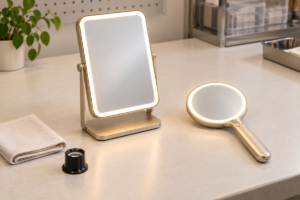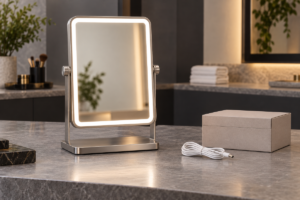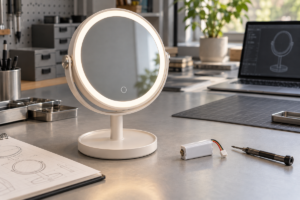

Rechargeable and plug-in LED makeup mirrors serve different channels. Rechargeable models are convenient for travel, compact beauty, and gift programs, while plug-in mirrors usually fit vanity, salon, hotel, and fixed-use scenarios better.
The better choice depends on where the mirror will be used, how bright the lighting must be, whether battery maintenance is acceptable, and how the buyer plans to handle warranty or return risk.
Direct Answer: Which Power Type Is Better?
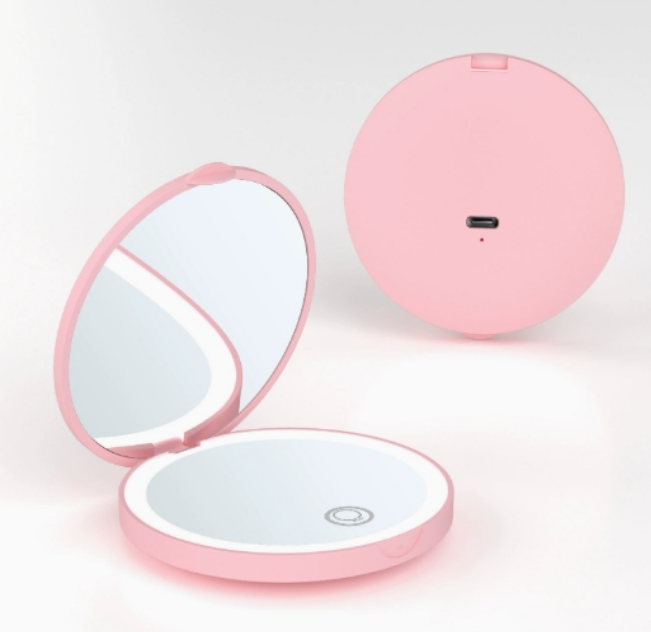
Rechargeable makeup mirrors are usually better for beauty brands, Amazon sellers, and retail programs that need portable use, cleaner merchandising, and stronger perceived value in a compact size. Plug-in makeup mirrors are usually better for tabletop vanity products that need steadier high brightness, larger mirror surfaces, or longer daily operating time without battery-management concerns.
In short, buyers should choose rechargeable when convenience and mobility help the product sell. Buyers should choose plug-in when lighting performance and fixed-location use matter more than portability.
Buyer Scenario: Where Each Mirror Type Fits Best
| Buyer scenario | Better option | Why it fits | Main sourcing watchpoint |
|---|---|---|---|
| Beauty brand launch | Rechargeable | Supports premium positioning, modern user story, and gift-ready presentation | Battery quality and charging stability |
| Amazon or e-commerce seller | Rechargeable | Portable value is easy to market and aligns with current shopper expectations | Parcel-drop protection and battery complaint risk |
| Retail chain countertop assortment | Rechargeable or plug-in | Depends on shelf space, price ladder, and whether the mirror is portable or fixed-use | Too many overlapping SKUs |
| Vanity or dressing-table program | Plug-in | Better for larger lighting output and longer use at a fixed location | Cable placement and carton size |
| Gift-with-purchase or travel line | Rechargeable | Compact structure is easier to position as portable beauty convenience | Cost control at low MOQ |
This decision framework should sit inside the broader makeup mirror sourcing guide for beauty brands and retailers. Power source is only one specification, but it often drives the retail story, accessory pack, test requirements, and packaging structure.
Why Rechargeable Mirrors Usually Win in Portable and Beauty-Brand Channels
Rechargeable makeup mirrors are easier to position as a higher-value item because the consumer does not need to replace dry batteries and does not have to stay near a wall socket during normal use. For compact mirrors, foldable travel mirrors, and many tabletop LED models, USB charging supports a more current product story and usually makes the packaging message simpler.
For private-label buyers, rechargeable products also create more room for design differentiation. The buyer can combine lighting mode, charging cable presentation, logo finish, and gift-box structure into one premium-looking offer. That is useful for beauty brands that want the mirror to feel like part of the cosmetics or skincare experience rather than a low-cost accessory.
Buyers who are still comparing entry-level battery formats can also review rechargeable vs. battery-powered makeup mirrors. That comparison is different from the rechargeable vs. plug-in decision because dry-battery models usually compete in lower-cost portable programs, while plug-in models compete more often in vanity and brighter-lighting categories.
When Plug-In Makeup Mirrors Are the Better Commercial Choice
Plug-in makeup mirrors make more sense when the buyer wants larger size, stronger brightness, or a fixed-use product that will stay on a dressing table, salon station, or retail display. In those cases, the plug-in structure removes battery-runtime concerns and can support more consistent lighting output over longer sessions.
That is why plug-in is often the safer choice for Hollywood-style vanity mirrors and larger tabletop formats. If the mirror is expected to feel substantial, stay in one place, and deliver brighter lighting for repeated use, plug-in can reduce power-related complaints and support a more stable performance story.
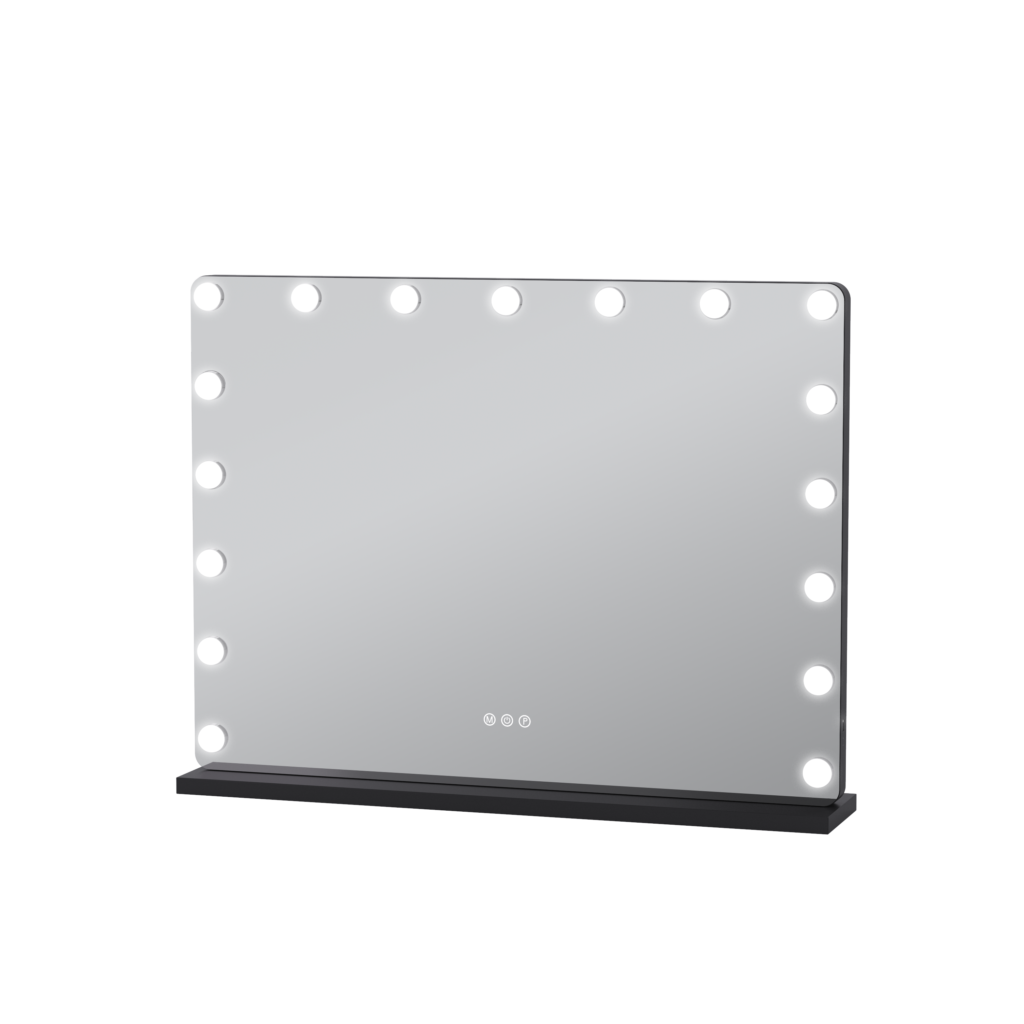
Buyers considering this format can review Mingda’s existing Hollywood vanity mirror buying guide alongside the broader Makeup Mirrors category to decide whether the product should sit in portable beauty, vanity-table, or premium gift channels.
Cost, Packaging, and Return-Risk Tradeoffs
Rechargeable does not always mean cheaper. The battery cell, charging board, cable, and related testing can raise unit cost and increase the attention buyers must give to transport labeling and charging reliability. But the product can still deliver stronger perceived value if portability matters to the end user.
Plug-in mirrors may avoid battery-component risk, but they can create other commercial pressures: larger cartons, more visible cable-management issues, and less relevance for consumers who want flexible use away from a fixed vanity. If the buyer chooses plug-in for a channel that really wants portability, the mirror can look old-fashioned even if the lighting is technically strong.
For sourcing managers, the real question is not which option is objectively better. It is which option creates fewer returns in the intended channel. Rechargeable products tend to fail when charging is unreliable, runtime is unclear, or packaging does not protect the mirror well in parcel delivery. Plug-in products tend to fail when cord length, brightness expectation, or countertop footprint do not match the buyer’s retail promise.
Technical Checks Buyers Should Confirm Before Sampling
- For rechargeable mirrors, confirm battery type, charging port, runtime expectation, charging time, and overcharge protection.
- For plug-in mirrors, confirm adapter spec, cord length, plug-market compatibility, and whether brightness stays stable during long use.
- Check whether the sample uses final lighting components, not temporary ones.
- Confirm touch control response, dimming logic, and color-temperature switching if included.
- Review packaging protection based on parcel delivery or retail shelf movement.
- Ask whether logo, color, and accessory changes affect MOQ or lead time.
Common Procurement Mistakes
The first mistake is choosing rechargeable only because the market sees it as more modern, without checking whether the target buyer actually needs portability. The second mistake is choosing plug-in only because it appears simpler, without considering whether the mirror will be sold into e-commerce, gift, or travel-driven channels where cords reduce appeal.
The third mistake is approving a sample based on appearance only. Buyers should confirm whether the sample reflects final battery quality, final adapter setup, final light diffusion, and final packaging protection. If those points are not locked early, the approved sample does not protect the bulk order.
Pre-RFQ Checklist for Sourcing Teams
- Define the sales channel and user scenario first.
- Choose portable, tabletop, or vanity placement before choosing the power type.
- Set the target price band and expected perceived-value story.
- Specify brightness level, color-temperature options, and control method.
- Confirm whether the product needs travel-friendly packaging or fixed-location presentation.
- Ask for MOQ, sample lead time, repeat-order lead time, and QC checkpoints.
- Prepare logo, instruction-manual, barcode, and carton-mark requirements before quotation.
Bottom Line
Rechargeable makeup mirrors are usually the best fit for portable, beauty-brand, gift, and e-commerce programs. Plug-in makeup mirrors are usually the best fit for larger vanity mirrors, stronger-lighting formats, and fixed-location use. The right choice comes from channel logic, not preference. Buyers who define use scenario, power expectations, and packaging route before RFQ will usually get a cleaner quotation and a lower return risk.
FAQ
Are rechargeable makeup mirrors better for Amazon sellers?
Usually yes, because portability and USB charging are easy to communicate in listings, but the packaging must still protect the mirror well and the charging function must be stable.
When should a buyer choose a plug-in makeup mirror?
Choose plug-in when the mirror is designed for fixed tabletop or vanity use, needs stronger lighting, or will be used for longer sessions without battery-runtime concerns.
Do rechargeable mirrors increase sourcing risk?
They can if the buyer does not check battery quality, runtime clarity, charging reliability, and transport packaging. The risk is manageable when those details are part of the sample and QC plan.
Are plug-in mirrors always lower cost?
Not always. They may avoid battery-related components, but larger structures, more powerful lighting, and bigger cartons can offset that advantage.
What should buyers send before requesting a quote?
Send the target channel, quantity range, preferred mirror format, power preference, brightness requirement, packaging route, branding needs, and destination market details.
How Mingda Mirror Can Support the Decision
Buyers comparing private-label directions can review Brand & Private Label Solution, Product Design Support, and Retail Chain & Supermarket Solution before sample development. Those pages help clarify whether the program needs a portable beauty item, a retailer-friendly shelf product, or a more developed OEM/ODM mirror range.
CTA
If you are deciding between rechargeable and plug-in makeup mirrors for a beauty brand, retail chain, or e-commerce program, contact Mingda Mirror with your target channel, price band, and preferred mirror format to prepare a cleaner quotation and sample plan.