
An LED makeup mirror after-sales agreement should identify the approved model and revision, define how defects are diagnosed, and state whether the remedy is a replacement unit, an approved spare part, a credit, or another negotiated solution. Agree who pays for freight, how quickly claims are assessed, and how long compatible parts will be available before approving a bulk order. A low unit price is not a complete landed cost if your team cannot resolve a failed switch or missing cable.
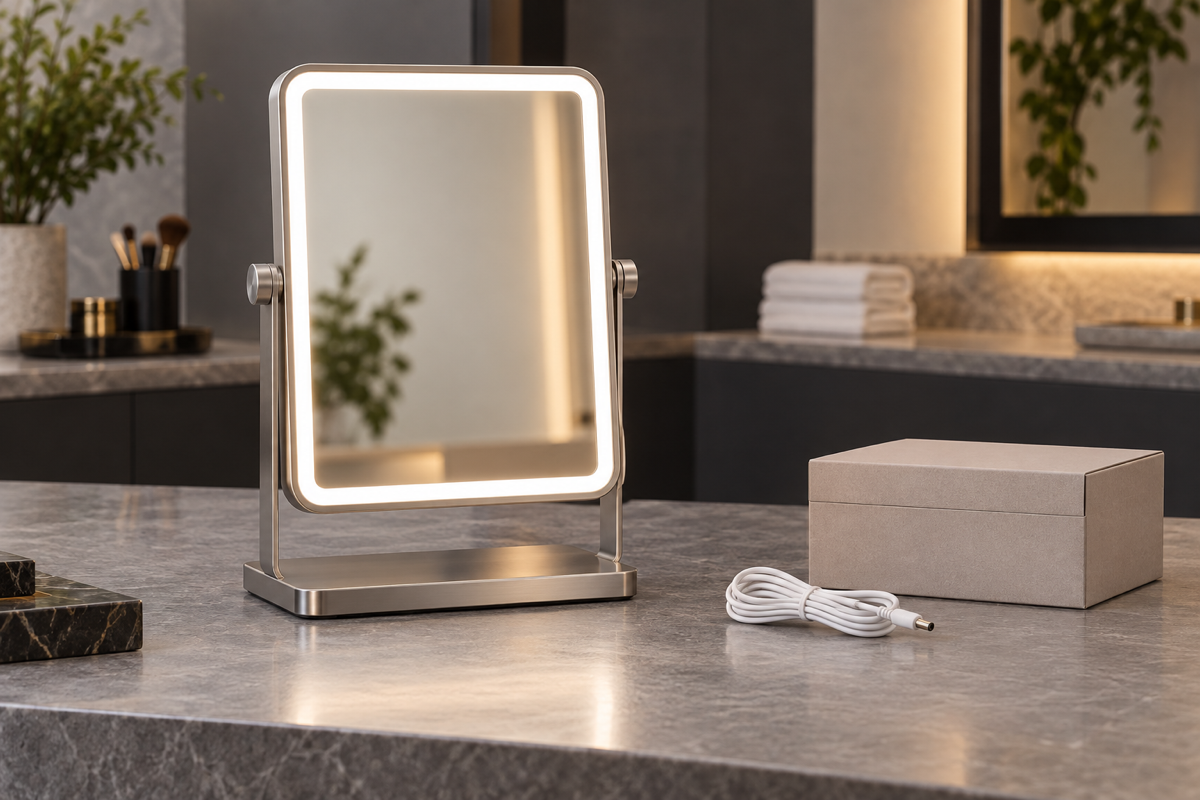
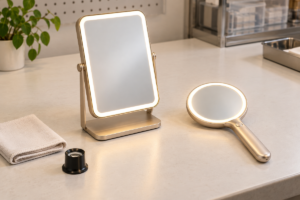
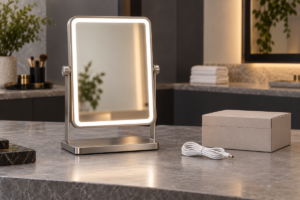
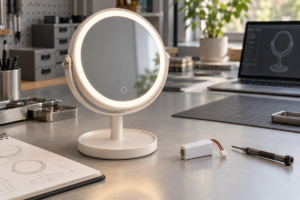
*Images in this guide are conceptual illustrations, not representations of a particular Mingda model or service commitment.*
Start with the failure and the safest remedy
For a private-label brand, an early service decision affects the listing, customer support script, spare inventory and reverse logistics. For a distributor, the priority may be a practical claim and credit process. A hotel buyer may need compatible units available through a phased installation. Ask the supplier to identify which faults are field-serviceable for the exact model; never assume a consumer can safely open a powered or rechargeable mirror.
| Buyer situation | Potential remedy to discuss | Approval point before ordering |
|---|---|---|
| Missing or damaged detachable cable | Send an approved replacement cable | Connector, electrical rating, length, finish and packaging match the approved SKU |
| Faulty sealed light or touch control | Replace complete unit or use supplier-authorized repair | Diagnostic steps, electrical safety, return route and authorization |
| Cosmetic damage in transit | Replace, credit or claim with carrier as agreed | Photos of product and outer carton, evidence deadline, allocation of freight risk |
| Repeated fault across a batch | Contain stock and agree investigation | Lot traceability, affected quantity, samples, response time and corrective action |
These are negotiation options, not a promise that every component is replaceable. Safety-critical parts, batteries and internal electrical assemblies may require qualified personnel and market-specific procedures. Suspected overheating, swelling, smoke or other hazardous failure should be isolated and escalated under the buyer’s safety process; do not ask a customer to disassemble it.
Build a model-specific spare-parts schedule
Ask for a schedule against the approved sample and bill of materials: model number, revision, color, market version, component description and part number. A cable that looks similar may have a different connector, electrical rating or length. A replacement unit may also differ in color temperature, finish or branding. Require written approval before substitution and a clear method to identify affected lots when a component changes.
Specify initial spare quantities based on forecast sales, lead time and realistic failure data rather than copying a universal percentage. For example, a pilot order of 1,000 units with an assumed 1% cable claim rate implies 10 cables before a safety buffer; that is a planning illustration, not a predicted defect rate. Recalculate after actual returns, and agree the minimum replenishment quantity, unit price, lead time and last-order notice. Confirm whether spare parts ship with the original order or separately, and who holds them.

Define a claim workflow both teams can actually use
1. Capture evidence without slowing the customer
Request order reference, model and revision, lot or date code, delivery date, fault description and clear photos or a short video when appropriate. Record whether the issue appeared on arrival or after use. Agree which evidence is essential, who reviews it and when the response clock starts. Do not require customers to expose internal electronics to prove a fault.
2. Agree responsibility and turnaround
Write down the acknowledgement and decision targets, the contact and escalation path, and whether an authorization is required before disposal or return. Specify product cost, replacement freight, duties, local handling and the treatment of confirmed manufacturing defects, transit damage, misuse and unresolved causes. Targets and compensation must be negotiated for the model and market; neither follows automatically from a sample quotation.
3. Close the loop on repeated faults
Track claims by SKU, lot, reason and units sold or shipped. A rising rate deserves containment and a root-cause review, not just more replacement units. Agree when the supplier will provide an investigation, corrective action, implementation date and verification evidence. Keep a retained approved sample and link any change to the next production run.
Compare replacement units with spare parts
Replacement units are often simpler for sealed, low-cost or electrically complex mirrors: fewer compatibility decisions and less customer repair risk, but higher shipping and inventory costs. Approved detachable accessories can reduce waste and freight when the failure is straightforward, but the buyer must control part identity and stock. Supplier-authorized repair can make sense for some higher-value products where trained technicians, safe instructions and local service capacity exist. Choose per fault and market, not one blanket remedy for every claim.
RFQ checklist for brand and retail buyers
- Identify destination markets, sales channels, annual forecast, launch date and the exact model, finish, power configuration and packaging.
- Request the available serviceable parts list, revision mapping, photographs and approved substitutions; distinguish user-replaceable accessories from technician-only parts.
- Ask for a written warranty proposal, exclusions, claim evidence, response targets, remedy options and escalation contact.
- Request separate prices and lead times for spare parts and replacement units, including minimum quantities, stock location, freight and replenishment terms.
- Agree lot identification, change notification, retention samples and corrective-action process for recurring defects.
- Confirm local consumer rights, product safety, battery transport and disposal obligations with qualified advisers; supplier terms cannot be assumed to replace applicable law.
Review the pre-production sample approval checklist and charging QC guide alongside the service schedule. If battery access matters, read the battery replacement guide. Browse Mingda mirror products to identify the intended format before requesting model-specific terms.
Frequently asked questions
Should we request free spare parts with every order?
Ask for both included and separately priced options. Compare total cost, forecast claims, shelf life, storage and replenishment lead time. An included quantity is useful only if the parts match the approved revision and are appropriate for the agreed repair process.
Can a customer replace an LED module or rechargeable battery?
Only if the specific product design, instructions and applicable requirements support that action. Confirm the permitted repairer and evidence with the supplier; do not infer serviceability from a generic product photograph.
How long should the supplier support spare parts?
Set a negotiated period based on sales duration, consumer obligations, expected product life and the buyer’s inventory plan. Request advance notice of discontinuation and a last-order option; verify local requirements separately.
What should a first claim include?
Start with the SKU and revision, lot code, order reference, date, fault description and safe external evidence. The agreed workflow should say what happens next, including who authorizes return, replacement or credit.
Bottom line
Approve an after-sales schedule at the same time as the product sample: specify the remedy by failure type, match parts to the exact revision, and assign response, freight and replenishment responsibilities. This makes the cheapest quote easier to compare with the cost of supporting real customers.
Planning a private-label or distribution order? Contact Mingda Mirror with your market, target model, forecast quantity, launch date and expected service approach. Ask the team to confirm the available options and written terms for your specific project.