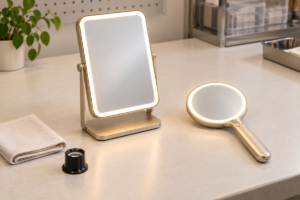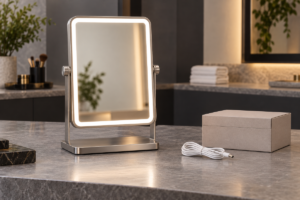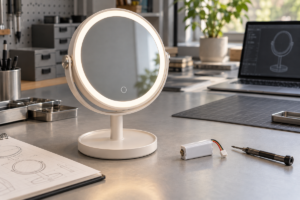

Right-size packaging for rechargeable LED makeup mirrors means designing the retail box, inner tray, accessories layout, and shipping carton around both product protection and parcel cost. For e-commerce buyers, the goal is not simply a smaller box. The package must protect the LED ring, mirror glass, hinge, base, charging cable, and gift-box appearance while avoiding unnecessary dimensional weight. A good packaging specification confirms product fit, drop resistance, carton dimensions, labeling space, and sample approval before mass production.
Why Packaging Size Has Become a Buying Decision
Rechargeable LED makeup mirrors are fragile, electronic, and visually judged at unboxing. A buyer may approve the mirror design, lighting, magnification, and finish, but still lose margin if the carton is oversized, the retail box corners collapse, or the inner tray allows the mirror to move during parcel delivery.
For Amazon sellers, DTC beauty brands, retail chains with online fulfillment, and distributors shipping mixed cartons, packaging now affects three commercial outcomes: freight cost, damage rate, and customer review quality. A package that is too small can create breakage. A package that is too large can increase dimensional weight and storage cost. A package that looks cheap can reduce perceived value even if the mirror itself is acceptable.
That is why packaging should be discussed at the RFQ stage, not after the golden sample is approved. Buyers should ask the supplier to quote the mirror together with its retail box, inner protection, outer carton, carton dimensions, gross weight, packing quantity, and drop-test expectation.
Right-Size Packaging Decision Matrix
Use this table when comparing packaging options for rechargeable LED tabletop mirrors, travel LED makeup mirrors, and compact lighted mirror lines.
| Packaging decision | Lower-cost option | Higher-protection option | Best-fit buyer scenario |
|---|---|---|---|
| Inner tray material | PET tray or simple paperboard support | Molded pulp, EPE foam, or hybrid support | Use stronger support for e-commerce, gift, rechargeable, and heavier mirror designs |
| Retail box size | Tight box with minimal empty space | Slightly larger box with protected pressure points | Avoid tight packaging when the LED ring, hinge, or mirror surface may take pressure |
| Accessory placement | Cable and manual placed loosely | Cable pocket, sleeve, or separate cavity | Important for mirrors with glossy housing or exposed mirror glass |
| Master carton plan | More units per carton | Fewer units with better partitioning | Use conservative packing for first orders, new designs, and parcel-heavy channels |
| Branding finish | Basic printed box | Premium box with protective structure | Valuable for beauty brands, gift sets, retail shelves, and influencer unboxing |
The strongest packaging is not always the best business choice. The right package is the one that meets the buyer’s channel risk without adding avoidable volume, material cost, or handling complexity.
Start With Product Geometry, Not a Standard Box
Many packaging problems begin when a supplier tries to fit a mirror into an existing standard box. Rechargeable LED makeup mirrors have pressure-sensitive parts: LED rings, touch buttons, USB-C ports, folding hinges, swivel joints, stands, batteries, and mirror glass. If the tray only protects the round mirror face but leaves the hinge or base under pressure, the product may pass visual inspection and still fail in transit.
For tabletop mirrors, confirm the total height, base diameter, mirror-head thickness, cable position, and hinge angle inside the tray. For travel mirrors, confirm whether the mirror ships folded, half-open, or separated from accessories. For double-sided magnifying mirrors, check whether the magnifying side needs extra film or sleeve protection.
The packaging sample should be reviewed with a complete production-intent mirror, not an empty shell or a similar older model. A small change in base thickness, charging port location, or hinge shape can change the tray requirement and carton size.
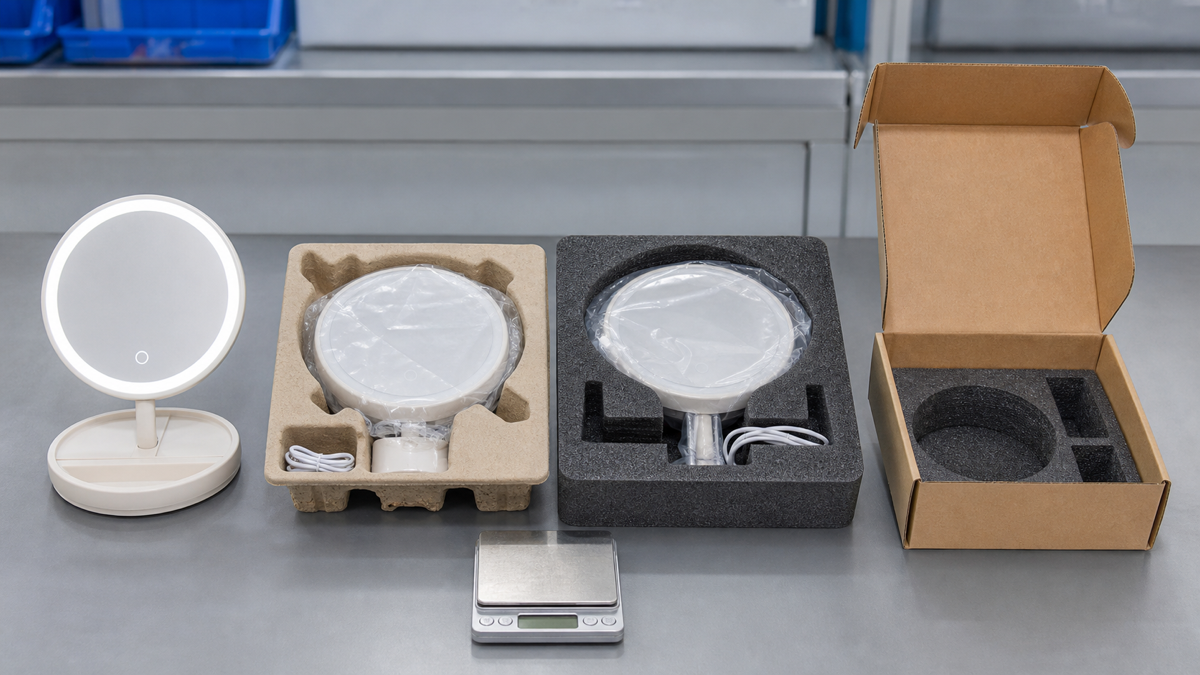
Molded Pulp, EPE Foam, or Paperboard: How Buyers Should Choose
Molded pulp is useful when buyers want a cleaner sustainability story, stable positioning, and a more premium unboxing feel than loose cushioning. It works well for many LED tabletop makeup mirrors if the tray is shaped around the base, mirror head, and accessories.
EPE foam can provide strong shock absorption and precise cavity support, especially for heavier mirrors or first shipments where breakage risk is not yet proven. However, some buyers prefer to reduce foam for brand or retailer requirements. If foam is used, buyers should confirm density, thickness, pressure points, and whether the material may leave marks on glossy surfaces.
Paperboard structures can be efficient for lighter compact mirrors, but they require careful fold strength and locking design. A paperboard insert that looks neat in a sample room may collapse when cartons are stacked or shipped through parcel networks.
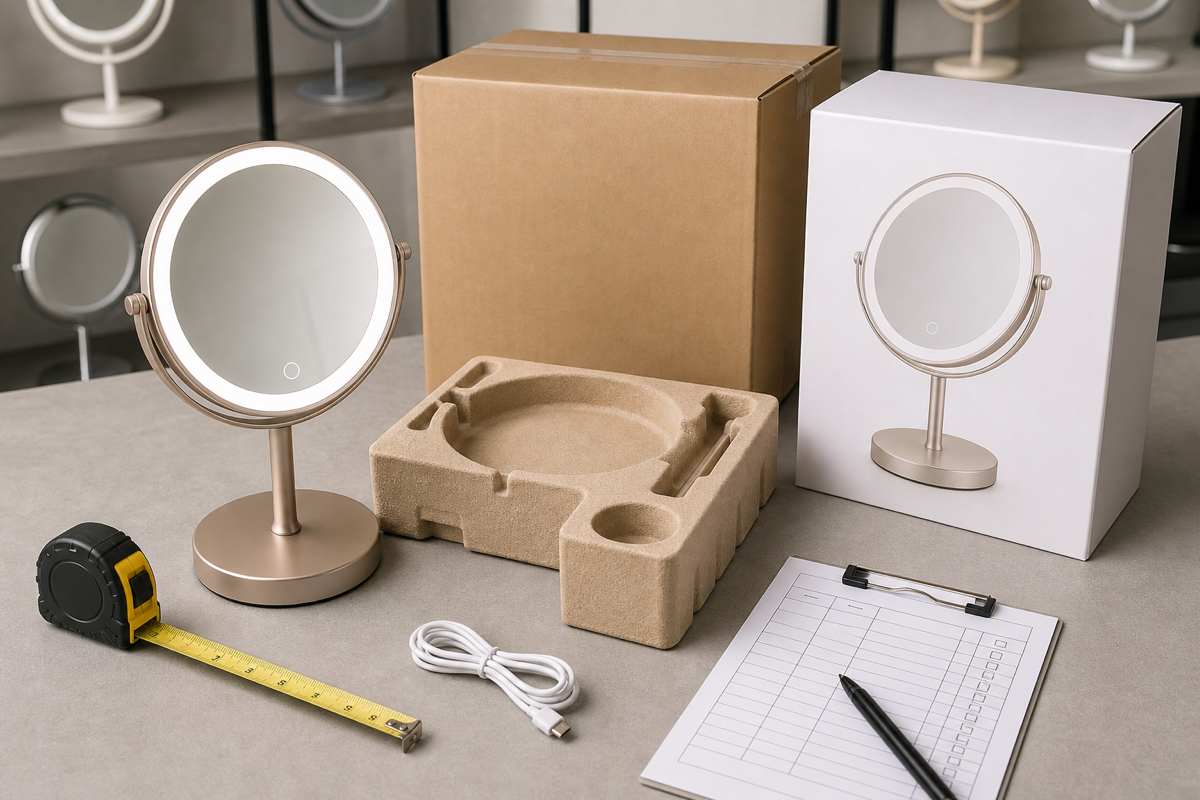
For private-label buyers using Mingda’s OEM/ODM customization services, the best approach is often hybrid: a clean retail box, a product-shaped molded tray or foam support, a separate cable/manual cavity, and an export carton sized for the actual fulfillment route.
Dimensional Weight: The Hidden Packaging Cost
Dimensional weight matters because parcel carriers often charge based on package volume when the box is large relative to its actual weight. For rechargeable LED makeup mirrors, this can happen when a supplier uses oversized retail boxes, deep empty spaces around the mirror head, or master cartons with poor unit layout.
Before approving packaging, ask for these numbers:
- Retail box length, width, height, and unit gross weight.
- Master carton length, width, height, gross weight, and units per carton.
- Estimated packing quantity per pallet or container.
- Whether the package is intended for direct parcel shipping, FBA inbound, retail distribution, or wholesale carton shipment.
- Photos showing the product, accessories, tray, retail box, and master carton together.
Do not compare unit price without comparing carton data. A mirror that is USD 0.20 cheaper at the product level may become more expensive after storage, parcel shipping, replacement shipments, and damaged gift boxes are included.
Packaging Tests Buyers Should Request Before Bulk Production
Packaging tests should match the sales channel. A retail shelf order and an Amazon parcel order should not use the same risk standard.
For e-commerce and marketplace orders, buyers should request a practical approval sequence:
- Fit test: shake the packed retail box lightly and confirm the mirror does not move freely.
- Surface protection check: open the box after vibration handling and inspect for scratches, cable marks, and mirror film movement.
- Corner pressure check: confirm the retail box and master carton corners do not collapse under normal stacking.
- Drop simulation: test the packed product from several orientations according to the buyer’s channel risk.
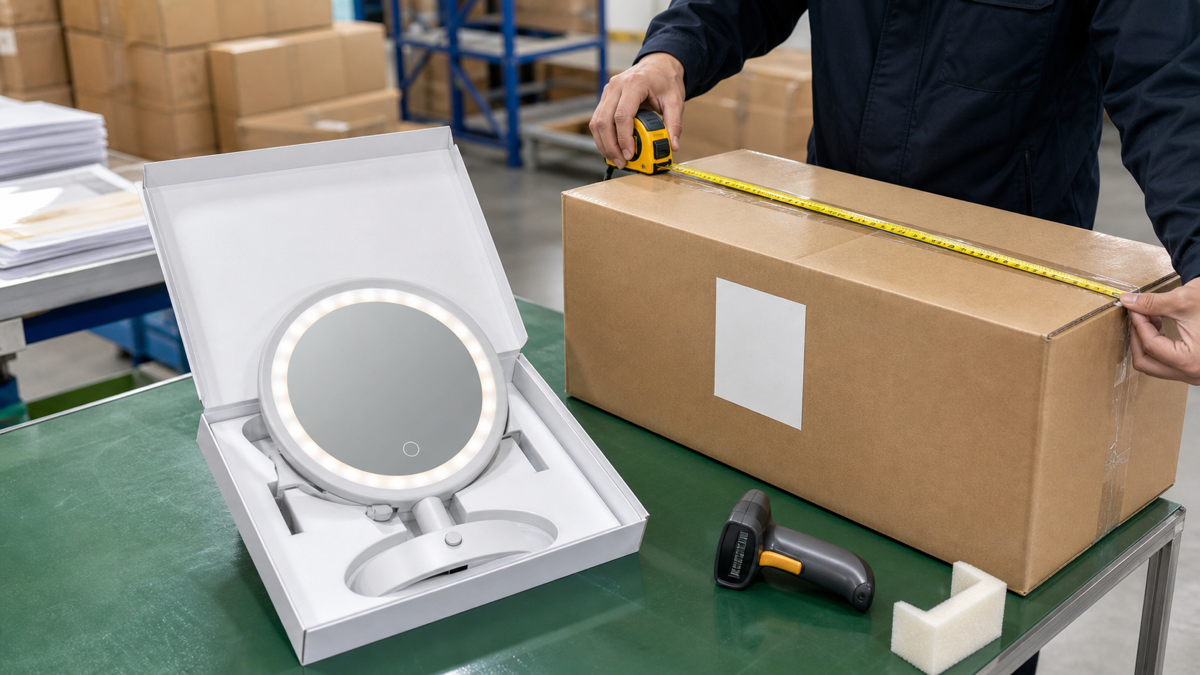
- Carton dimension check: measure the carton after sealing, not only before packing.
- Label space check: confirm shipping labels, barcodes, battery marks if needed, and carton marks do not cover important branding or handling information.
For rechargeable products, the packaging review should also include cable placement and battery-related documentation. The cable should not press against the mirror surface, and any required battery labels or documents should be handled before shipment, not at the warehouse.
RFQ Information That Helps a Supplier Quote Packaging Correctly
A supplier can only quote right-size packaging when the buyer gives clear commercial context. When sending an RFQ for a rechargeable LED makeup mirror, include:
- Target sales channel: Amazon, DTC, retail shelf, wholesale, distributor, gift set, or mixed channel.
- Mirror type: tabletop, foldable travel, wall-mounted, compact, single-sided, or double-sided.
- Mirror size, base size, hinge structure, magnification, lighting modes, and battery target.
- Branding requirement: logo method, retail box finish, user manual, barcode, and color-box style.
- Packaging priority: lowest volume, premium unboxing, stronger drop protection, lower plastic content, or retail shelf display.
- Required carton data: retail box size, master carton size, units per carton, gross weight, and pallet/container plan.
- Target market and compliance notes, especially if rechargeable battery documentation or labeling is required.
This information helps the supplier avoid quoting a generic box. It also makes price comparison fairer because every supplier is quoting the same protection level and packing method.
Common Mistakes That Increase Returns or Freight Cost
The most common mistake is approving a beautiful retail box without testing the packed mirror. The second is choosing the smallest box before confirming pressure points. The third is treating packaging as a graphic design task instead of a structural protection task.
Buyers should also avoid changing the mirror structure after packaging approval without rechecking the tray. A new hinge, thicker base, different cable, or updated charging port can create pressure or movement inside the same box.
For Amazon and DTC buyers, another risk is failing to test the package as the customer receives it. A mirror may survive export carton shipment but fail when one unit is shipped alone through a parcel network. If single-unit parcel shipping is part of the business model, test single-unit packaging separately.
Pre-Order Packaging Checklist
Before confirming a rechargeable LED makeup mirror order, review this checklist with the supplier:
- Is the complete mirror fully supported in the tray without pressure on the LED ring, hinge, or mirror glass?
- Are the cable, manual, cleaning cloth, adapter if any, and accessory bags separated from the mirror surface?
- Does the retail box protect both product function and unboxing appearance?
- Are retail box and master carton dimensions measured and recorded after final packing?
- Is the packaging suitable for the actual sales channel, not only export shipping?
- Has the supplier confirmed carton strength, sealing method, label area, and carton marks?
- Are battery-related labels or documents prepared when required by the target market?
- Are replacement parts, spare retail boxes, or after-sales policy clarified for launch orders?
This checklist should be attached to the purchase order or sample approval record. It gives the buyer, factory, packaging supplier, and inspection team the same reference standard.
Bottom-Line Recommendation
For rechargeable LED makeup mirror buyers, the best packaging strategy is to approve product design and packaging structure together. Start with the mirror geometry, confirm the sales channel, compare inner support options, measure retail and master carton dimensions, and test the package before bulk production.
The lowest packaging cost is not always the lowest landed cost. A right-size package can protect the mirror, improve unboxing, reduce replacement shipments, and keep dimensional weight under control. That is the packaging standard buyers should request before committing to a private-label or e-commerce launch.
FAQ
What is right-size packaging for LED makeup mirrors?
Right-size packaging uses the smallest practical box and carton that can still protect the LED ring, mirror glass, hinge, base, accessories, and retail appearance through the intended sales channel.
Should Amazon sellers use stronger packaging than retail buyers?
Usually yes. Amazon and DTC orders often face single-unit parcel handling, so buyers should confirm inner tray fit, carton strength, label space, and drop resistance more carefully than for store-only shelf shipments.
Is molded pulp better than foam for rechargeable makeup mirror packaging?
Neither is automatically better. Molded pulp can support sustainability and premium unboxing goals, while EPE foam can provide strong shock absorption. The right choice depends on mirror weight, structure, channel, and buyer requirements.
When should packaging be approved in the sourcing process?
Packaging should be reviewed during sample approval and confirmed before mass production. Waiting until production is finished can create carton-size changes, shipment delays, and unexpected repacking cost.
Can Mingda Mirror help design private-label packaging for LED makeup mirrors?
Yes. Mingda Mirror can support rechargeable LED makeup mirror sample approval, tray and carton review, logo and retail box planning, packaging photos, and pre-shipment checks for private-label buyers.
RFQ CTA
If you are sourcing rechargeable LED makeup mirrors for Amazon, retail, wholesale, DTC, or private-label beauty programs, send Mingda Mirror your mirror size, sales channel, target quantity, battery and lighting requirements, packaging priority, and carton-data requirements. Our team can help review the product and packaging plan before you approve bulk production. Contact Mingda Mirror to request a packaging-aware RFQ.
Social Media Content Ideas
LinkedIn angle: Explain why right-size packaging should be part of the RFQ, not a final production detail, for rechargeable LED makeup mirror buyers.
Facebook angle: Share a practical buyer checklist for reducing mirror breakage, crushed gift boxes, and unnecessary parcel cost.
Instagram angle: Use the packaging sample bench image to show how molded inserts, carton dimensions, and cable placement affect the customer unboxing experience.
Short CTA: Read the full right-size packaging guide and contact Mingda Mirror for private-label LED makeup mirror sourcing support.