
For a private-label mirror launch, the best MOQ is not the lowest number a supplier can quote, and the shortest lead time is not the date written on the first quotation. Buyers get a dependable first order by matching the MOQ to a defined SKU, approved components, packaging readiness, and a realistic production slot. For LED tabletop, compact, and Hollywood mirrors, a small change to the frame finish, battery, light module, insert, or retail box can turn an apparently simple repeat order into a new planning cycle. Lock the commercial brief before comparing quantities and dates.
This guide helps brands, retailers, distributors, and e-commerce sellers ask for an order plan they can actually use: a model-specific MOQ, a dated approval path, and an explicit list of what can move the ship date.

*Concept image for planning discussion. Confirm the production plan, components, tests, and packing method against the approved physical sample.*
Start with the launch constraint, not a generic MOQ
MOQ has several layers. A supplier may be able to assemble a low quantity of a stock mirror, while the factory, component vendor, coating process, battery pack, or printed carton has a higher minimum. A buyer who only asks, “What is your MOQ?” can receive a technically correct answer that does not cover the desired color, logo, plug, magnification, or retail pack.
For a private-label inquiry, separate the order MOQ from the customization MOQ. Ask which elements are available from approved stock and which require a component or packaging minimum. This is especially important when an Amazon or retail launch needs a new carton design but wants to start with a conservative inventory commitment.
| Planning choice | Usually suits | MOQ / lead-time effect | Buyer control |
|---|---|---|---|
| Existing model + stock packaging | Market test or replenishment | Lowest complexity; fastest after stock confirmation | Confirm exact revision and remaining inventory |
| Existing model + logo / color / retail box | Brand launch | Packaging, finish, and label minimums may govern | Approve artwork, color standard, and pack-out early |
| Existing platform + functional changes | Differentiated retail or e-commerce SKU | New components and validation can extend planning | Freeze the feature list before tooling or procurement |
| New mirror development | Strategic range expansion | Tooling, samples, reliability checks, and pilot run drive timing | Use formal gates and a written change-control process |
Build a lead-time plan around approval gates
A credible lead-time quotation names the starting point. “Thirty days” is ambiguous unless it says whether the clock begins at deposit, artwork approval, sample approval, component arrival, or production release. For private-label mirrors, the practical path is usually: commercial brief, engineering/sample confirmation, artwork and pack-out approval, component booking, pilot or first-article review, production, final inspection, and shipment release.
Do not treat every stage as a fixed calendar promise. The duration depends on model complexity, selected materials, testing, order quantity, supplier capacity, and destination requirements. Instead, request a working plan with owners and dependencies.
A useful production-plan checkpoint list
1. SKU freeze: model, dimensions, magnification, lighting behavior, power configuration, plug, finish, logo location, and target channel are agreed. 2. Golden sample approval: the visual, functional, and packaging reference is signed off with date and revision. 3. Artwork release: carton, insert, manuals, labels, barcode placement, warnings, and market-required marks are approved as production files. 4. Component readiness: critical mirror glass, LEDs, drivers, batteries, switches, frames, and cartons are confirmed against the approved revision. 5. Pilot / first-article review: the buyer and factory agree what evidence is needed before full production continues. 6. Final QC and shipment release: inspection method, acceptable defect boundaries, packed-product checks, and document handover are completed.
This sequence protects both sides. It gives a buyer a way to distinguish a supplier’s manufacturing time from time that remains under buyer control, such as late artwork or changing a color after the material is booked.
Where private-label mirror projects commonly lose time
The most expensive delay is usually a late change that looks small. An updated logo can affect the printing file and carton schedule; a different CCT or brightness target can require a lighting sample; a revised rechargeable configuration can affect component availability and destination documentation. For a Hollywood mirror, a stand, bulb layout, or mounting change can also alter packing protection and transport cube.
Avoid these three planning mistakes:
- Mixing sample feedback with a new specification. Mark every requested change as either a correction to the agreed brief or a new commercial/technical request. The latter deserves a revised date and cost review.
- Approving product before packing. A mirror that looks right on a bench can still fail the intended carton, insert, or fulfillment route. Approve the packed sample as a separate gate.
- Treating a production slot as a shipping date. Ask when the order can enter production, when final inspection is planned, and what evidence is required before release.
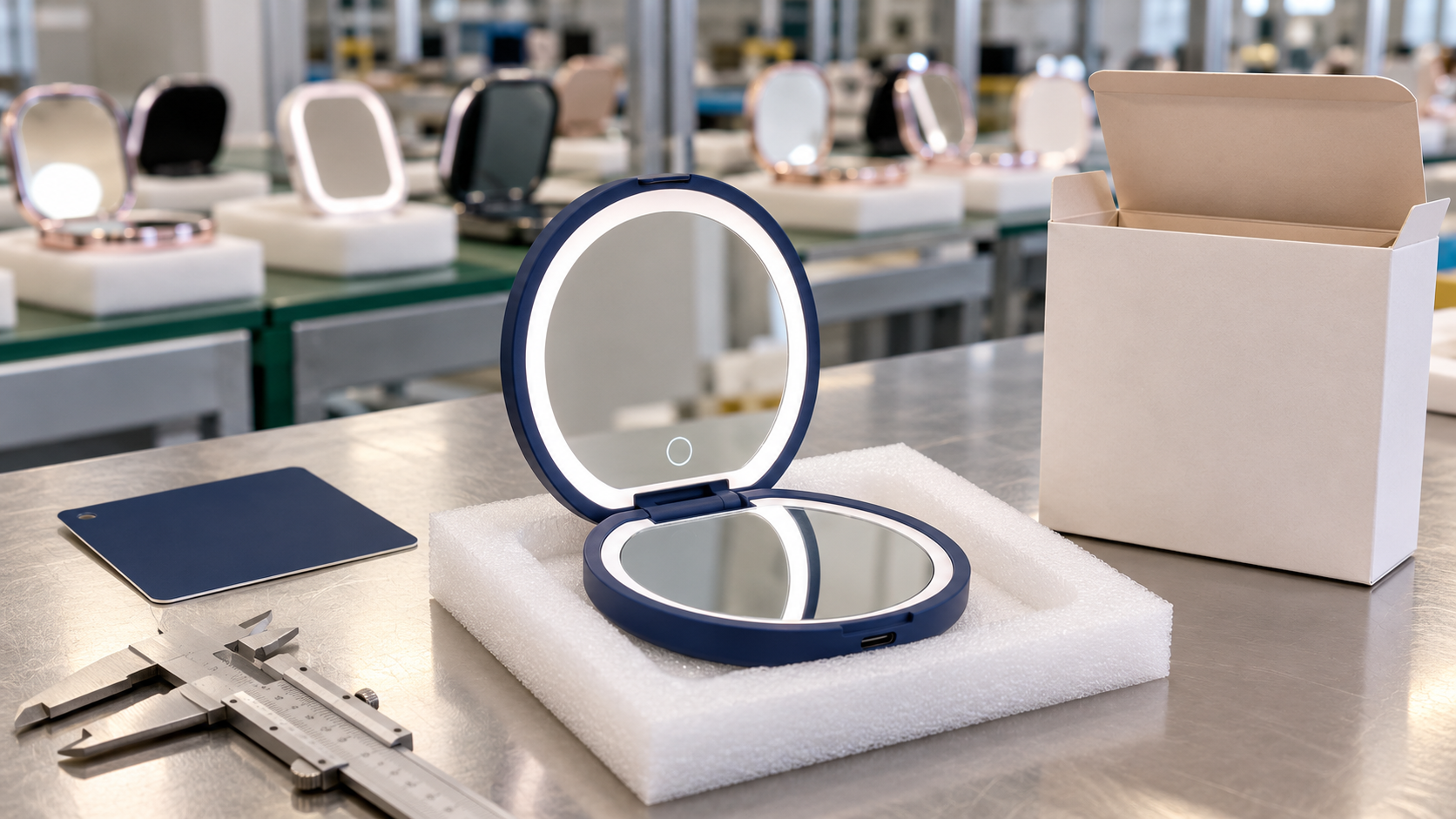
*Concept image: a complete product, packing insert, and measurement check should be reviewed together before a private-label order moves to bulk production.*
Use an RFQ that makes the MOQ comparable
When several suppliers quote different terms, an RFQ should make their assumptions visible. Include the fields below so the answer can be compared line by line rather than by headline unit price.
| RFQ input | What to request | Why it matters |
|---|---|---|
| Product definition | photos/drawing, size, magnification, material, lighting, power, plug | Prevents quotes for different mirror revisions |
| Brand treatment | logo method, color/finish standard, artwork ownership | Identifies custom-process and approval needs |
| Channel and market | retail, distributor, hotel, Amazon/e-commerce; destination | Shapes labels, pack-out, testing, and delivery assumptions |
| Quantity and cadence | first order, forecast, replenishment rhythm | Lets a supplier plan components and capacity appropriately |
| Packaging target | retail carton, insert, master carton, labeling, test expectation | Separates product MOQ from packaging MOQ and breakage risk |
| Required dates | sample decision, purchase order, ready date, delivery window | Makes timing dependencies explicit |
| Quality release | golden sample, inspection level, evidence, claim path | Defines the handoff before shipment rather than after a problem |
For a custom LED makeup mirror, add the desired light color range, dimming behavior, charger/cable expectation, and whether a rechargeable battery is included. For a compact or handheld mirror, specify folding and hinge requirements, travel use, and the retail display context. For a Hollywood mirror, include tabletop or wall use, power location, assembly, and carton handling constraints.
What a buyer should confirm before placing the order
Before issuing a PO, ask the supplier to return a one-page production-release summary. It should state the approved model revision, quantity, color/finish, pack-out, major components, planned inspection date, ready-to-ship definition, and open risks. If the supplier cannot name the assumptions behind the lead time, the date is not yet decision-ready.
Also decide whether the first order is a learning order or a launch order. A learning order may accept a stock platform and a simpler printed label to reduce risk. A launch order may justify custom packaging and wider finish choice, but it needs more approval time. Neither choice is universally better; the right one matches the sales channel, inventory exposure, and launch deadline.
Bottom line
Choose a private-label mirror MOQ and lead time only after the product revision, brand treatment, packaging, and release criteria are clear. A dependable supplier plan separates stock availability, component minimums, buyer approvals, production capacity, QC, and shipment release. That makes the tradeoff transparent: simpler first-order customization can shorten the path, while deeper differentiation needs earlier decisions and controlled approvals.
Mingda Mirror can help qualified buyers turn a target SKU into a production-ready inquiry. Send your target market, sales channel, estimated first quantity, reference product, logo/packaging requirements, and launch window through our Contact page. You can also review Makeup Mirrors, Hollywood Mirrors, OEM/ODM services, and our QC process before requesting a quotation.
FAQ
Is a lower MOQ always better for a first private-label mirror order?
No. A very low MOQ can be useful for a market test, but confirm whether it uses the same approved components, packaging, and quality controls as the planned repeat order. A low assembly quantity does not necessarily include a custom carton, finish, or battery configuration.
When should the lead-time clock start?
Use a written definition. For a customized order, the most useful plan shows time before and after the final approved sample, artwork, and deposit. It should also identify any long-lead components or destination-specific release requirements.
Can a buyer change packaging after approving the mirror sample?
Yes, but treat it as a controlled change. Packaging affects dimensions, protection, printed files, master-carton count, and potentially the ready date. Approve a packed sample before the production release.
What should an e-commerce buyer add to the RFQ?
State the fulfillment route, intended retail presentation, labeling/barcode needs, target bundle contents, and expected handling risk. Request a packed-product review rather than relying only on an unpacked product sample.