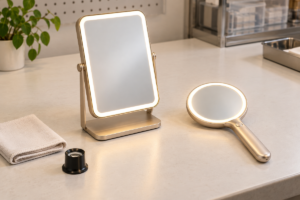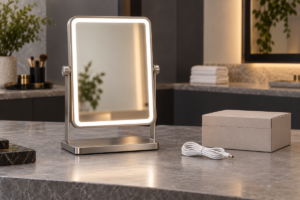

Hollywood vanity mirror packaging should be approved by checking glass protection, bulb or LED strip protection, frame corner support, cable separation, retail box strength, master carton layout, and pre-shipment handling tests. For retailers, importers, hotel project buyers, and e-commerce sellers, the safest package is not simply the thickest foam. It is a structure that holds the mirror frame securely, keeps pressure away from the glass and lighting system, and matches the real shipping route from factory to warehouse to customer.
Large Hollywood mirrors create higher logistics risk than small tabletop mirrors because they combine glass, lighting, metal or MDF frames, bulbs or LED modules, plugs, switches, and often a heavier retail box. If one weak point is missed, the buyer may see cracked corners, loose bulbs, scratched frames, dented cartons, or high return cost after the first shipment.
Why Hollywood Mirror Packaging Needs Its Own Standard
A Hollywood vanity mirror is not only a fragile glass product. It is also a lighting product, a furniture-like display item, and in many orders a branded retail product. The packaging has to protect several layers at the same time: mirror glass, bulb sockets or LED strips, frame finish, tabletop base or wall-mount hardware, plug cable, dimmer switch, adapter if used, manual, and retail box appearance.
For wholesale distribution, the main risk is carton compression, pallet movement, and warehouse handling. For e-commerce or direct-to-consumer orders, the risk expands to courier drops, mixed parcels, customer returns, and repacking. For hotel or salon projects, the packaging must help installation teams identify hardware and avoid on-site scratches before the mirror is mounted.
This is why Mingda Mirror recommends treating Hollywood mirror packaging as part of the product specification. The RFQ should define packaging structure, carton data, accessory placement, label requirements, and test expectations before mass production starts.
Common Breakage Points in Bulk Shipping
| Breakage point | What buyers may see | Packaging control to request |
|---|---|---|
| Mirror glass | Cracks, pressure marks, edge chips | Keep pressure on the frame, not the glass; add clearance and surface protection |
| Frame corners | Dents, paint damage, cracked MDF or metal corners | Use shaped corner guards and avoid empty corner space |
| Bulbs or LED modules | Loose bulbs, broken sockets, diffuser scratches | Separate bulb accessories or protect fixed lighting zones from direct impact |
| Tabletop base | Bent stand, loose bracket, scratched finish | Dedicated cavity or separate sleeve for the base and hardware |
| Cable and switch | Cable marks on mirror surface or missing accessories | Keep power parts in a separate compartment or accessory box |
| Retail box | Crushed corners, poor shelf presentation | Match board strength to mirror weight and outer carton plan |
| Master carton | Carton burst, shifting units, pallet damage | Control carton quantity, fill ratio, tape method, and stacking plan |
Start With the Mirror Structure Before Choosing Materials
Buyers often ask whether EPE foam, molded pulp, paper corner guards, honeycomb board, or pearl cotton is best. The better first question is: where can this mirror safely take pressure?
A Hollywood mirror with a metal frame and fixed bulbs needs a different package from an MDF framed mirror with LED strips, a detachable base, and a plug cable. A tabletop mirror needs stand and base protection. A wall-mounted mirror needs hardware separation and edge protection. A retail-display version needs a cleaner unboxing experience than a plain wholesale carton.
Before approving packaging, confirm:
- overall mirror size, frame thickness, and assembled weight
- whether bulbs are fixed, removable, or packed separately
- whether the base is assembled or packed as a separate part
- plug type, cable length, switch location, and adapter requirement
- wall-mount hardware, screws, anchors, and instruction sheet position
- retail box requirement, barcode label, and country-specific warning label
- master carton quantity, gross weight, carton size, and pallet method
When these points are clear, the supplier can design the insert around real stress points instead of choosing a generic box size.
Packaging Materials: What Works Best for Different Orders
Hollywood mirror buyers should compare packaging material by protection, presentation, cost, sustainability expectation, MOQ, and tooling time. The right answer may change between a trial order and a mature retail program.
| Packaging option | Best use case | Main advantage | Buyer watch point |
|---|---|---|---|
| EPE foam insert | E-commerce and fragile bulk orders | Strong cushioning and easy shape control | Confirm thickness, density, and whether foam touches glass or bulbs |
| Paper corner guard plus honeycomb board | Retail and sustainability-focused programs | Better paper-based story and good corner support | Needs careful sample testing for heavy mirrors |
| Molded pulp insert | Standardized medium-volume retail orders | Cleaner look and repeatable structure | Tooling must match the final mirror and accessory layout |
| Hybrid structure | Large mirrors with accessories or detachable bases | Balances protection, presentation, and accessory separation | More approval steps before mass production |
| Double carton or mailer carton | Direct-to-consumer shipping | Adds outer impact layer and protects retail box | Increases dimensions, freight cost, and storage space |
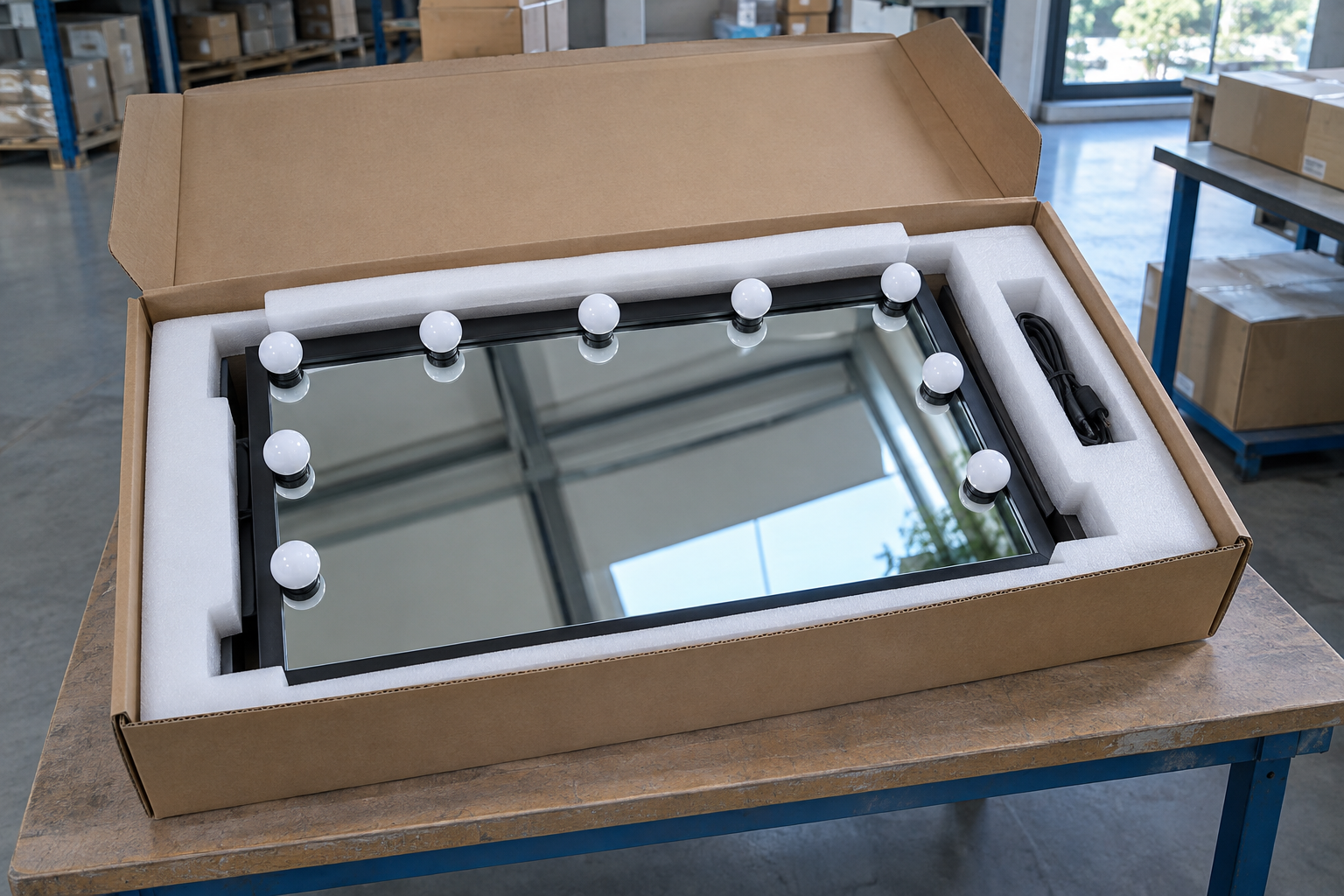
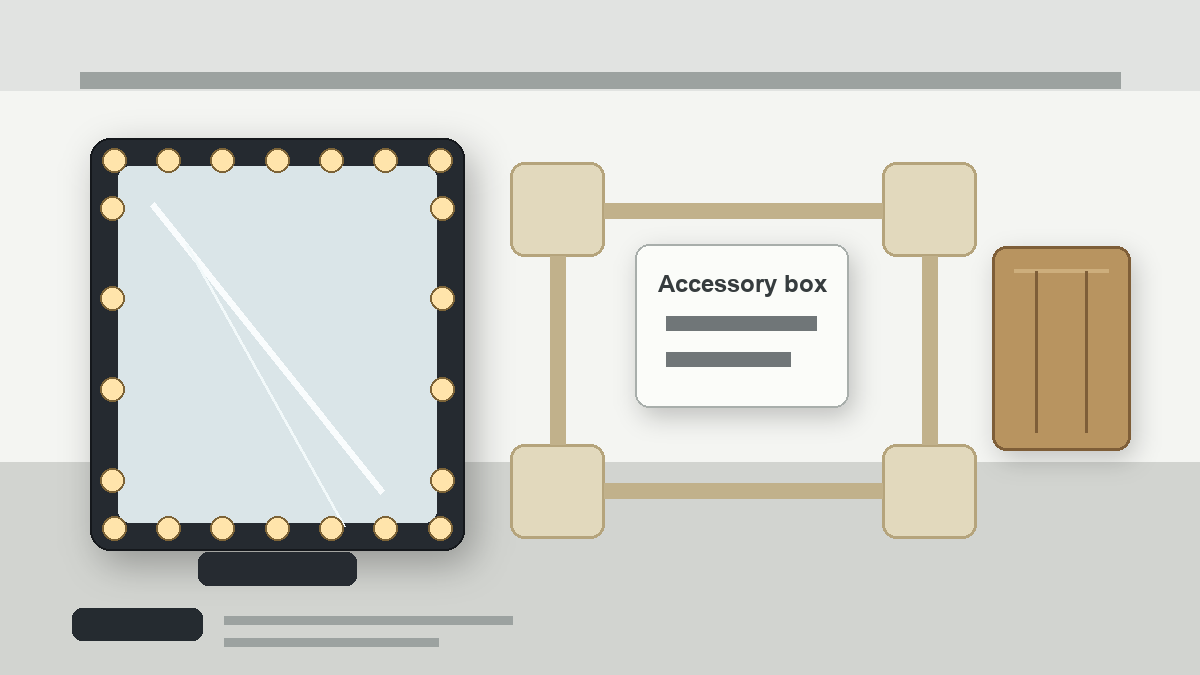
For high-value Hollywood mirrors, evaluate a hybrid structure against the actual packed sample and delivery route: surface sleeve or film for scratch control, corner guards for frame impact, shaped cushioning for the lighting zone, accessory compartment for cable and hardware, retail box for presentation, and export carton for stacking strength.
What Buyers Should Inspect on the Packaging Sample
A packaging sample should be evaluated as a working logistics system, not just as a neat open-box photo. Ask the supplier to show the mirror packed, shaken lightly, opened, repacked, and inspected. For larger programs, request a documented handling or drop-test assumption that matches the channel.
Pre-shipment packaging checklist
- Check restraint and cushioning against the agreed packed-sample criteria; a hand-shake check does not replace a defined transport test.
- The glass surface has protection but is not pressed by the insert.
- Frame corners are supported with no empty impact space.
- Bulbs, LED diffusers, sockets, and switches are not bearing carton pressure.
- Cable, plug, remote, screws, and manual are separated from the mirror face.
- The retail box closes without bulging.
- Carton dimensions and gross weight match the buyer’s warehouse or marketplace data.
- Carton labels, barcode, model number, color, plug type, and quantity are readable.
- A repacked unit still protects the mirror during a return or internal transfer.
Buyers should also inspect the first mass-production units, not only the sample room package. Material substitutions, looser inserts, or rushed accessory packing can happen when the line is under schedule pressure.
Retail, E-commerce, and Project Buyers Need Different Packaging Decisions
For retail chains, the package must protect the mirror and still look acceptable when the box reaches a store, distributor warehouse, or showroom. Retail buyers should confirm box print quality, barcode placement, carton marks, pallet plan, and whether the retail box can survive distribution without looking damaged.
For e-commerce sellers, the package must handle individual parcel movement. A mirror that survives export carton transport may still fail when shipped as one unit to a customer. Online sellers should consider whether the retail box needs an additional mailer carton, whether loose bulbs need a separate accessory box, and how the product will look after a customer opens and repacks it.
For hotel, salon, or project buyers, the package should make installation easier. Hardware kits, wall anchors, instructions, and model labels should be easy to identify. If several mirror sizes or plug versions ship together, carton labels should prevent wrong-room or wrong-market installation.
How Packaging Affects MOQ, Lead Time, and Total Cost
Custom packaging can reduce damage, but it also affects purchasing plans. A custom insert may require tooling, a printed box may need proof approval, and a stronger carton may change freight cost. Buyers should ask for the packaging cost and timeline separately from the mirror unit price, especially when comparing suppliers.
For trial orders, buyers may choose a standard strong carton with upgraded inserts and simple labels. For stable retail or e-commerce lines, a custom retail box, shaped insert, and channel-specific carton plan can be more cost-effective because it reduces replacement claims, damaged inventory, and negative customer reviews.
The best supplier quote should state the mirror specification, packaging structure, accessory layout, carton quantity, gross weight, carton size, label requirement, testing assumption, and packaging approval date. If these details are missing, two suppliers may appear to quote the same Hollywood mirror while offering very different protection levels.
Common Mistakes Buyers Should Avoid
The first mistake is approving packaging only from a closed-box photo. A box can look strong while the mirror moves inside. Always ask for open-package photos and packed-unit details.
The second mistake is letting accessories touch the mirror. Power cords, plugs, screws, and loose bulbs can scratch the glass, frame, or LED diffuser during vibration.
The third mistake is using one insert for several mirror sizes. A small clearance error can become a large breakage problem when cartons are stacked or dropped.
The fourth mistake is ignoring return handling. If a customer or installation team cannot repack the mirror securely, the product may break during return transfer even if it arrived safely the first time.
For related planning, buyers can also review Mingda Mirror’s e-commerce LED makeup mirror packaging guide, private label packaging artwork checklist, and Hollywood mirror product options.
Separate Transit Damage Evidence from Packaging Approval
Agree a receiving inspection window and an evidence owner before dispatch. Link each claim to the buyer SKU, lot, carton ID, approved insert revision and delivery route. Record units received, units inspected and units damaged separately; a complaint count without an inspection denominator is not a shipment breakage rate.
| Receiving observation | Evidence to retain | Decision before reshipment |
|---|---|---|
| Outer carton visibly crushed | Carton and pallet photos, delivery record, carton ID and condition before opening | Segregate affected stock; investigate handling and packing evidence without assigning responsibility from the carton alone |
| Glass or lighting damaged inside an intact carton | Unboxing sequence, insert fit, accessory position and original packed-sample revision | Review clearance and restraint; agree a corrected packed sample and repeat checks |
| Damage after customer repacking | Original delivery condition, returned packaging and missing or misplaced supports | Review repacking instructions and return materials separately from outbound packaging approval |
For a failed packed-sample test, retain the test conditions, sample IDs, original failures, corrective action and retest results. Agree who may release the revised pack and itemize replacement units, parts, sorting and transport costs. A successful test supports the agreed route assumptions; it does not guarantee zero breakage. Use the Hollywood mirror packing guide for pre-order packaging layers and this evidence matrix for receiving and claim review.
Bottom-Line Recommendation
For Hollywood vanity mirrors, packaging should be approved as a protection system for glass, lighting, frame corners, accessories, retail presentation, and master-carton movement. Do not compare suppliers by unit price alone if the packaging structure is unclear. Ask for a packed sample, open-box photos, carton data, accessory layout, and realistic handling assumptions before confirming bulk production.
Mingda Mirror can support Hollywood vanity mirror buyers with product selection, OEM/ODM customization, packaging structure review, carton planning, sample approval, and pre-shipment QC. To prepare an RFQ, share your target mirror size, frame material, lighting type, sales channel, packaging requirement, order quantity, destination market, delivery route and agreed claim evidence. Request separate packaging, sample-test, tooling and replacement-freight costs through the Contact page.
FAQ
What is the best packaging for Hollywood vanity mirrors?
Most Hollywood vanity mirrors need surface protection, shaped corner guards, a stable insert, accessory separation, a strong retail box, and a controlled master carton. Larger or e-commerce units may also need a double-carton structure.
Should bulbs be installed or packed separately?
It depends on the mirror design and channel. Fixed bulbs or LED modules need strong protection around the lighting area. Removable bulbs should be packed in a separate protected compartment with clear accessory counting.
Can one package serve retail and e-commerce orders?
Sometimes, but only if the retail box and insert can handle parcel movement. Many online sellers use a retail box inside an additional mailer or stronger outer carton to reduce direct-to-consumer damage.
What carton details should buyers confirm before shipment?
Confirm carton dimensions, gross weight, unit quantity, carton marks, barcode or SKU labels, plug version, destination market, pallet plan, and whether the carton structure matches the expected handling route.
How can buyers reduce mirror breakage claims?
Approve packaging with real product samples, protect the frame instead of pressing the glass, separate accessories, inspect first production packing, and include packaging photos and carton data in the pre-shipment QC record.
Social Media Content Ideas
LinkedIn angle: explain why Hollywood mirror buyers should compare packaging systems, not only mirror unit price.
Facebook angle: show how corner guards, accessory separation, and stronger cartons protect a vanity mirror before it reaches the customer.
Instagram angle: use the packaging inspection image to highlight a complete Hollywood mirror, foam corners, accessory box, and export carton.
CTA: Read the full packaging checklist and send Mingda Mirror your Hollywood mirror size, channel, and order quantity for an RFQ-ready packaging plan.