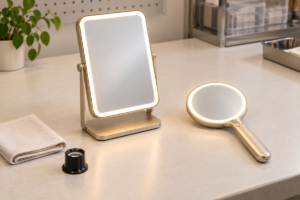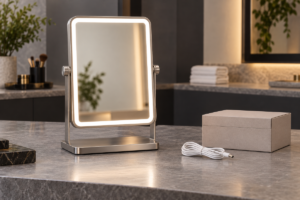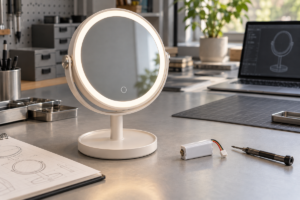

The best travel makeup mirror is the smallest model that still provides a usable full-face view, stable support and comfortable lighting for the intended trip. For brands and retail buyers, select it against a defined travel scenario rather than a universal size or magnification claim. Approve the closed dimensions, packed weight, hinge, viewing distance, power method and protective case together. A pocket compact and a folding hotel-room mirror solve different problems; neither is automatically the better assortment choice.
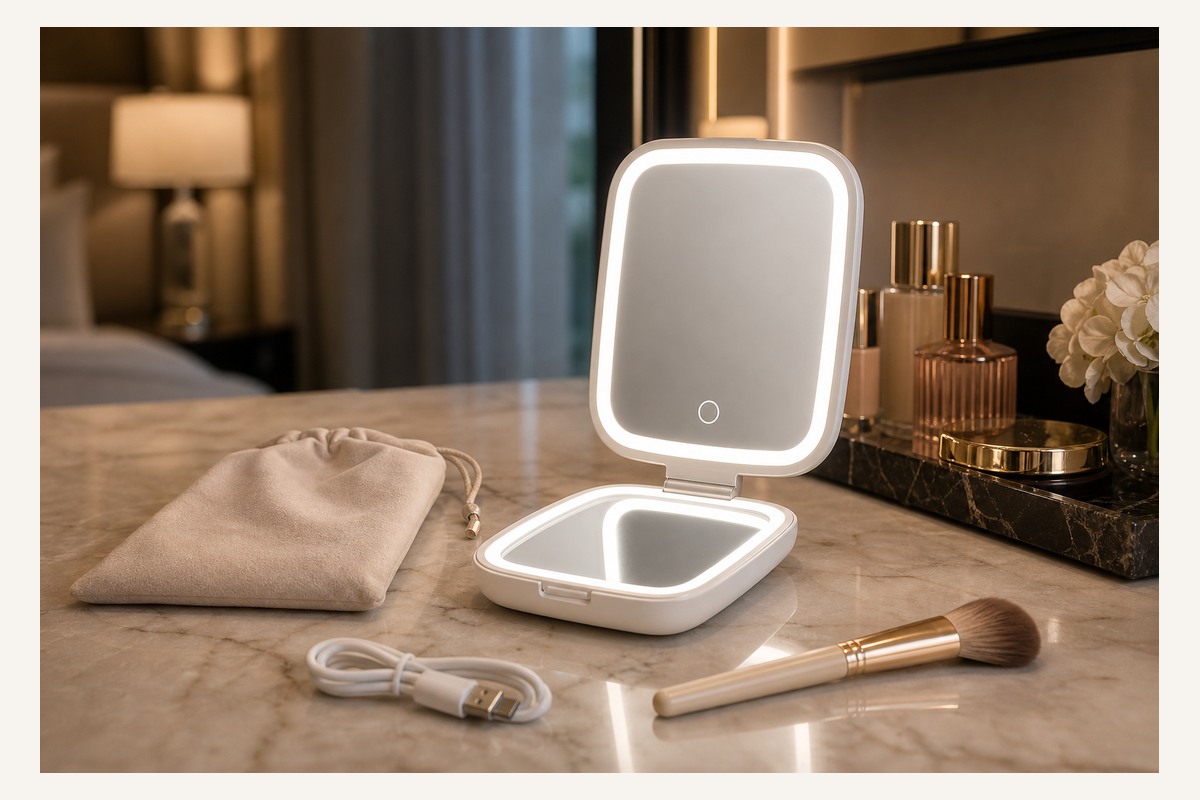
Match the travel scenario to the mirror format
Start with the customer’s available space and routine. A commuter may need brief touch-ups while holding the mirror. A guest staying several nights may prefer hands-free use on a desk. A gift buyer may value a compact case and presentation, but the packaging still needs to protect the hinge and reflective surface. Record the target sales channel and retail price band before comparing samples.
| Buyer scenario | Format to evaluate | Tradeoff | Sample decision |
|---|---|---|---|
| Daily bag and short trips | LED pocket compact with protective lid | Lower packed volume, smaller viewing area | Check grip, opening force and face visibility at a natural distance |
| Hotel desk and longer stays | Folding tabletop LED mirror | Hands-free use, more bag space | Check angle retention and stability on a typical desk |
| Gift and private-label retail | Compact mirror with coordinated pouch or box | Presentation adds cost and packed volume | Approve the logo, insert and complete packed sample |
| Detail grooming | Standard view plus a magnifying side | Closer viewing distance and smaller field of view | Let intended users compare magnification before committing to the range |
Compare size, magnification and lighting on real samples
Record open and closed dimensions separately. Include the stand, hinge and charging connection in the usable footprint, and weigh the mirror with the actual pouch and cable. A smaller advertised diameter does not establish better portability if the protective case is bulky. Conversely, reducing size too far can make a mirror inconvenient for full-face makeup.
A standard-view surface supports an overall view; magnification supports close detail. Compare candidate magnifications at their intended working distances and check whether users can find focus comfortably. Do not promise that a high magnification number is easier for every customer. Explain the difference in the product listing and instructions so expectations match the approved sample.
For LED models, specify CCT, color-rendering target, brightness settings, dimming behavior and switch operation. Compare samples in dim accommodation lighting as well as the supplier showroom. Inspect diffusion around the light source and reflections at several angles. A bright ring that creates glare may be less useful than a lower setting with more even light. Record the chosen setting and measurement conditions when comparing supplier results.
Decide how the mirror will be powered
Rechargeable models need a documented charging routine, compatible cable and clear indication of charging status. Replaceable-battery models need clear battery specifications and access instructions. Plug-in formats depend on an available outlet and appropriate power supply. Choose according to the travel use case and service plan, rather than describing one power method as universally superior.
Ask suppliers to report runtime with the brightness setting, test start condition and cutoff method. Compare like-for-like results; an unspecified runtime claim is not a reliable purchasing comparison. Check whether the light can turn on accidentally inside the case, how the switch is protected and whether the lid can close without pinching the cable. Use the makeup mirror sample approval checklist to keep the accepted configuration traceable.
Control hinges, surfaces and packaging before bulk orders
Check the complete assembly, not only the mirror glass. Open and close the lid, adjust the stand, inspect the frame edges and confirm that the selected angle holds during ordinary use. Agree a written inspection method, sample quantity and acceptance criteria with the supplier. Keep the sample revision and observed results with the buyer SKU so repeat orders are compared with the same reference.
Approve the actual pouch, insert, retail box and shipping carton together. Confirm that surfaces cannot rub against accessories and that the hinge is supported without unwanted pressure. Parcel orders and store replenishment may need different packaging reviews. Document the packed configuration and evaluation conditions rather than presenting an illustrative image as proof of a completed transit test.
For private-label orders, request separate quotations for the standard model, custom finish, logo process, packaging and tooling where applicable. MOQ and lead time depend on the configuration and supplier capacity. Ask which approvals start the production clock and how a finish or insert change affects repeat orders. This makes the quotation useful for purchasing rather than simply collecting a low unit price.
Common travel mirror buying mistakes
- Choosing the smallest model without checking the full-face view and stand stability.
- Comparing runtime claims measured at different brightness settings.
- Approving a mirror but leaving the cable, pouch or packaging revision undecided.
- Using one attractive photo as evidence of hinge durability or lighting quality.
- Ignoring replacement arrangements for failed switches, charging faults or damaged arrival units.
Prepare a travel makeup mirror RFQ
Send the destination market, sales channel, target price band, quantity by SKU and required delivery date. Include closed dimensions, packed-weight target, viewing format, magnification, lighting controls, power method and accessory list. Attach logo artwork and packaging expectations, then ask for sample costs, MOQ by finish, production lead time and repeat-order conditions as separate line items.
Before releasing the order, identify who signs the appearance, function and packed samples. Agree how reported faults will be matched to a SKU and lot, what evidence the supplier needs and who owns corrective action. Review the channel-fit pilot guide before expanding the range, and compare current makeup mirror options against that brief.
Bottom-Line Recommendation
Choose a travel makeup mirror by the actual trip and handling conditions, then validate the complete packed sample. For a first range, keep distinct use cases and clear specifications so customers understand why each model exists. Resolve usability, power and packaging exceptions before committing to a wider assortment.
Contact Mingda Mirror for a travel mirror quotation with your target channel, quantity, closed-size requirement, power preference, branding and launch date. Request an itemized quotation and sample approval schedule so your team can compare the complete order scope.
FAQ
What size travel makeup mirror should a retail buyer choose?
There is no universal minimum size. Test the closed footprint, packed weight and usable viewing area with the intended travel scenario. A pocket touch-up model and a folding desk model should have different approval criteria.
Is higher magnification better for travel?
It can help with detail work, but requires an appropriate viewing distance and offers a smaller field of view. Compare samples with intended users and retain a standard view when full-face use is important.
What should buyers confirm about rechargeable travel mirrors?
Confirm the charging input, cable, instructions, indicator behavior and runtime test conditions for the actual configuration. Agree packaging and fault-handling arrangements before the bulk order.
How are MOQ and lead time determined?
Ask for a quotation covering the model, finish, logo and packaging separately. Component availability, customization and sample approvals affect the schedule; confirm the production start milestone in writing.