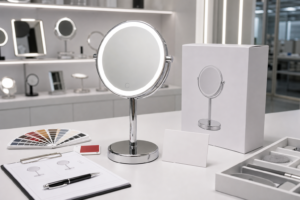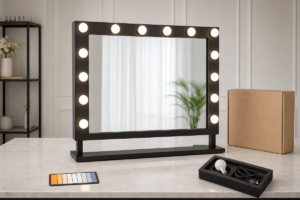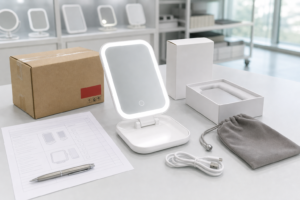

Rechargeable makeup mirrors are a strong fit for beauty brands, Amazon sellers, retailers, and travel-focused gift programs, but buyers should not treat the battery as a simple accessory. For bulk orders, the right decision is to confirm battery capacity, charging interface, protection circuit, runtime, heat control, packaging, documentation, and sample test results before approving mass production. A mirror that looks attractive in a product photo can still create return risk if it charges slowly, has unstable dimming, overheats during use, or ships without the documents needed for your sales channel.
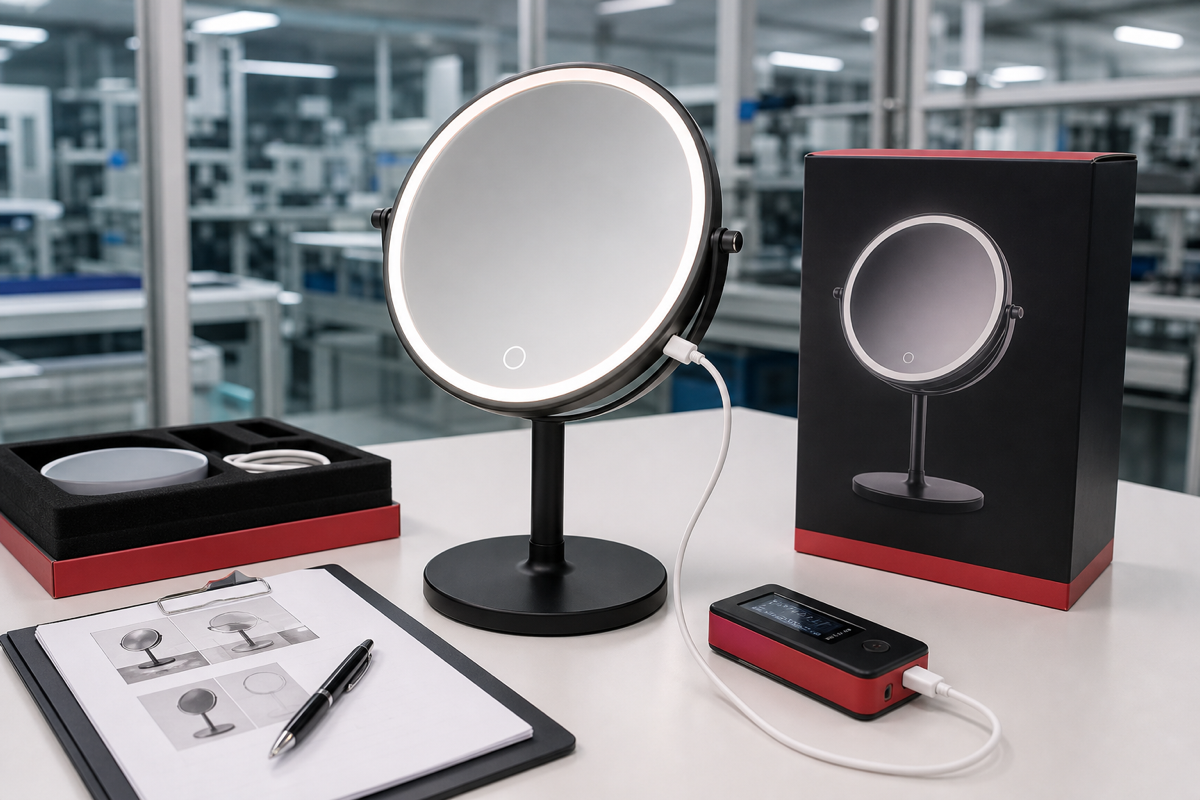
Why Battery and Charging Details Matter in Mirror Sourcing
For a rechargeable LED makeup mirror, the lighting system, battery, charging port, PCB, switch, and packaging are connected decisions. A brighter mirror may need a larger battery, better heat management, and stronger packaging protection. A compact travel mirror may need shorter runtime but stricter drop protection and clearer charging instructions. Before issuing a purchase order, brands should ask how the battery is specified, how charging is tested, and whether the final packed product can pass the buyer’s target market requirements.
Useful internal references include Mingda Mirror’s makeup mirror product range, OEM and ODM customization service, QC process, and contact page.
What Buyers Should Confirm Before Choosing a Rechargeable Model
The first sourcing decision is not simply USB-C or not. Buyers should define the sales channel and user scenario, then match the charging specification to that use case.
| Buyer scenario | Recommended charging priority | What to confirm before RFQ |
|---|---|---|
| Amazon and e-commerce sellers | Stable charging experience and clear user instructions | Runtime at common brightness, charging time, cable type, packaging protection, complaint handling |
| Beauty brands and private labels | Premium feel and reliable daily use | Battery capacity, dimming stability, finish options, logo placement, retail box design |
| Retail chains and distributors | Consistent batches and easy after-sales support | Replacement policy, spare parts, carton drop protection, inspection report format |
| Travel and gift buyers | Portability and safe packed accessories | Compact cable packing, protective insert, battery documentation, shelf-ready packaging |
| Salon and professional use | Longer runtime and durable switch/hinge | Heat rise, charging cycle test, stand stability, sample aging test |
If the buyer sends only a product photo, suppliers may quote the lowest workable specification. If the buyer sends channel, target runtime, packaging style, and compliance requirements, the quotation becomes easier to compare.
Battery Specification: Capacity Is Only One Part of the Decision
Battery capacity is important, but it should not be evaluated alone. Buyers should ask for the rated capacity, battery type, protection circuit design, expected runtime at different brightness levels, and charging time under the supplied cable and adapter conditions. A mirror advertised with a large battery may still disappoint users if the LED brightness drains it quickly or if the dimming circuit is unstable.
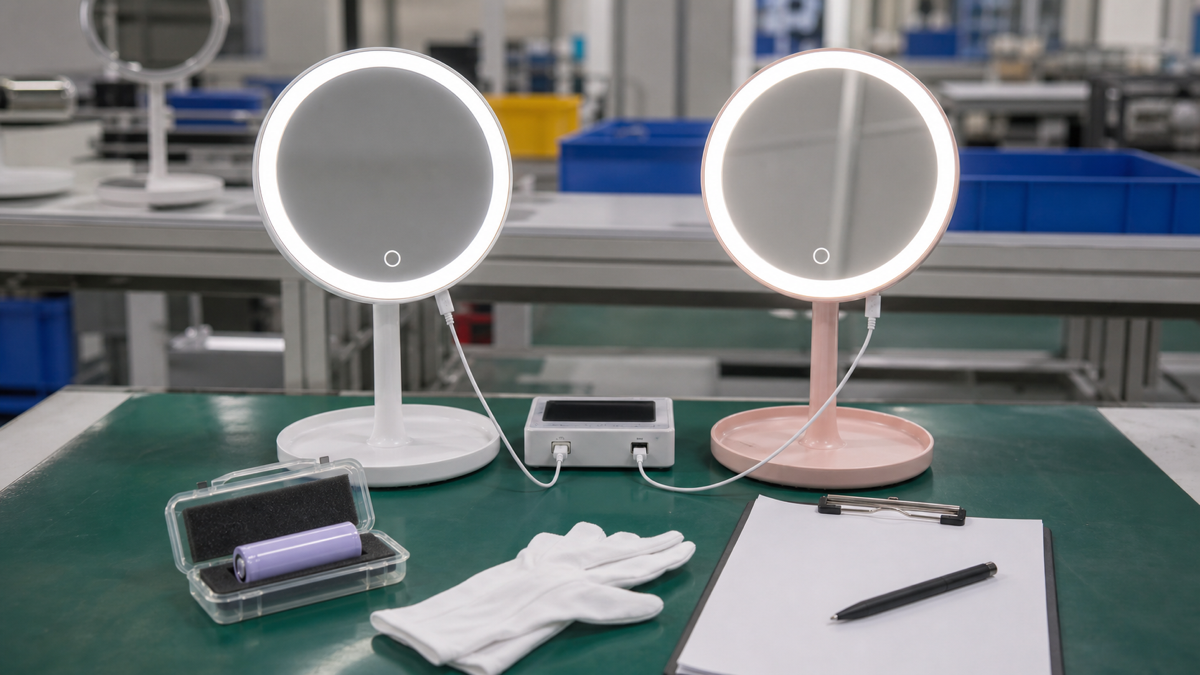
For bulk buying, compare samples under the same conditions. Set the mirror to the brightness level most users will actually choose, then record runtime, light stability, surface temperature, and charging time. A stable user experience matters more than a battery number that looks strong on a specification sheet.
USB-C Charging: Convenience, But Not a Shortcut Around QC
USB-C is now expected by many consumers because it is familiar and convenient. For business buyers, the key is implementation. The port should feel secure, align cleanly with the housing, and survive repeated plug-in and pull-out use. Ask whether the sample supports the intended charging current, whether the port is reinforced, whether the supplier tests port durability, and whether the packed set includes the cable. If an adapter is not included, the packaging and manual should state the recommended adapter range clearly.
Safety and Compliance Documents to Request
Requirements vary by market and sales channel, so buyers should confirm their own importer and platform obligations. As a practical baseline, ask which documents can be provided for the mirror, battery, charger accessories, and packed product. Common requests may include battery transport documentation, material safety information, electrical test reports, CE or UKCA documents for relevant markets, FCC-related information for the US when applicable, RoHS material compliance, warning statements, instruction manual review, and product traceability records.
The supplier should be able to explain what each document covers. A test report for one component is not always the same as a report for the final product. A sourcing manager should confirm model numbers, product photos, rated input, battery specification, and report dates before relying on documents for a shipment.
Packaging Checks for Rechargeable Makeup Mirrors
Rechargeable mirrors need packaging that protects both the glass and the electronic parts. The mirror head, stand, charging cable, and accessories should have fixed positions inside the insert. The charging port should not press directly against a hard carton wall, and the cable should not scratch the mirror surface. For e-commerce shipment, the inner box and outer carton should be tested for drop and compression risk.
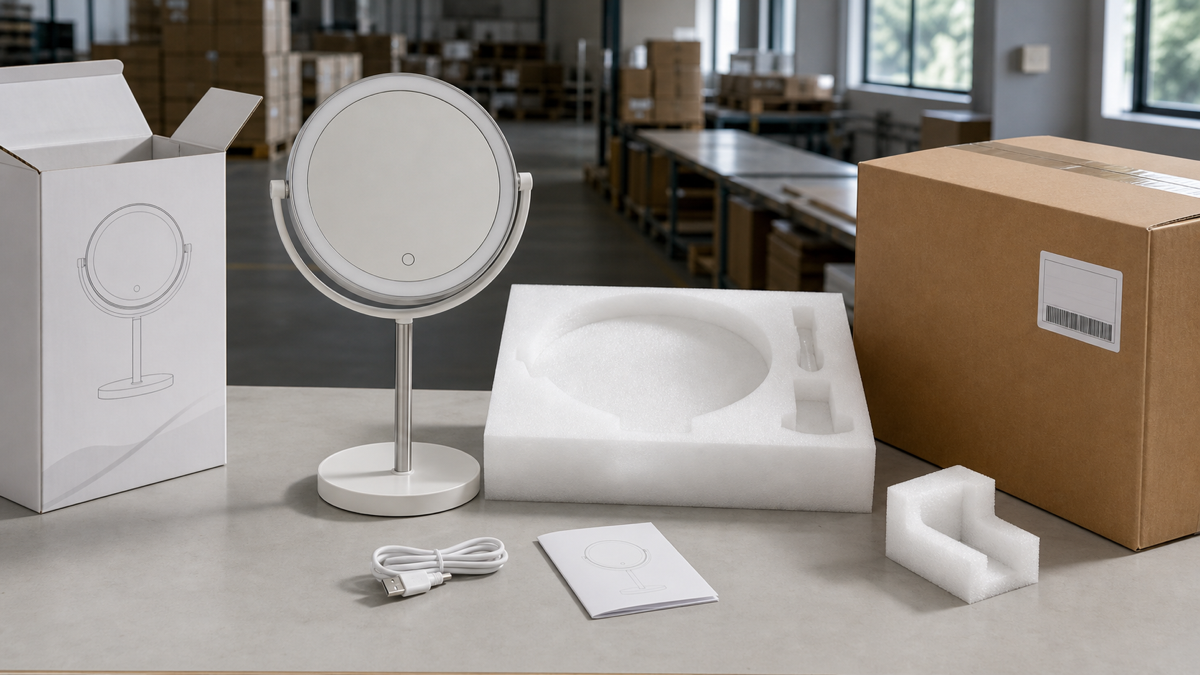
Before mass production, review a fully packed sample, not just the mirror itself. Shake the box gently, check whether the mirror moves, inspect the insert fit, and confirm that the cable, manual, and accessories cannot damage the mirror during shipping. This is especially important for Amazon sellers because a technically good mirror can still receive poor reviews if customers receive scratched glass, broken stands, or loose accessories.
Pre-RFQ Checklist for Battery and USB-C Orders
- Target sales channel: Amazon, retail, distributor, salon, travel, or beauty brand program.
- Mirror type: tabletop, foldable, handheld, compact, wall-mounted, or multi-use design.
- Battery capacity and expected runtime at normal and high brightness.
- Charging interface, cable inclusion, recommended adapter, and charging indicator behavior.
- Protection circuit, heat rise, charging stability, and port durability test plan.
- Sample aging test, brightness stability test, and repeated switch/hinge operation.
- Compliance documents required for the target market and shipping method.
- Retail box structure, insert material, accessory placement, and carton drop protection.
- Logo, color, manual, warning label, barcode, and private-label packaging files.
- MOQ, sample lead time, mass production lead time, inspection standard, and replacement terms.
Common Mistakes Buyers Should Avoid
The most common mistake is choosing the cheapest rechargeable mirror without checking charging performance. Another mistake is approving a good-looking unpacked sample, then discovering during shipment that the cable, mirror head, and stand move inside the retail box. For private-label orders, do not leave the manual, warning labels, rating information, and importer details until the end of production. Handle these files during sample approval so the supplier can align the product, packaging, and documentation before the schedule is locked.
Bottom-Line Recommendation
For rechargeable makeup mirrors, buyers should approve the product as a complete system: mirror design, battery, USB-C port, lighting performance, packaging, documents, and after-sales plan. The best sample is not only the one with the brightest LED or the largest battery; it is the one that can deliver stable charging, reliable runtime, safe packing, clear instructions, and consistent batch quality for the buyer’s real sales channel.
Mingda Mirror supports LED makeup mirror development, private-label packaging, sample approval, and production QC for brands, retailers, importers, and e-commerce sellers. To prepare an RFQ, share your target market, mirror style, battery/runtime requirement, packaging format, logo needs, and expected order quantity through the Mingda Mirror contact page.
FAQ
What battery capacity should buyers choose for a rechargeable makeup mirror?
There is no single best capacity for every market. Buyers should match battery capacity with mirror size, LED brightness, expected runtime, charging time, and price level. A beauty brand may prefer longer runtime, while a travel program may prefer lighter weight and compact packaging.
Is USB-C always better than Micro-USB for LED makeup mirrors?
USB-C is usually easier for consumers to accept, but buyers still need to check port strength, charging stability, cable quality, and instruction wording. A poorly implemented USB-C port can create the same return risk as any other weak charging design.
Should the adapter be included in bulk orders?
Many programs include only the cable, but the right choice depends on market expectations, packaging cost, compliance scope, and retail positioning. If the adapter is not included, the manual and packaging should clearly state the recommended charging input.
What should be tested before mass production?
Test runtime, charging time, brightness stability, heat rise, USB-C port fit, switch function, hinge or stand strength, packaging drop protection, and final packed sample appearance. For e-commerce, also inspect the unboxing experience and accessory placement.
How can buyers reduce after-sales complaints?
Set clear specifications before quotation, approve a fully packed sample, request relevant test documents, define inspection standards, and confirm replacement handling for defective units. Good battery and packaging control reduces reviews about charging failure, short runtime, breakage, and missing accessories.
Social Media Content Ideas
For LinkedIn, highlight this sourcing rule: test runtime and charging stability before approving mass production. For Facebook, explain how better packaging reduces damaged mirror returns. For Instagram, use the battery QC scene to show behind-the-scenes quality control. The CTA should point readers to the full article and invite buyers to send RFQ requirements to Mingda Mirror.