
Direct answer: inspect a mirror order in two stages: document the delivery condition before unloading, then compare a controlled sample of cartons and units against the purchase order, approved sample, pack-out specification, and accessory list. Do not sign off a bulk order simply because the pallet count looks correct. For fragile mirrors, the first photos, count records, and retained samples often decide whether a carrier, marketplace, supplier, or internal team can investigate a later discrepancy.
This guide is for beauty brands, retailers, distributors, Amazon/e-commerce sellers, and project buyers receiving makeup, handheld, or LED mirror orders. It is a practical receiving-control guide, not legal, insurance, carrier, or marketplace-claim advice. Agree the inspection window, claim route, and acceptance criteria in the purchase order before dispatch.
Why receiving inspection is a commercial control, not a warehouse chore
A factory final inspection confirms what was released at origin. It does not prove the condition, quantity, or carton identity at the point your business receives the shipment. A receiving check closes that gap: it preserves the first evidence of transit damage, identifies a wrong SKU or pack-out before units enter sellable stock, and keeps any later claim tied to a specific shipment and carton.
That distinction matters for mirrors. Glass, a lit mirror face, a hinge, a rechargeable battery, a cable, a base, and retail packaging can each be intact or non-conforming independently. A perfect outer pallet does not guarantee a complete, working retail unit. Conversely, one crushed master carton should be documented and segregated; it does not automatically establish that an entire production lot is defective.
For parcel-oriented e-commerce routes, packaging needs to be suitable for normal handling; Amazon specifically treats mirrors as fragile products and tells sellers to assess whether packaging can withstand the route. Where a buyer specifies a simulation test such as ISTA 3A, confirm that the procedure, sample, route, and pass/fail criteria are appropriate to the shipment rather than treating the test name as a universal guarantee.

Set the receiving standard before the shipment leaves
The receiving team should not have to infer what “acceptable” means. Attach a concise receiving appendix to the PO or quality agreement, and align it with the approved sample and the mirror sample-to-mass-production process. It should identify the SKU revision, expected pallet and carton count, unit quantity, carton markings, retail pack-out, accessories, agreed functional checks, defect definitions, sampling plan, and the evidence required if something is wrong.
The four records to reconcile
| Record | Check at receiving | Why it matters |
|---|---|---|
| Purchase order and approved SKU sheet | Model, color, voltage/power version, quantity, market-specific accessories | Stops a visually similar but wrong item from entering inventory |
| Packing list and carton map | Master-carton count, inner-pack quantity, pallet/carton identifiers | Creates a traceable count from truck to unit |
| Approved sample and pack-out standard | Mirror finish, lighting function, insert, cable, manual, retail box | Defines the version that was actually approved |
| Carrier delivery record | Delivery time, visible damage, shortage notation, photo references | Preserves the first handover evidence |
If your channel requires labels, barcode placement, or special preparation, list those controls by SKU and destination. Do not rely on a generic carton photo from a different order. For rechargeable products, include the exact cable/adapter scope and any approved labeling; transport and marketplace requirements vary by route and program.
A two-stage receiving workflow for mirror orders
Stage 1: Check the vehicle, pallet, and outer-carton condition
Before the driver leaves, count visible pallets/cartons and compare them with the delivery record. Photograph the vehicle opening, pallet wrap, all damaged corners, punctures, wet areas, crushed cartons, missing labels, and any mixed or substituted carton style. Capture a wide image for context and close images for each issue. Note exceptions on the delivery record according to your agreed procedure; do not make unsupported fault conclusions on the spot.
Quarantine clearly damaged, wet, or mismatched cartons. Keep their labels, outer packaging, and the opening sequence intact until the responsible parties agree the next action. If you accept a shipment with an exception, record that acceptance is subject to internal inspection rather than declaring the contents compliant.
Stage 2: Open a controlled sample and reconcile sellable units
Select cartons from different pallets, layers, and production/carton identifiers. For each selected carton, record the carton ID, operator, time, SKU, quantity found, packaging condition, and result. Open it carefully so the inner protection and any damage pattern are visible in photos.
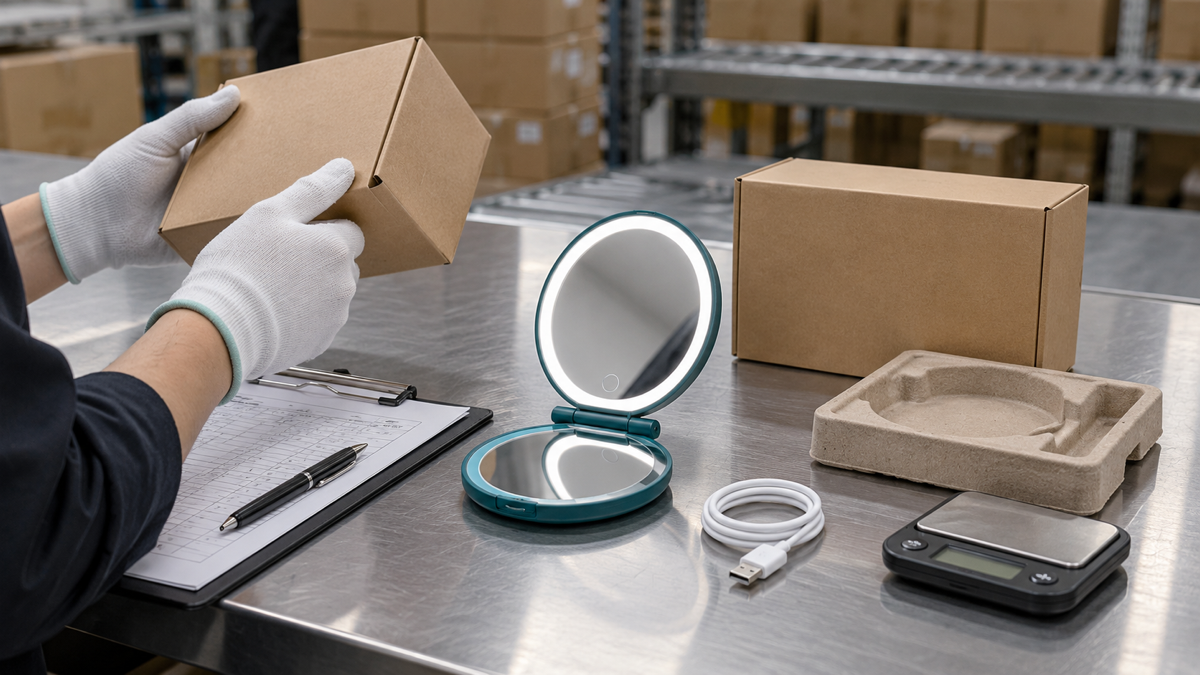
Then compare the retail unit with the approved sample. Check mirror glass and edges, frame/base or hinge, illumination and switch operation where applicable, charging port/cable fit for rechargeable designs, magnification marking if specified, included accessories, retail-pack contents, barcode/label version, and cosmetic presentation. Keep a retained sample from each result type: pass, transit-damaged, packing discrepancy, and suspected product non-conformance.
Choose the response by what the evidence actually shows
| Finding | Immediate control | Evidence to retain | Commercial next step |
|---|---|---|---|
| Damaged outer carton; unit not yet checked | Quarantine carton and nearby units | Carton ID, wide/close photos, delivery record | Inspect contents; follow the agreed carrier/supplier notification route |
| Shortage or extra cartons | Hold reconciliation | Delivery record, carton map, pallet photos, count sheet | Reconcile against packing list before booking stock |
| Wrong SKU, color, plug, or accessory set | Block from sellable inventory | PO/SKU sheet, carton label, unit and pack-out photos | Ask for written disposition; do not relabel without approval |
| Transit damage to a correct unit | Segregate affected units | Full unit, packaging, label, and unpacking photos | Separate logistics evidence from factory-quality conclusions |
| Repeated functional or cosmetic issue | Expand the controlled sample per agreed plan | Lot/carton trace, test result, retained samples | Escalate as a potential production non-conformance |
This separation is essential. A shattered unit in a visibly crushed carton points to a different investigation from a repeated switch failure in undamaged cartons. Keep the claim narrative factual: what was received, what was checked, how many units were affected, and which records support the observation.
Sampling: make it agreed, traceable, and proportionate
There is no single sample size that fits every mirror order. The right plan depends on quantity, unit value, defect risk, channel, route, and the consequence of a failure. A buyer may use a statistically defined plan, a customer-specific standard, or a 100% check of higher-risk points. What matters is that the plan names the lot definition, sample selection method, defect categories, acceptance/rejection rule, recheck rule, and decision owner before receiving day.
Do not quietly change the sample method after a problem appears. If a controlled sample finds a potential systemic issue, document the trigger for expanded inspection and who authorized it. For more upstream detail, connect the receiving plan to the LED makeup mirror pre-shipment inspection checklist and the LED makeup mirror inspection report checklist.
What e-commerce and marketplace buyers should add
E-commerce orders need a receiving record that can work across warehouse, customer-service, and claims teams. Retain SKU identifiers, inbound shipment references, carton/unit quantity, delivery proof, high-resolution photos of the packaging and labels, and the exact condition of the affected unit. Amazon’s current guidance for damaged or missing-item reimbursement requests requires specific order/identity evidence and images, while its inbound-shipment claims guidance calls for ownership and delivery records. Requirements and claim windows change, so verify the applicable current policy in your own marketplace account before relying on a workflow.
For a fragile mirror, map three separate moments: factory release, inbound receipt, and customer return. Each has different evidence. That makes it easier to see whether a packaging redesign, a fulfillment correction, or a supplier corrective action is actually needed. If packaging is the risk, start with the custom mirror packaging specification guide rather than adding more dunnage without a controlled trial.
RFQ-ready questions to settle before the first delivery
- Which SKU revision, color, power variant, and accessory set will the receiving team use as the reference?
- What is the expected master-carton, inner-pack, pallet, and unit count—and which carton identifiers connect them?
- Which defects require immediate quarantine, which allow conditional receipt, and who makes the disposition decision?
- What photos, samples, and documents must be retained for a transit, shortage, or non-conformance investigation?
- What sample plan applies, and when may it be expanded?
- Who notifies the supplier, carrier, 3PL, insurer, or marketplace, and within what contractually agreed window?
- For rechargeable mirrors, which charging components and destination-specific labels must be present?
FAQ
Should every makeup mirror unit be opened at receiving?
Not necessarily. Use the plan agreed for the order and risk level. A controlled sample may be appropriate for a stable, traceable program; a 100% check may be justified after a known issue, a high-value launch, or carton damage. Record the reason and scope either way.
Can a receiving team blame the supplier for a broken mirror in a damaged carton?
No. The receiving record should document condition and evidence, not assign fault without investigation. The packing configuration, pre-shipment evidence, handover condition, and route records may all matter.
What if the carton count is correct but the accessories are missing?
Treat the unit as a pack-out discrepancy, quarantine the affected SKU/lot as needed, and compare the approved accessory list with the packing and inspection records. Do not substitute components without written control of the SKU revision.
Is an ISTA test report enough to accept the shipment?
No. A test report can support a packaging decision when it matches the real product, pack-out, and distribution route. It does not replace receiving counts, condition photos, SKU checks, or functional verification.
Bottom line: receive against a written standard, not a visual impression
The best receiving inspection is short enough for a warehouse team to perform consistently and specific enough to support a commercial decision. Before bulk dispatch, agree the reference SKU, pack-out, carton map, sampling method, evidence set, exception path, and decision owner. At delivery, document first, segregate clearly, and reconcile facts before stock becomes sellable.
Mingda Mirror can discuss product configuration, samples, packaging, and quality-control requirements for a defined mirror program. For a focused quotation, contact our team with your mirror type, sales channel, destination, planned order quantity, target launch date, required accessories, packaging route, and proposed receiving controls.