
For most brands, retailers and importers, ODM is the faster route when an existing mirror platform already fits the customer need; OEM is the better route when a differentiated product, tooling control or proprietary specification can justify the extra development work. The practical decision is not a label on a quotation. It is whether the buyer can lock the product specification, approval gates, ownership terms and change-control process before committing a deposit.

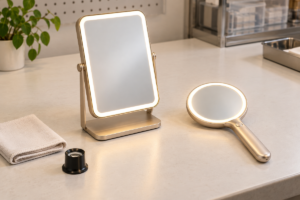
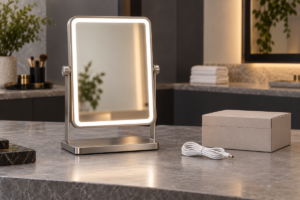
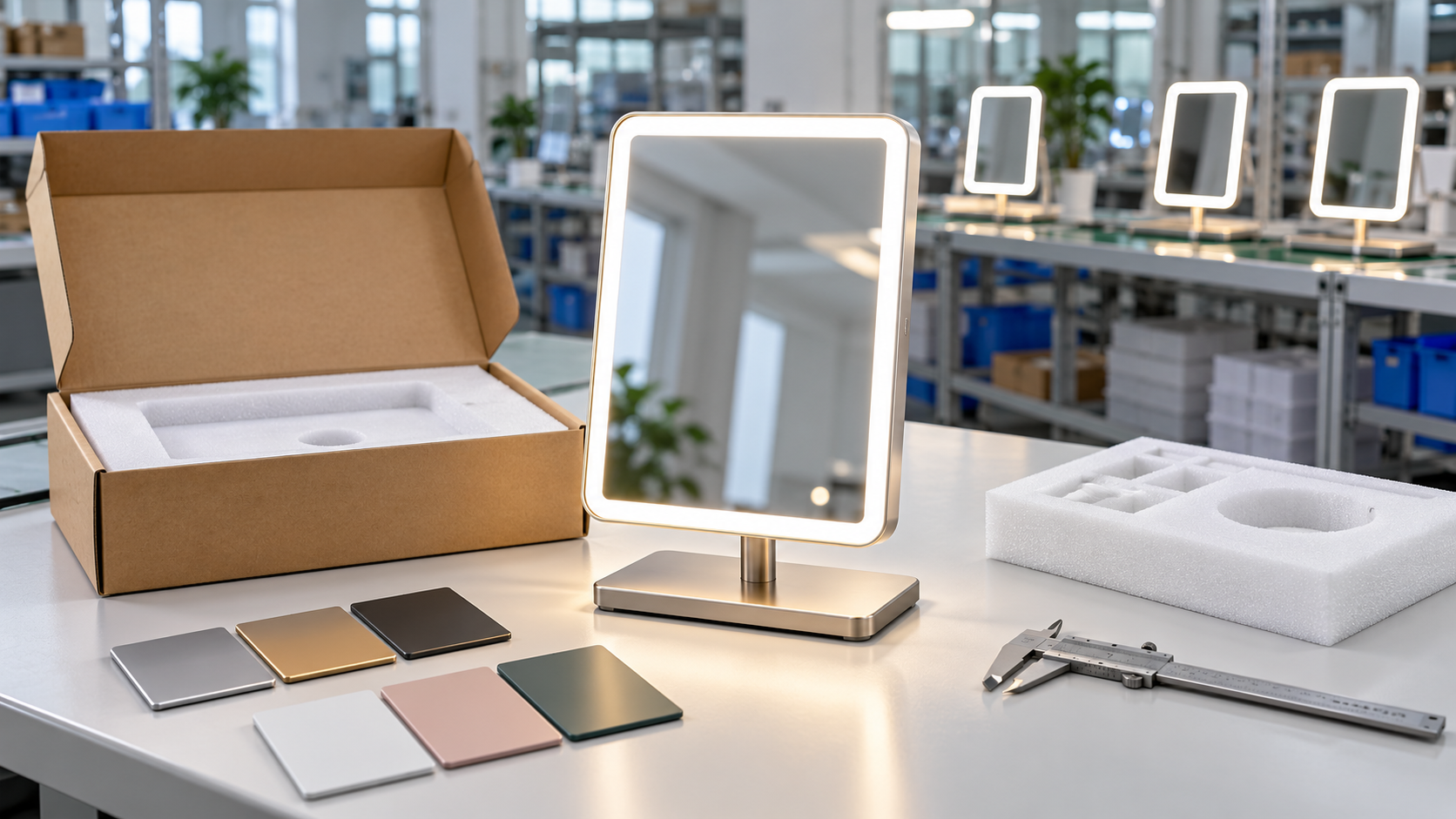
*Images in this article are conceptual illustrations, not photographs of a specific Mingda product.*
OEM vs ODM makeup mirrors: what is the buyer difference?
An ODM makeup mirror starts from a supplier-developed platform. The buyer may select available sizes, finishes, lighting settings, packaging or branding options, subject to the supplier’s technical and commercial limits. This can shorten sampling because the core design has already been developed.
An OEM makeup mirror is manufactured to the buyer’s approved specification. That specification can range from a modest adaptation of an existing model to a new appearance, mechanical structure, electronics, packaging and tooling program. OEM needs a more disciplined brief because a sketch, reference image or target price does not define a production-ready product.
| Decision point | ODM platform | OEM program |
|---|---|---|
| Starting point | Existing supplier model or shared platform | Buyer-approved product specification |
| Typical customization | Available color, logo, pack, accessory or configured feature options | Appearance, structure, electronics, materials, packaging and tooling can be defined for the approved model |
| Development work | Confirm selected options and production reference sample | Engineering review, samples, validation and potentially new tooling |
| Main buyer risk | Assuming a catalog option is unchanged or exclusive | Leaving decisions and ownership terms undefined before development starts |
| Best fit | A time-sensitive launch with a proven format | A differentiated range that needs controlled product identity |
Neither route is automatically lower risk. An ODM sample can still have different lead time, availability or component options than the buyer expects. An OEM project can still use common parts where that makes commercial sense. Ask the supplier to identify the exact base model, revision and options in the quotation rather than relying on the words OEM or ODM alone.
When should a buyer choose an ODM makeup mirror?
Choose ODM when the sales proposition depends more on reliable execution than a wholly new product architecture. A retailer might need a complete lighted tabletop mirror with a selected finish, retail box and approved accessory set. An e-commerce seller may need to validate packed dimensions, charging behavior, product images and fragile-product protection before launch. In these cases, an available platform can reduce development unknowns—if the buyer still verifies the complete delivered configuration.
Before approving an ODM route, request the current sample and a written option list. Confirm the mirror size, magnification, lighting modes, power input, cable or adapter arrangement, finish, logo location, retail packaging and master-carton configuration. For a rechargeable model, separately confirm the battery specification and route-specific transport documentation; do not infer it from a similar-looking sample.
Also agree on change notification. An ODM platform may evolve as components become unavailable or as a supplier improves a design. State which changes require buyer approval and retain a signed reference sample. This is especially important when a brand has already invested in listing photography, instructions or replacement parts.
When does OEM make commercial sense?
OEM makes sense when the product itself is part of the buyer’s competitive position: a distinct shape, stand, mirror size, light behavior, storage feature, material story or packaging experience that cannot be achieved through an existing option set. It can also suit a project buyer who must control dimensions, mounting interface or service-part compatibility for a defined installation.
The buyer should first test the business case. Ask whether the expected volume, margin and product-life plan can support engineering, samples, tooling, validation and the cost of a controlled spare-parts plan. Do not treat a low first-unit quote as the complete investment: tooling, artwork, test fixtures, certification work, packaging validation and revision rounds may each have separate timing or cost implications.
The approval gates that protect either route
The strongest procurement process uses the same discipline for ODM and OEM, with more detailed reviews for a custom program.
1. Commercial brief. State destination market, sales channel, target quantity, target retail position, launch window and the problem the product must solve. A target price is useful context, but it is not a specification. 2. Specification freeze. Record dimensions, glass and magnification, illumination, controls, power configuration, finishes, accessories, logo, instructions, retail pack and shipping pack. Link each item to a drawing, photo, approved chip or sample where possible. 3. Sample approval. Inspect the complete product, not just the mirror face: stability, reflection, light uniformity, control response, hinges or joints, charging or plug operation, accessory fit and packed presentation. Capture the approved revision. 4. Packing and route validation. Review the individual box, protective insert, carton configuration and marks required for the destination. Test the packed unit for the actual shipping and fulfillment route; a retail-ready box is not automatically parcel-ready. 5. Pre-production confirmation. Confirm the production reference, inspection plan, allowed tolerances, change-notification process, production timing and remedy for an unapproved deviation before mass production starts.
For useful context on factory readiness, see Mingda Mirror’s services. Buyers planning a new range can also compare the stock, private-label and OEM paths and use this custom mirror quotation guide to organize an RFQ.
Procurement mistakes to avoid
Calling a cosmetic change an OEM program without defining the base model
If a project begins with an existing platform, identify that platform and its current revision. Then list every requested change and mark whether it is an available option, a new component, a tooling change or an engineering question. This prevents a supplier and buyer from approving different assumptions under the same name.
Approving a sample before the packaging and accessories are final
The item a customer receives includes the mirror, cable or adapter where applicable, instruction set, retail pack and protective materials. Require a packed-product review before production approval. For online channels, align the test with the intended fulfillment route and compare against current marketplace requirements.
Leaving ownership and service terms for later
Where a project involves buyer-funded tooling, artwork or bespoke parts, put ownership, permitted use, storage, maintenance, replacement access and end-of-project arrangements in the agreement. For any customized model, decide how spare cables, adapters, glass, switches or other serviceable parts will be identified and supplied.
RFQ-ready questions for a mirror supplier
Send these decisions with the first RFQ to receive a more comparable answer:
- Is the preferred route an existing ODM platform, a modified platform or a full OEM design—and why?
- Which product features are fixed, which are selectable and which require engineering or tooling?
- What is the MOQ, sample timing and production lead time for each option, rather than one blended estimate?
- What tests, inspections and approvals apply to the complete packed product?
- Which destination-market electrical, labeling or transport documents may be relevant to the selected model?
- What is the process if a component, packaging material or approved finish changes after the sample is signed off?
- What happens to tooling, artwork files and approved production records at the end of the program?
Frequently asked questions
Is private label the same as OEM?
Not always. Private label often means branding an existing product or package. It may use an ODM platform, an OEM-developed product or a combination. Ask what is actually customized, what remains standard and whether any tooling or engineering work is included.
Does ODM always have a lower MOQ than OEM?
No universal rule applies. MOQ can change with the model, finish, packaging, components, destination requirements and supplier production plan. Request MOQ by variant and ask whether samples, mixed colors or revised packaging change it.
How long does a custom makeup mirror development take?
It depends on the scope and approval cycle. An available platform with a standard branding option can move differently from a new structure requiring tooling and validation. Ask the supplier for a milestone plan covering design review, samples, corrections, production approval and mass production—not only a final delivery date.
Can an OEM mirror use standard components?
Yes, where they meet the approved specification. Using proven common components can reduce development risk, but the buyer should document the exact approved component or performance requirement and the change-control process.
Bottom line
Use ODM for a controlled launch on an existing platform; use OEM when the buyer has a clear reason to invest in a differentiated, tightly specified product. In both cases, the real risk control is a signed product-and-packaging reference, explicit change approval and a quotation that separates standard options from development work. To compare the right path for your next range, contact Mingda Mirror with your market, sales channel, target quantity, reference product and launch timing.