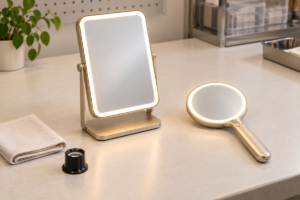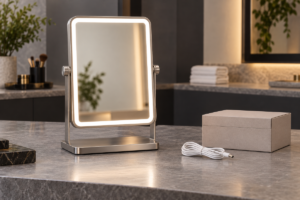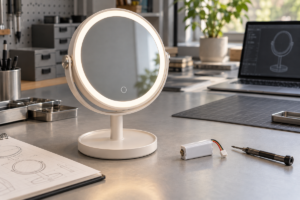

Wall-mounted rechargeable LED makeup mirrors should be sourced by checking five points before price negotiation: arm stability, lighting quality, battery and charging design, installation fit, and packaging protection. For retailers, Amazon sellers, salon suppliers, hotel bathroom buyers, and private-label brands, this product is not just a lighted mirror with a wall bracket. It is a moving, rechargeable, wall-installed product that can create return risk if the arm drifts, the battery claim is unrealistic, the USB port is poorly protected, or the carton does not protect the hinge and glass.
The best buying decision starts with a clear use scenario, a sample approval test, and an RFQ that defines product structure, charging standard, packaging, and QC acceptance criteria.
Why This Mirror Type Needs a Different Buying Checklist
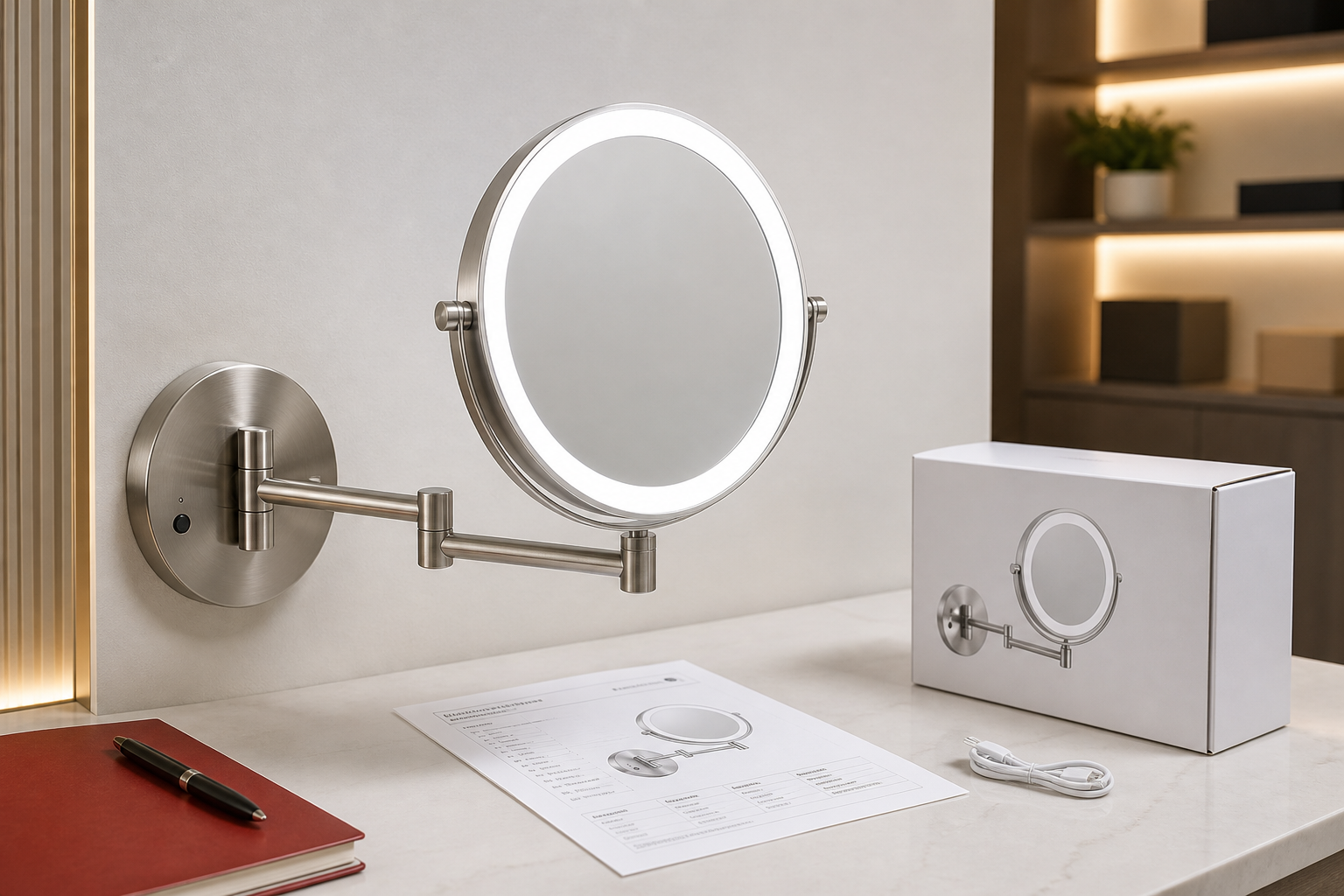
A tabletop LED makeup mirror is usually judged by size, brightness, magnification, battery runtime, and packaging. A wall-mounted rechargeable LED makeup mirror adds more variables: the arm must stay stable after repeated extension, the wall plate must match the installation surface, the mirror head should rotate smoothly, and the charging port must be easy to reach.
This is why a normal beauty-mirror buying checklist is not enough. The buyer should evaluate the product as a combined mirror, lighting, battery, hinge, wall bracket, and packaging system.
For e-commerce sellers, the main risk is a mismatch between listing claims and real user experience. For salons and hotel projects, the risk is different: installation problems, loose arms, inconsistent lighting comfort, and replacement difficulty after the product is already mounted. For retailers and distributors, packaging, spare parts, and shelf presentation also affect margin.
Useful internal references for buyers include Mingda Mirror’s makeup mirror product range, OEM and ODM customization service, quality control process, and contact page.
Match the Product to the Sales Channel First
Before requesting a quotation, decide where the mirror will be sold or installed. The same product structure may not fit every channel.
| Buyer channel | Better product direction | Main sourcing risk | What to confirm before RFQ |
|---|---|---|---|
| Amazon or marketplace seller | Compact arm, clear USB-C charging, strong packaging, simple manual | Return risk from weak battery claims or unstable arm | Runtime test, charging cable, carton drop protection, listing-safe claims |
| Retail chain | Premium finish, attractive box, reliable demo sample, stable replenishment | Shelf damage, unclear feature communication, barcode or packaging errors | Packaging artwork, barcode position, MOQ by color, replacement allowance |
| Salon supplier | Durable hinge, easy cleaning, strong wall plate, comfortable brightness | Arm drift and frequent adjustment wear | Hinge cycle test, mounting hardware, finish durability, spare parts |
| Hotel or apartment project | Consistent finish, installation drawing, serviceable parts, clear lead time | Installation mismatch and room-by-room replacement cost | Wall type, screw kit, charging access, sample approval before rollout |
| Private-label beauty brand | Customized finish, logo, gift box, manual, market-positioned feature set | Over-customization before product structure is proven | Approved sample, packaging dieline, MOQ, lead time, QC standard |
If the buyer cannot define the channel, the supplier can only quote a generic product. Later changes in arm length, plating, battery size, packaging, or accessories affect cost and lead time.
Check Arm Stability, Hinge Strength, and Wall Plate Design
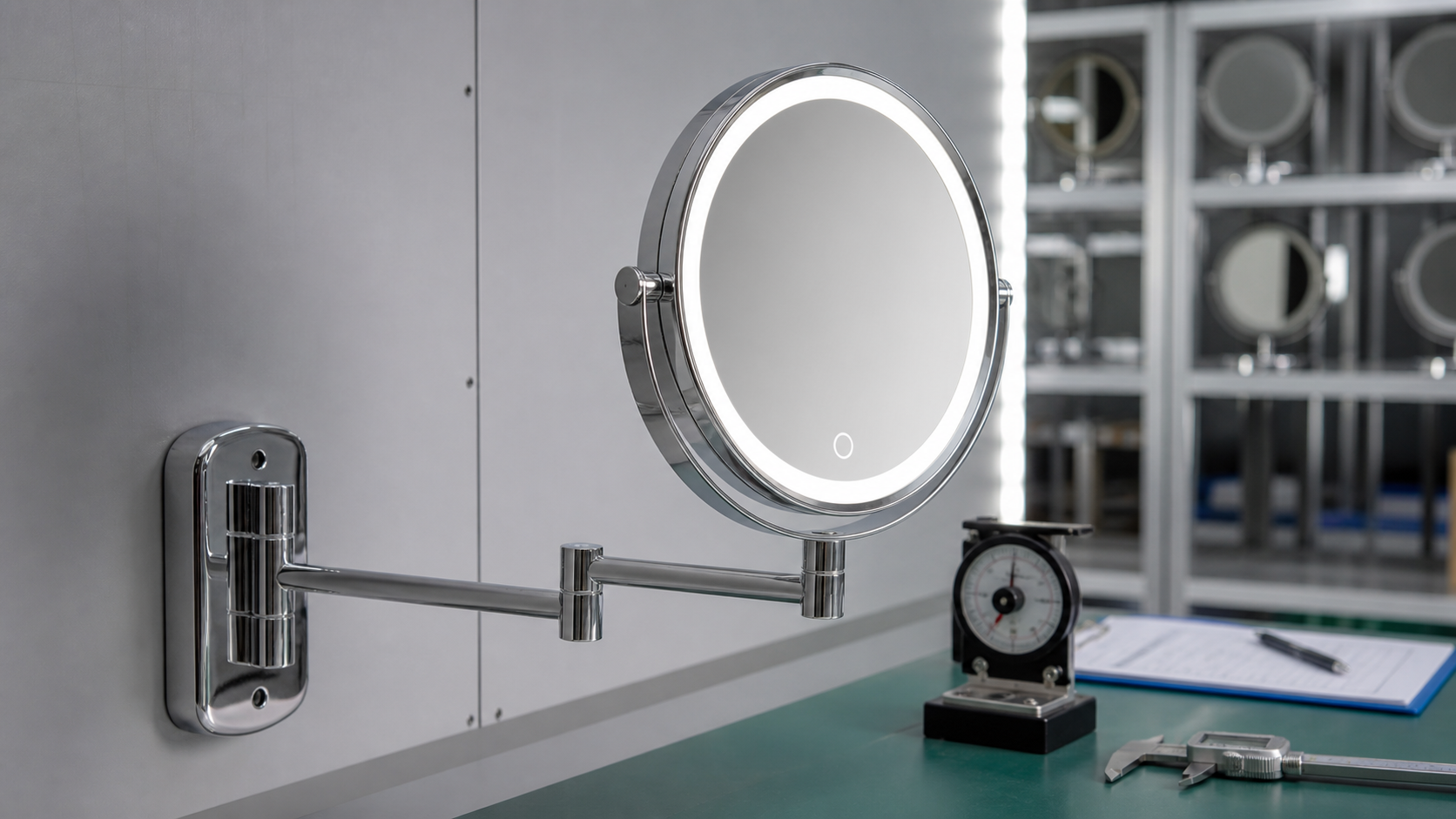
The arm is the highest-risk mechanical part because users adjust it repeatedly. During sample approval, extend the arm fully, rotate the mirror head, fold it back to the wall, and check whether the mirror stays in position without drifting.
Ask the supplier to confirm:
- Arm extension length and folded depth from the wall.
- Mirror head diameter and product weight.
- Hinge structure and tightening method.
- Wall plate size, screw spacing, and mounting hardware.
- Angle-holding performance after repeated movement.
- Whether the hinge can be tightened or replaced if it loosens.
For hotel and salon buyers, arm stability matters more than a slightly lower unit price. A loose hinge after installation creates service calls and replacement labor.
Define Lighting Quality Before Accepting Brightness Claims
Many suppliers describe LED mirrors with vague terms such as bright, dimmable, or natural light. B2B buyers should request measurable lighting details instead: CCT, brightness level, dimming method, light diffusion, glare control, and color rendering.
For retail and e-commerce channels, buyers should avoid listing claims that the approved sample cannot repeat in bulk production. If the product says three-color light, confirm the actual warm, neutral, and cool light ranges. If it says stepless dimming, test whether the touch control is smooth and whether the memory function works consistently.
For salon or hotel buyers, lighting comfort is more important than maximum brightness. Test face-level glare, reflection comfort, and LED ring uniformity in a similar room environment.
Battery, USB-C Charging, and Runtime: What Buyers Should Test
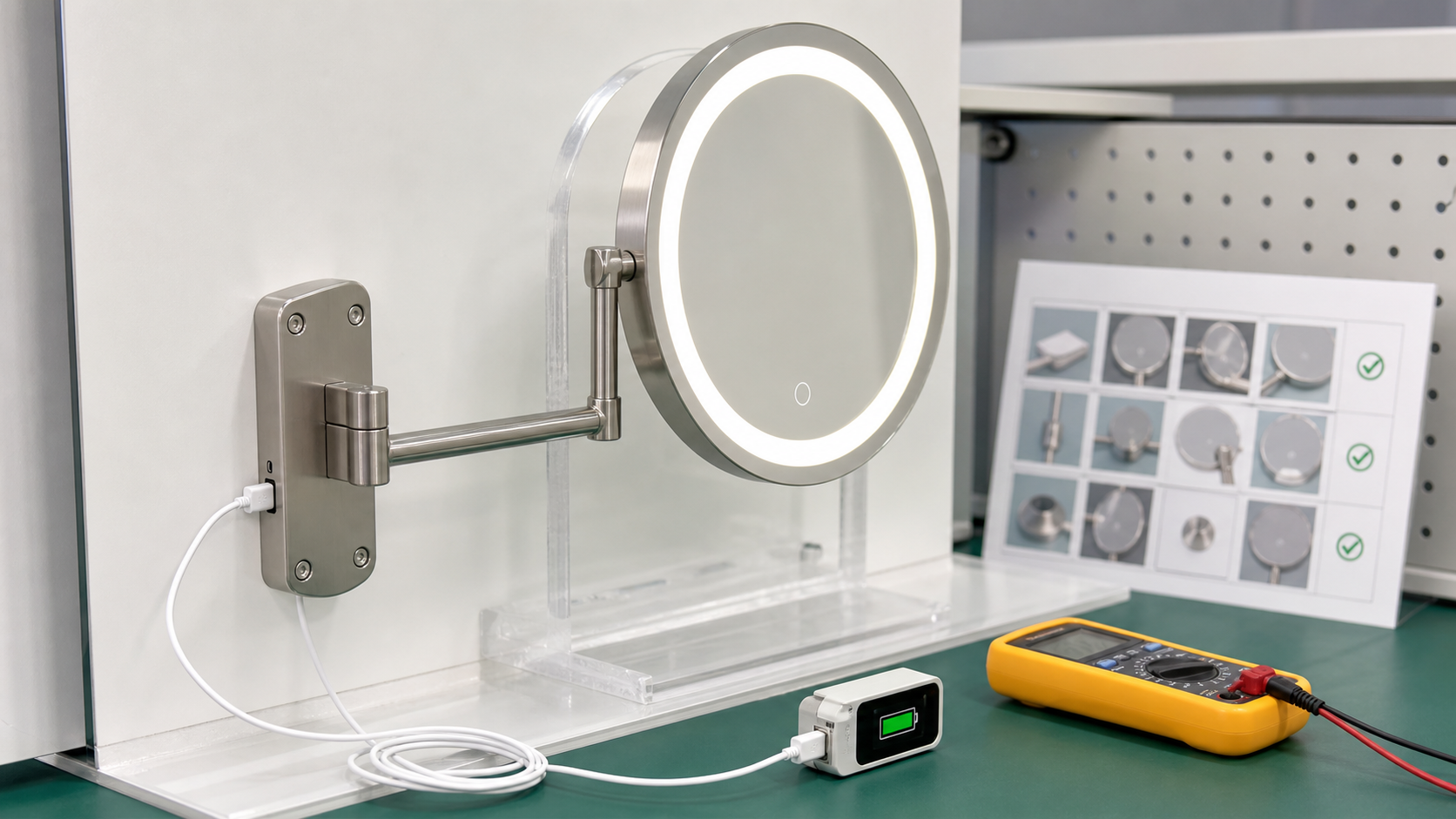
Rechargeable mirrors reduce visible wiring and improve installation flexibility, but they also add QC requirements. The battery, charging board, cable, touch control, and LED ring must work as one system.
Buyers should request charging and runtime data under defined conditions. A claim such as “works for several hours” is not RFQ-ready. Instead, define:
- Battery capacity and approved cell type.
- Charging port type, usually USB-C for newer product lines.
- Input rating and recommended adapter.
- Full charging time.
- Runtime at low, medium, and high brightness.
- Whether the mirror can be used while charging.
- Low-battery indicator behavior.
- Battery protection and shipment documentation requirements.
The test condition matters. A mirror may run much longer at low brightness than at maximum brightness. If the sales sheet only shows best-case runtime, e-commerce reviews and hotel or salon operations can suffer.
Installation Details Buyers Should Not Leave Until After Sampling
Wall-mounted rechargeable mirrors are easier to place than hardwired bathroom mirrors, but they still need installation planning. Confirm the wall type, screw kit, wall plate, charging access, and user instructions before mass production.
For retail and e-commerce orders, the package should include a simple installation manual, screw bag, anchors, charging cable, and any required accessory pouch. For hotel or apartment projects, buyers should request installation drawings with wall plate dimensions, folded depth, extended depth, and recommended mounting height.
If the product is used near a bathroom vanity, confirm whether the material, electrical structure, and warranty language match the intended environment. A rechargeable wall-mounted makeup mirror is not automatically the same as a wet-area bathroom mirror.
Packaging Must Protect the Mirror, Arm, and Wall Plate
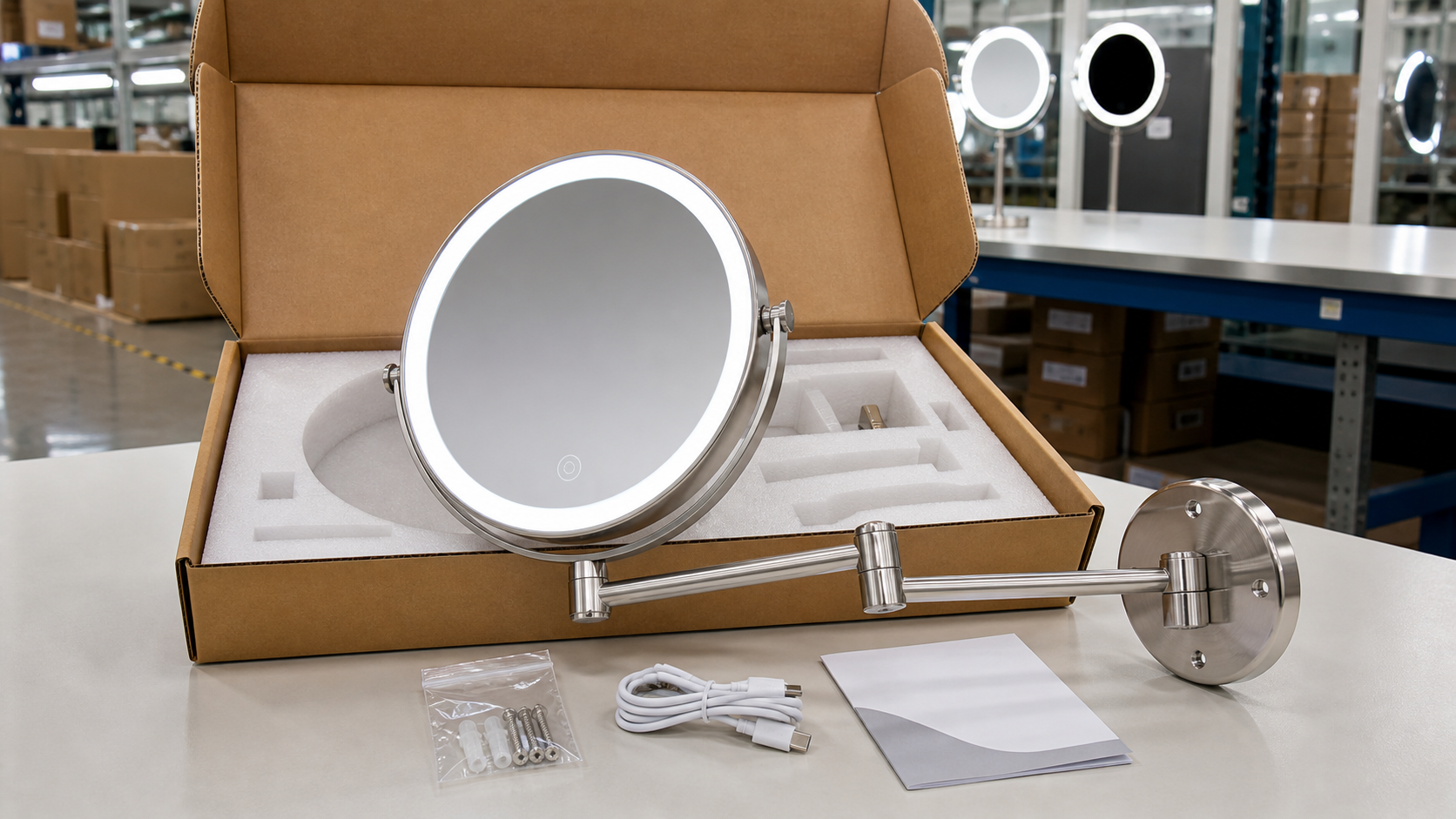
The most fragile areas are not only the glass. The arm, hinge, wall plate, and LED ring can be damaged when the product moves inside the carton. A good package holds the mirror head and arm separately, protects the finish, and prevents the wall plate from pressing into the glass.
Before approval, ask for a packed sample rather than only a product sample. Inspect:
- Molded foam or paper-pulp structure around the mirror head.
- Separate space for arm, wall plate, screws, and cable.
- Scratch protection for chrome, nickel, black, gold, or custom finishes.
- Inner box strength for retail shelves or e-commerce parcel delivery.
- Master carton quantity, carton weight, and pallet plan.
- Barcode, warning label, instruction booklet, and accessory bag placement.
For Amazon and e-commerce sellers, packaging should be designed for parcel handling, not only container shipment. For retail buyers, the box must communicate key features without overpromising battery or brightness performance.
Sample Approval Checklist Before Bulk Order
Use the sample stage to freeze the specification. Do not rely on a quotation sheet alone.
| Checkpoint | What to test | Approval result buyers need |
|---|---|---|
| Arm stability | Extend, fold, rotate, and hold at common use angles | No drifting, shaking, scraping, or loose joint feeling |
| Wall mounting | Check wall plate, screws, anchors, folded depth, and mounting height | Installation parts match the target channel |
| Lighting | Test CCT, dimming, glare, LED uniformity, and touch response | Lighting matches listing or project requirement |
| Charging | Test USB-C port, cable, charging time, runtime, and use while charging | Battery claim is realistic and repeatable |
| Finish | Inspect plating, coating, fingerprints, scratches, and color consistency | Finish matches approved sample and buyer positioning |
| Packaging | Review foam, accessory bag, manual, barcode, carton, and drop-risk points | Product cannot move freely inside package |
| Documentation | Confirm manual, charging warnings, SKU label, QC report, and test records | Buyer has evidence for sales, compliance, and claims |
The approved sample should become the control sample for production. Any later change to battery, LED board, arm structure, finish, or packaging should be recorded before mass production.
Common Buying Mistakes
Common mistakes include choosing the longest arm without testing hinge stability, focusing on battery capacity without checking real brightness and runtime, approving the product and packaging separately, and copying consumer-facing claims into the purchase order without supplier confirmation. Claims about brightness, runtime, magnification, bathroom use, or fast charging should be based on the approved sample and test conditions.
RFQ-Ready Information to Send the Supplier
A strong RFQ should include:
- Target market and sales channel.
- Mirror diameter, magnification requirement, and finish preference.
- Arm length, folded depth, and mounting surface.
- LED CCT, dimming method, brightness expectation, and touch-control functions.
- Battery capacity target, charging port, cable, and runtime requirement.
- Logo, manual, color box, barcode, and accessory bag requirements.
- Packaging route: retail shelf, e-commerce parcel, wholesale carton, or project delivery.
- Sample quantity, inspection standard, order quantity, and expected delivery schedule.
Mingda Mirror can then recommend whether an existing model, modified ODM model, or custom OEM development is more suitable.
Review the First Month Before Reordering
At the first-month review, separate delivered units, installed units, and units actually in service. Record arm drift, mounting problems, charging complaints, packaging damage, and confirmed defects by SKU and production lot. Keep the observation period and denominator with each rate; a complaint count without exposure data cannot establish reliability.
For returned samples, reproduce the reported issue using the approved mounting arrangement, extension position, cable, power source, and light setting. Separate installation mismatch from confirmed product defects, record repair or replacement time, and assign an owner and due date for corrective action. Agree with the buyer which unresolved issues must be closed before the next order.
Carry the findings into the next LED makeup mirror inspection report checklist. Preserve the approved product and packaging revision so the next lot is checked against the corrected configuration.
Bottom-Line Recommendation
For B2B buyers, the safest wall-mounted rechargeable LED makeup mirror is not simply the brightest or cheapest option. Choose the model that matches the sales channel, holds its arm position after repeated use, has realistic charging and runtime claims, installs cleanly, and ships in packaging that protects the whole mirror system.
For Amazon or e-commerce, prioritize packaging, clear USB-C charging claims, and review-risk control. For salons or hotels, prioritize hinge durability, finish consistency, installation drawings, and replacement support. For private-label retail, confirm the sample, packaging artwork, MOQ, and lead time before adding custom colors or gift-box upgrades.
FAQ
What MOQ should buyers expect for wall-mounted rechargeable LED makeup mirrors?
MOQ depends on whether the buyer chooses an existing model or requests custom finish, logo, packaging, battery, or structure changes. Existing models usually allow easier trial orders, while custom finishes or packaging require higher MOQ because materials and printing must be prepared separately.
Is USB-C always better than Micro-USB for rechargeable wall-mounted mirrors?
USB-C is usually more suitable for newer retail and e-commerce product lines because customers recognize it and replacement cables are easier to find. Buyers should still confirm charging board quality, cable specification, input rating, and runtime instead of judging only by the port shape.
Can a rechargeable wall-mounted makeup mirror be used in bathrooms?
It depends on the product design and intended environment. Buyers should not assume every rechargeable makeup mirror is suitable for wet bathroom use. Confirm material, electrical design, manual wording, installation location, and warranty limits before positioning it for bathroom projects.
What should be checked during sample approval?
Check arm stability, wall plate fit, lighting comfort, dimming response, charging behavior, battery runtime, finish quality, packaging protection, accessory completeness, and instruction clarity. The packed sample should be approved before mass production.
How should buyers prepare a private-label quotation request?
Send the target channel, order quantity, product size, magnification, finish, lighting modes, battery requirement, logo position, packaging type, barcode needs, inspection standard, and delivery market. This helps the supplier quote realistic cost, MOQ, and lead time.
Request a Wall-Mounted LED Makeup Mirror RFQ
If you are planning a wall-mounted rechargeable LED makeup mirror line for retail, e-commerce, salon supply, hotel bathrooms, or private-label beauty products, share your target channel, mirror size, arm requirement, battery expectation, finish, packaging, and order quantity with Mingda Mirror. The team can help review the specification, prepare samples, and quote an RFQ-ready solution.
Contact Mingda Mirror through the RFQ page to discuss your wall-mounted LED makeup mirror project.
Social Media Content Ideas
LinkedIn angle: Explain why arm stability and battery claims should be approved together before sourcing wall-mounted rechargeable LED makeup mirrors.
Facebook angle: Share a buyer-friendly checklist for choosing a wall-mounted LED makeup mirror that will not create packaging or charging complaints.
Instagram angle: Use the packaging approval or QC bench visual to show how a premium wall-mounted mirror is tested before bulk orders.
CTA: Read the full buying guide and send your channel, size, arm, battery, and packaging requirements for an RFQ.