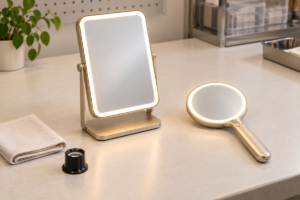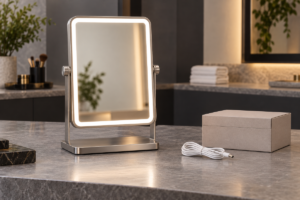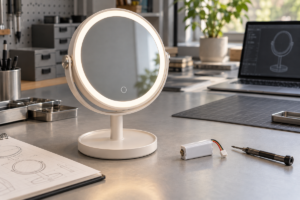

LED tabletop makeup mirror hinge and stand stability should be approved with repeatable tests, not a quick visual check. For a retail, beauty-brand, or e-commerce order, the mirror head must hold its selected angle, the base must resist tipping during touch-control use, and the joint must remain smooth after repeated adjustment. Buyers should define angle-holding, operating-force, cycle, wobble, and packaging checks in the sample approval sheet. This prevents a common bulk-order problem: an attractive illuminated mirror that gradually droops, shakes during makeup use, or arrives with a loose joint.
For buyers building an LED makeup mirror line, mechanical stability affects perceived quality as much as brightness or battery runtime. A weak hinge generates poor reviews even when the LEDs work perfectly. It also increases replacement cost because hinge complaints are difficult to repair after delivery.
Why hinge and base performance matter commercially
A tabletop mirror is adjusted frequently and often operated with one hand. The user tilts the head, taps the touch sensor, rotates the mirror, or moves it across a vanity. Each action loads the hinge, stem, fasteners, and base differently.
Retail buyers need a sample that still feels premium after customers handle it on display. E-commerce sellers need enough stability to survive parcel delivery and everyday adjustment without creating return claims such as “mirror will not stay up” or “base feels cheap.” Beauty brands also need the movement quality to match their intended price position.
Mechanical failures usually come from one of five areas:
- hinge torque is too low, so the mirror head slowly falls;
- torque is too high, so adjustment feels stiff and stresses the housing;
- the base footprint or weight is insufficient for the mirror head;
- fastener tolerance varies between samples and mass production;
- packaging allows the joint to carry impact during transportation.
Define the buyer scenario before setting the test
The correct stability target depends on the product format and channel. A compact rechargeable mirror for travel may accept a lighter base because portability is important. A larger tabletop mirror for a premium vanity line needs a wider or heavier base and smoother controlled movement. A double-sided mirror places different loads on its pivot than a slim single-sided LED ring mirror.
| Buyer scenario | Main mechanical priority | Practical sourcing tradeoff | Approval focus |
|---|---|---|---|
| Premium retail display | Smooth movement and strong perceived quality | Heavier metal parts raise cost and freight | Consistent feel across samples and display cycling |
| E-commerce parcel sales | Angle holding plus shipping resistance | Stronger insert may increase pack size | Drop-test inspection and post-shipment hinge check |
| Travel or gift SKU | Low weight and compact structure | A light base reduces tipping margin | Touch-operation stability and folded-joint protection |
| Salon or frequent-use setting | High adjustment-cycle durability | Stronger joint may feel firmer initially | Cycle test, fastener retention, and replaceability |
The supplier should not copy one torque setting across all structures. Mirror-head weight, center of gravity, pivot diameter, friction material, stem height, and base geometry all change the result.
Build a repeatable hinge torque approval method
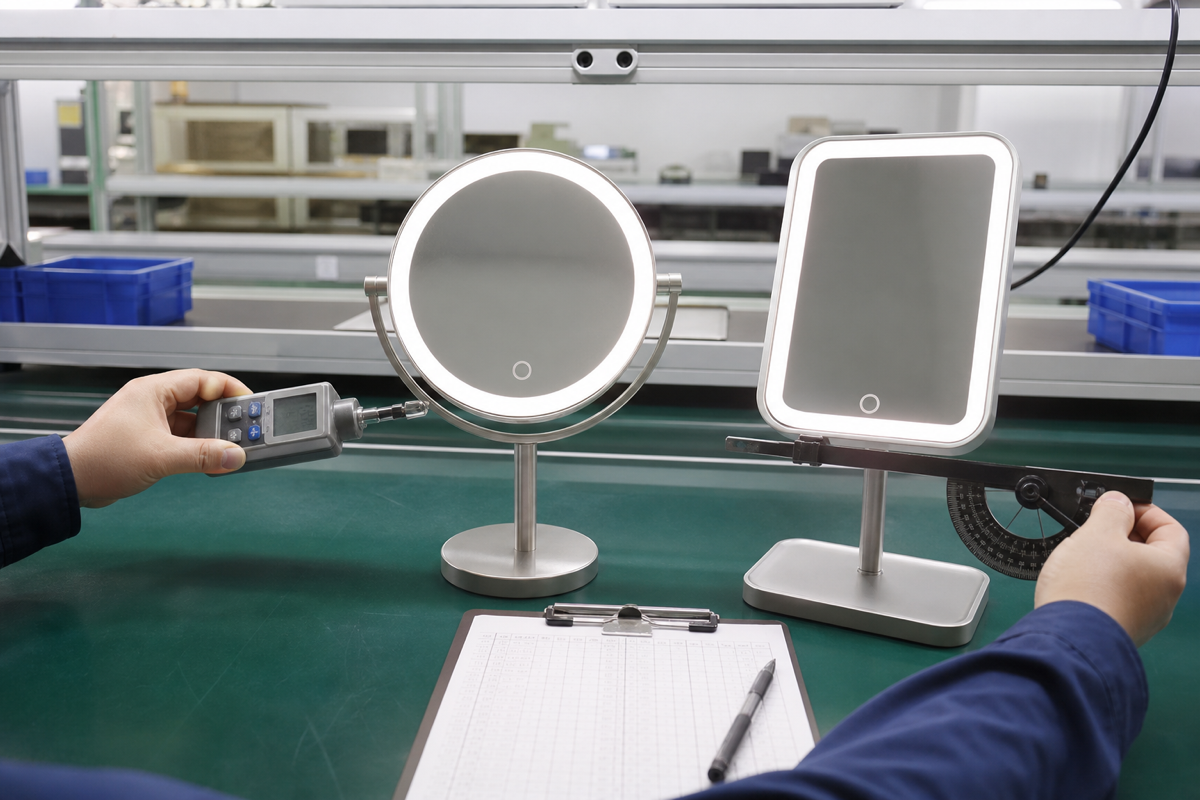
Start by agreeing on the usable tilt range. Mark several positions, such as near-vertical, mid-angle, and the most demanding forward tilt. Place the sample on a level surface, move it to each position, and observe whether the head changes position over a defined period. A supplier can then record the operating force or torque with suitable equipment and create an approved range rather than relying on “tight enough.”
The goal is not the highest possible torque. Excessive resistance can crack plastic hinge bosses, loosen threaded inserts, deform decorative covers, or make the product feel difficult to use. The target is a controlled band: firm enough to hold the head, but smooth enough for normal one-hand adjustment.
Buyers should request data from several samples, not one golden sample. Check units from different cavities, assembly operators, or production times when possible. A wide spread between samples is a warning that spring force, washers, fastener tightening, or molding tolerance is not controlled.
Test stand stability and touch-control use
Hinge approval alone does not prove the complete mirror is stable. Test the assembled unit on representative vanity surfaces. Tap the touch sensor at the upper, side, and lower areas of the mirror. Adjust the head through its full usable range. The base should remain flat, the stem should not flex noticeably, and the mirror should settle quickly without prolonged shaking.
Review these construction details with the supplier:
- base width and depth relative to mirror-head size;
- base weight and internal weight retention;
- anti-slip pad material, contact area, and adhesive quality;
- stem-to-base fastener design and anti-loosening method;
- hinge pin, washer, spring, and friction material specification;
- housing support around the joint and screw bosses.
A larger base improves stability but can increase carton size and freight. Added metal weight can improve perceived quality but may conflict with travel positioning. Buyers should therefore approve the complete product-and-packaging system, not one isolated component.
Use cycle testing to expose gradual loosening
A new sample may pass an angle-holding test and still loosen after repeated use. Define an adjustment cycle that moves the mirror through its intended range and back. Inspect at planned intervals for torque loss, squeaking, surface wear, cracking, fastener movement, wire interference, and changes in the mirror-head position.
The cycle count should reflect the channel, warranty expectation, and price tier. More important than quoting an impressive number is agreeing on the same test speed, travel range, load, acceptance limit, and post-test inspection for both sample approval and production QC.
If power wires pass through the hinge or stem, cycle testing should also confirm that tilting does not pinch, twist, or fatigue the cable. Recheck lighting, dimming, charging, and color-temperature switching after the mechanical test.
Control mass-production variation
Convert the approved sample into a measurable control plan. The bill of materials should lock the hinge parts, washers, lubricants, springs, fasteners, base weight, and anti-slip pads. Assembly instructions should define tightening method and inspection points. Production inspectors should test a sample from each lot using the same angle-holding and touch-stability method.
Ask the supplier to record failures by type rather than only reporting a pass rate. Drooping, excessive stiffness, lateral play, base rocking, loose stem, and cosmetic damage have different root causes. Separate data makes corrective action faster and helps buyers judge whether a problem is isolated or systemic.
Packaging must protect the approved torque
The hinge can leave the factory correctly adjusted and arrive loose if the packaging lets the mirror head move or places impact load on the joint. The inner insert should support the head and base independently, restrict movement, and prevent accessories from contacting the mirror surface.
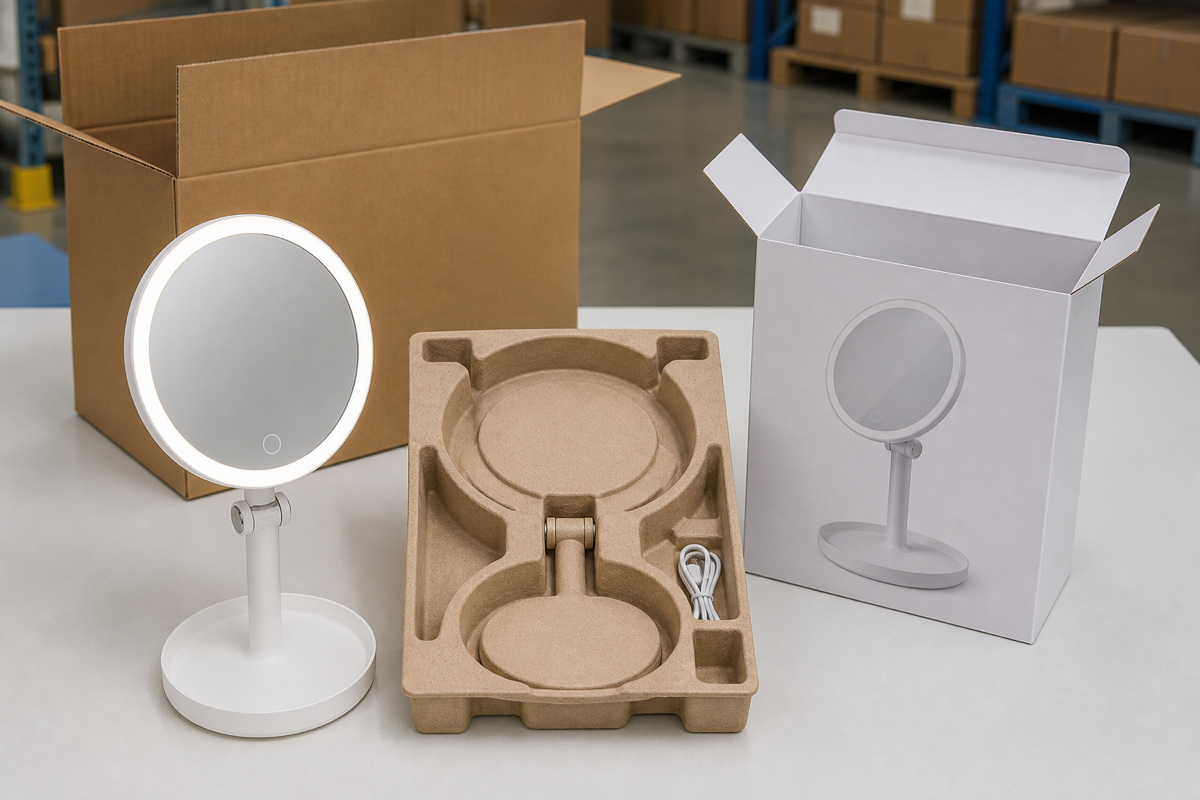
After packaging drop or vibration testing, remove the product and repeat the angle-holding, touch-operation, base-rocking, lighting, and charging checks. For e-commerce programs, test the retail pack inside the actual shipping configuration. A decorative color box alone may not provide sufficient parcel protection.
Pre-RFQ checklist for buyers
Before requesting a firm quotation, send the supplier these requirements:
- product format, mirror-head size, stem height, base footprint, and target weight;
- intended channel, retail price position, and expected adjustment frequency;
- required tilt or rotation range and preferred movement feel;
- angle-holding positions, observation time, and acceptable movement;
- cycle-test method and post-test acceptance criteria;
- base stability and touch-control test conditions;
- anti-loosening, washer, pad, and internal-weight requirements;
- packaging insert, carton, drop, and vibration test expectations;
- sample quantity, approval timing, production inspection level, and replacement policy.
These details allow suppliers to quote the correct structure and QC process. Without them, two quotations may describe visually similar mirrors but include very different hinge parts, base weights, packaging protection, and failure risk.
Bottom-line recommendation
For bulk LED tabletop makeup mirror orders, approve hinge torque and stand stability as measurable product specifications. Test several samples at multiple angles, include touch-operation and cycle checks, lock the mechanical parts in the production standard, and repeat the stability test after packaging validation. Choose the lightest structure only when it still meets the intended channel’s durability and return-risk target.
Mingda Mirror can help brands, retailers, and e-commerce buyers review LED tabletop makeup mirror structure, lighting, rechargeable power, private-label packaging, and QC requirements as one controlled program. Explore our OEM/ODM services and quality-control process, or contact Mingda with your target size, channel, order quantity, packaging route, and stability expectations for an RFQ-ready proposal.
FAQ
What causes an LED tabletop makeup mirror to droop?
Common causes include insufficient hinge friction, inconsistent washers or springs, loose fasteners, plastic deformation, excessive mirror-head weight, and production tolerance variation. Packaging impact can also change a joint that passed factory inspection.
Is a heavier base always better?
No. More weight can improve tipping resistance and perceived quality, but it increases material cost and freight. The base should provide adequate stability for the mirror size, stem height, touch location, and channel without unnecessary shipping weight.
How should buyers compare hinge samples from different suppliers?
Use the same mirror angle, operating-force method, observation time, cycle range, surface, and post-test acceptance criteria. Compare several units per supplier and record variation, not just the best sample.
Should hinge stability be checked after a drop test?
Yes. Recheck angle holding, lateral play, base rocking, lighting, charging, and cosmetic condition after the packaged product completes the agreed transport test. This confirms that packaging protects the mechanical setting through delivery.
What should be locked before bulk production?
Lock the hinge construction, friction parts, fasteners, tightening method, base weight, anti-slip pads, usable angle range, cycle-test criteria, packaging insert, inspection frequency, and approved sample reference.