
For a first bulk order of LED tabletop makeup mirrors, buyers should choose one hero SKU that is easy to sell, easy to explain, and stable in production before expanding into a wide assortment. The safest starting point is usually a rechargeable LED tabletop mirror with comfortable neutral lighting, practical magnification, a stable base, USB-C charging, reliable packaging, and private-label readiness. This reduces review risk, avoids slow-moving variants, and gives the buyer a clean sample approval path before placing larger repeat orders.
This guide is written for beauty brands, Amazon and e-commerce sellers, retailers, distributors, and wholesalers preparing a first RFQ or first private-label purchase for LED tabletop makeup mirrors.
Why the First SKU Matters More Than a Large Assortment
Many new buyers ask for several mirror sizes, finishes, magnification levels, and packaging versions at the same time. That feels like a complete product line, but it can create problems before the market has proven demand. More SKUs mean more sample cost, more packaging versions, more inventory pressure, more photo assets, and more chances for quality details to vary.
For a first bulk order, the goal is not to show every possible option. The goal is to launch a SKU that can earn customer trust, generate clear reviews, and provide enough sales data for the second order. A strong first SKU should answer one buyer scenario clearly: daily vanity use, travel-friendly use, gift retail, salon counter use, or e-commerce private-label sale.
For most beauty and e-commerce buyers, Mingda recommends starting with a mainstream rechargeable LED tabletop makeup mirror rather than a complex multi-SKU range. Once the first model performs well, the buyer can add a compact travel version, a larger premium version, or a wall-mounted option based on channel feedback.
Start With the Sales Channel, Not the Mirror Shape
The right LED tabletop makeup mirror depends on where it will be sold and how customers will judge it.
| Sales channel | First-order SKU priority | Recommended mirror direction | Main risk to control |
|---|---|---|---|
| Amazon or marketplace | Review stability and return reduction | Rechargeable mirror with simple controls and strong packaging | Battery complaints, weak charging cable, broken mirror in delivery |
| Beauty brand DTC | Brand feel and unboxing quality | Premium finish, clean logo placement, gift-ready packaging | Packaging looks generic or product does not match brand positioning |
| Retail chain | Shelf clarity and price tier | One mainstream size with durable base and clear feature story | Too many variants confuse buyers and store staff |
| Distributor or wholesaler | Broad resale fit | Neutral color, standard magnification, reliable carton protection | Over-customized SKU limits resale channels |
| Salon or professional use | Daily operation durability | Stable tabletop structure with comfortable lighting and easy cleaning | Weak hinge, unstable base, glare, hard-to-clean surface |
This channel-first decision prevents a common sourcing mistake: choosing the mirror that looks most attractive in a supplier catalog but does not fit the buyer’s actual sales model.
Choose One Main Product Format
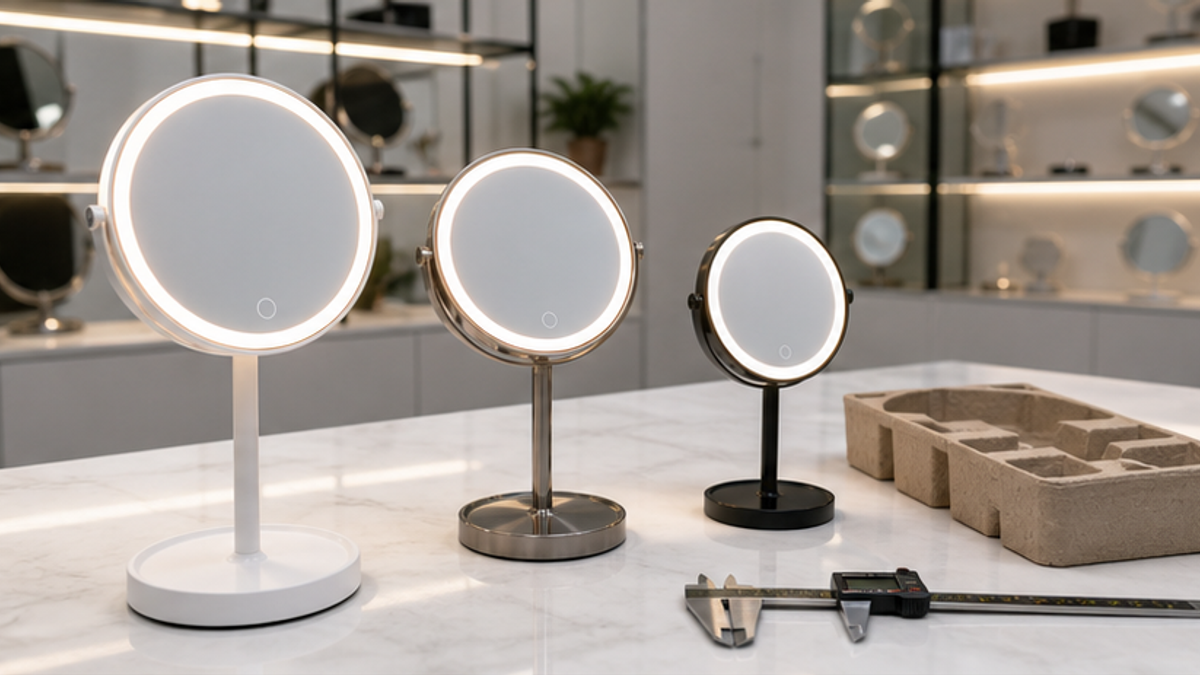
For first orders, the main format should be simple enough for repeat production and attractive enough for end customers. Buyers usually compare three LED tabletop makeup mirror directions.
Standard Rechargeable Round LED Tabletop Mirror
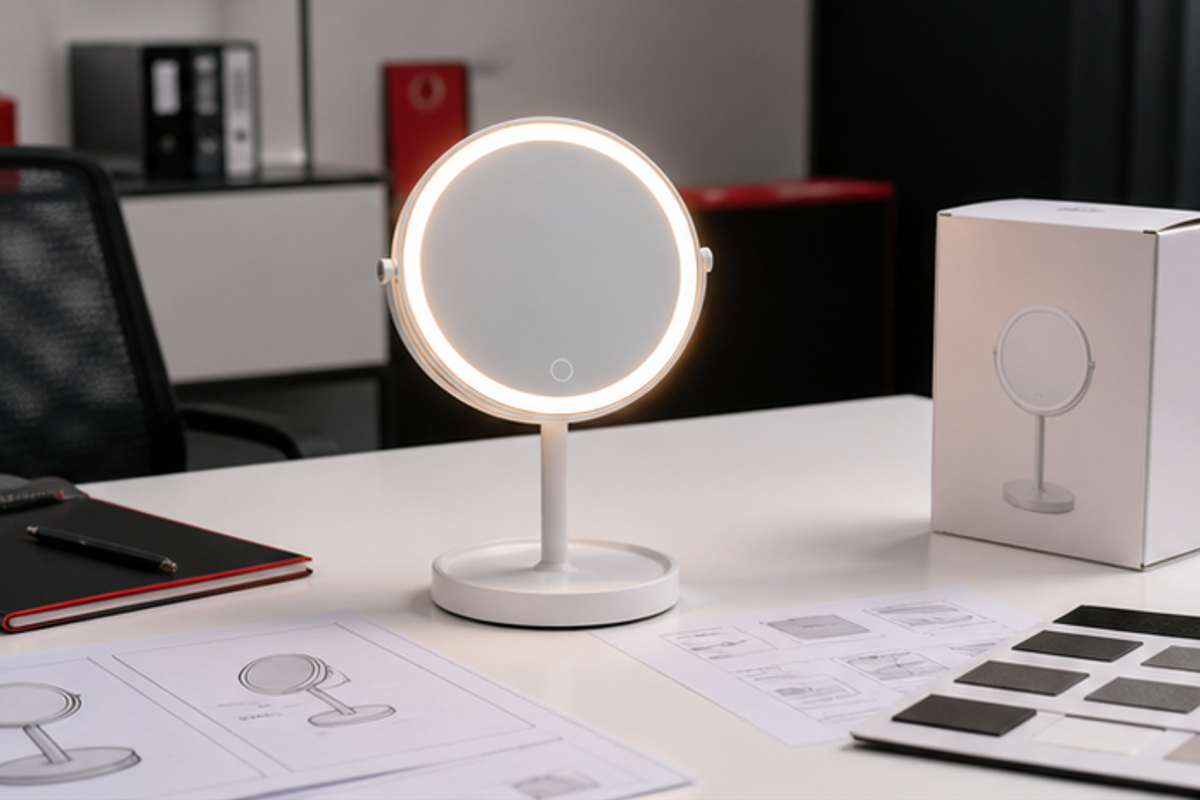
This is often the safest first SKU for beauty brands, Amazon sellers, and retail buyers. It is easy for shoppers to understand, works on vanity desks, supports gift positioning, and can be packed efficiently.
The buyer should confirm mirror diameter, base stability, LED diffusion, CCT options, dimming method, USB-C charging, battery capacity, and packaging protection. A clean round design also gives room for private-label logo placement on the base, back shell, manual, color box, or carton.
Compact Travel-Friendly Tabletop Mirror
A compact LED tabletop mirror can work well for travel, gift, and promotional channels. It may reduce shipping cost and storage space, but buyers must test whether the mirror still feels useful for daily makeup. If the mirror is too small, customer reviews may mention limited visibility or weak stability.
Compact models should be selected when portability and price point matter more than premium vanity presence.
Premium Larger Tabletop Mirror
A larger mirror can support a higher retail price and stronger product photography. It may fit beauty brands, influencers, salon counters, and premium DTC channels. The tradeoff is higher packaging cost, more breakage risk, and greater inventory value per unit.
For a first order, buyers should choose a larger SKU only when the brand positioning, shipping budget, and packaging structure are already clear.
Specification Decisions Buyers Should Lock Before RFQ
A first-order RFQ should not only say “LED makeup mirror.” It should define the specification decisions that affect price, quality, and buyer satisfaction.
Key specification points include:
- Mirror size: choose a practical viewing area for the target channel rather than only the lowest freight cost.
- Lighting: confirm CCT, brightness range, dimming control, LED diffusion, and whether memory function is needed.
- Color rendering: ask whether the light is suitable for makeup color judgment, especially for beauty-brand positioning.
- Magnification: decide whether the SKU is single-sided, double-sided, or includes a magnifying area.
- Power: confirm rechargeable battery, USB-C charging, cable quality, adapter inclusion, and destination-market expectations.
- Base and hinge: test whether the mirror remains stable when tilted and touched repeatedly.
- Finish: choose white, black, chrome, rose gold, brushed metal, or custom color based on channel positioning.
- Packaging: define gift box, e-commerce carton, molded pulp or foam insert, manual, warning label, and master carton.
- Compliance: clarify destination market, battery documents, electrical test expectations, and any retailer requirements.
The best first SKU is the one where these decisions can be approved cleanly during sampling. If a buyer cannot define these points, the supplier can only quote a rough product direction, not a reliable bulk order.
Battery, USB-C, and Lighting Checks Before Approval
Rechargeable LED tabletop makeup mirrors are popular because they remove cable clutter from the vanity desk and fit e-commerce product stories well. The same feature can also create complaints if battery and charging details are not controlled.
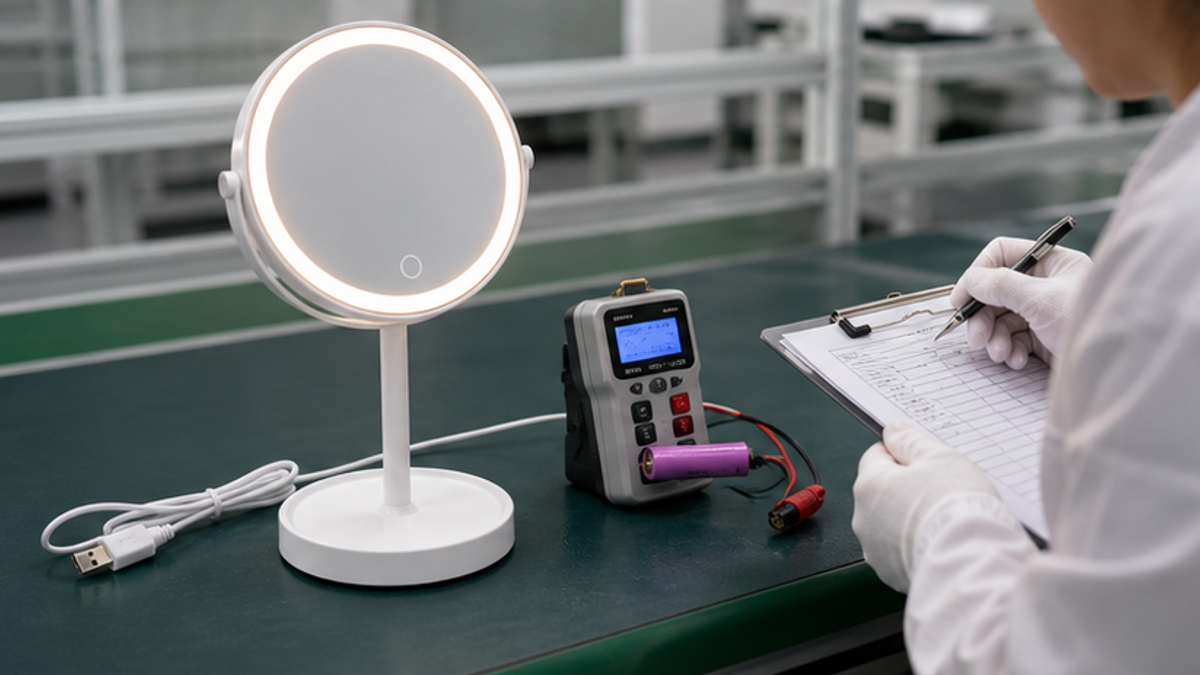
Before mass production, buyers should test:
- Charging port fit and durability after repeated plugging.
- Charging cable quality and whether the cable length fits normal use.
- Battery runtime at different brightness levels.
- Charging indicator behavior and user clarity.
- Heat during charging and continuous lighting.
- Dimming smoothness and touch switch response.
- LED ring uniformity with no obvious dark spots.
- CCT consistency across multiple samples.
- Battery documentation needed for shipping or marketplace review.
For Amazon and DTC buyers, this step is especially important. A product can look premium in photos but still receive poor reviews if charging is unstable or the light output drops too quickly.
Packaging Should Be Designed Around the Sales Route
Packaging is part of the product decision, not a separate afterthought. A first-order SKU that sells through e-commerce needs different packaging logic from a SKU shipped to retail shelves or distributor warehouses.
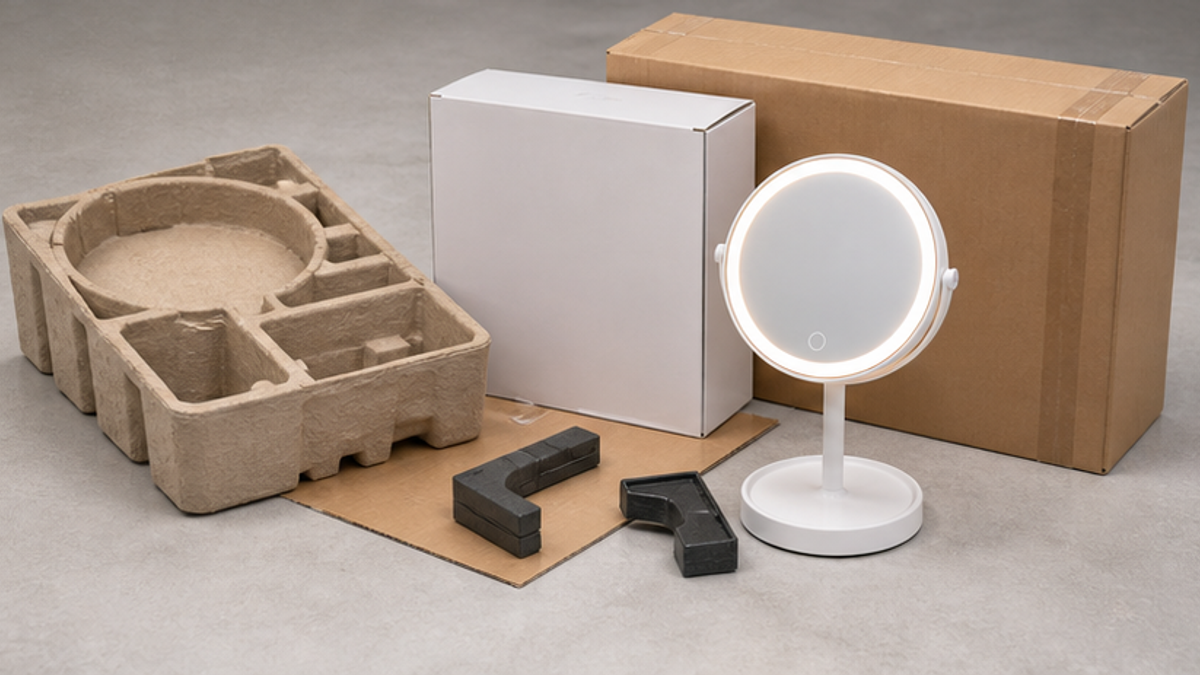
For marketplace and DTC orders, buyers should focus on drop protection, compact carton size, clear accessory placement, and private-label unboxing. For retail orders, the color box needs stronger shelf value, barcode planning, and possibly hang-tag or display information. For distributors, master carton strength, SKU labels, and easy warehouse identification are more important.
A practical packaging approval checklist includes:
- Mirror head, base, charging cable, manual, and accessories each have a fixed position.
- The LED ring and mirror surface do not touch hard carton surfaces directly.
- The box survives normal e-commerce handling and international freight.
- The color box has room for buyer branding, barcode, warning marks, and destination language.
- The master carton supports stacking without compressing the product box.
- The packaging can be repeated at scale without slow assembly.
Buyers should ask for packaging photos or packaging samples before bulk production. A low unit price is not useful if the first shipment creates breakage, refunds, or retailer rejection.
How Many Units Should the First Bulk Order Include?
MOQ depends on structure, color, packaging, battery configuration, and customization level. A first bulk order should be large enough to justify stable production but controlled enough to avoid tying too much inventory to an unproven SKU.
For a private-label LED tabletop makeup mirror, buyers should discuss:
- MOQ for standard color versus custom color.
- MOQ for logo printing or laser marking.
- MOQ for custom color box and instruction sheet.
- Lead time for sample, packaging proof, mass production, and inspection.
- Spare parts or replacement ratio for charging cables, stands, and accessories.
- Whether the first order can use standard tooling while reserving customization for the second order.
The commercial decision is simple: customize what helps conversion, but do not customize so many details that the first order becomes slow, expensive, and hard to replenish.
Common First-Order Mistakes
The first mistake is choosing too many variants. Three colors, two sizes, two magnifications, and several packaging designs can turn one launch into a complex inventory project.
The second mistake is focusing only on mirror appearance. Buyers also need to test charging, hinge stability, base weight, LED comfort, packaging, and carton strength.
The third mistake is using consumer preference language in the RFQ instead of supplier-ready specifications. “High quality and bright light” is not enough. CCT, dimming, battery runtime, material, finish, packaging route, and test requirements should be stated clearly.
The fourth mistake is approving one perfect sample without asking how mass production will be controlled. Buyers should confirm inspection points, defect standards, packaging approval, and how changes are recorded before the first shipment.
Pre-RFQ Checklist for the First SKU
Send these points before requesting a final quotation:
- Target buyer and sales channel.
- Expected first-order quantity and reorder plan.
- Preferred mirror size, shape, and finish.
- Rechargeable battery and USB-C requirements.
- CCT, dimming, brightness, and switch preference.
- Magnification requirement, if any.
- Logo position and private-label packaging needs.
- E-commerce, retail, distributor, or project packaging route.
- Destination market and required test reports.
- Sample approval deadline and target shipment window.
- Inspection requirements before shipment.
- Replacement parts and after-sales expectations.
This checklist helps the supplier quote the real SKU instead of a low starting model that changes after sampling.
Bottom-Line Recommendation
For the first bulk order of LED tabletop makeup mirrors, choose one rechargeable hero SKU with practical size, comfortable lighting, stable structure, USB-C charging, protective packaging, and simple private-label options. Avoid launching too many variants before the market confirms demand. Use the first order to prove review stability, packaging safety, and replenishment logic, then expand the line with travel, premium, or channel-specific versions.
Mingda Mirror supports LED makeup mirror sourcing, OEM/ODM customization, sample approval, battery and lighting QC, packaging development, and private-label production. Review our Makeup Mirrors, OEM/ODM Services, QC Process, and Product pages, or contact Mingda Mirror with your target channel, quantity, mirror size, charging requirement, packaging route, and launch timeline.
FAQ
What is the best LED tabletop makeup mirror for a first private-label order?
For most buyers, a rechargeable round LED tabletop makeup mirror with neutral lighting, USB-C charging, stable base, and protective packaging is the safest first SKU. It fits beauty, gift, retail, and e-commerce channels without overcomplicating the first order.
Should buyers start with one SKU or several mirror variants?
Most first-time buyers should start with one hero SKU, then expand after sales data and review feedback confirm demand. Multiple variants increase sample cost, packaging complexity, inventory risk, and replenishment pressure.
What should Amazon sellers check before ordering LED makeup mirrors?
Amazon sellers should check battery runtime, USB-C charging stability, LED consistency, packaging drop protection, accessory completeness, carton dimensions, warning labels, product photos, and return-risk points before bulk ordering.
Can the first LED tabletop makeup mirror order use private-label packaging?
Yes. Buyers can usually customize logo placement, color box, manual, barcode, carton mark, and insert layout. For a first order, keep customization focused on brand presentation and packaging safety instead of changing every product detail.
How long does a custom LED tabletop makeup mirror order take?
Lead time depends on sample approval, packaging proof, customization, order quantity, and testing requirements. Buyers should reserve time for sample review, correction, mass production, inspection, and shipment rather than planning only around factory production days.
Social Media Content Ideas
LinkedIn angle: explain why a first LED makeup mirror order should prove one reliable hero SKU before expanding into a wide assortment.
Facebook angle: show how rechargeable LED makeup mirror packaging and USB-C quality affect customer reviews and repeat purchases.
Instagram angle: use the sample review cover image to highlight complete product, packaging, and buyer-ready first-order planning.
CTA: Read the full sourcing guide and send Mingda Mirror your target channel, quantity, charging requirement, and packaging route for a first-SKU recommendation.