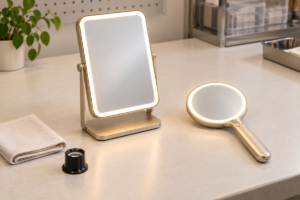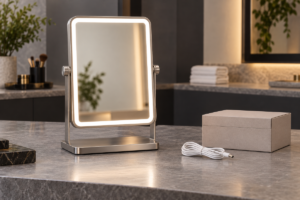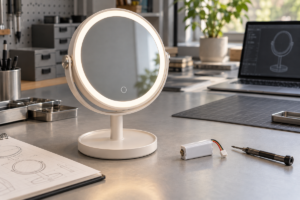

For retail and e-commerce buyers, dimmable LED makeup mirrors are usually the better choice when the SKU must serve multiple lighting environments, product-page claims, gifting, or premium positioning. Fixed-brightness mirrors can still work for entry-level, promotional, or tightly cost-controlled programs, but buyers should treat them as simpler channel-specific SKUs rather than universal products. The sourcing decision should be based on target price, brightness range, CCT options, control reliability, packaging protection, and how clearly the feature can be explained to shoppers before the first bulk order.

Why This Comparison Matters for B2B Buyers
Lighting is one of the first features shoppers notice on an LED makeup mirror, but it is also one of the easiest features to specify too vaguely. A buyer may request a “bright LED mirror” and receive a sample that looks good in a showroom but feels too strong at night, too weak under retail store lights, or inconsistent across production batches.
That gap creates real commercial risk. For Amazon and other e-commerce sellers, unclear brightness claims can lead to poor reviews and higher returns. For retailers, testers need to work under store lighting without confusing shoppers. For distributors, one SKU may need to satisfy several customer channels. For private-label brands, dimming behavior affects perceived quality, product-page copy, and after-sales questions.
The practical question is not whether dimming sounds more advanced. The question is whether the added function improves sell-through, review quality, and SKU flexibility enough to justify the higher component and QC requirements.
Quick Comparison: Dimmable vs Fixed-Brightness Mirrors
| Decision Point | Dimmable LED Makeup Mirror | Fixed-Brightness LED Makeup Mirror |
|---|---|---|
| Best channel fit | Premium retail, Amazon, DTC, gifting, beauty brand lines | Entry retail, promotion sets, value channels, simple wholesale |
| Shopper benefit | Adjustable brightness for day, evening, travel, and different rooms | Simple one-touch operation with predictable output |
| Buyer risk | Poor dimmer calibration, flicker, touch-control failure, confusing instructions | Brightness may feel too strong or too weak for some users |
| QC focus | Brightness range, dimming steps, memory function, flicker, switch life | Stable output, LED consistency, heat, power draw |
| Product-page value | Strong feature story when claims are accurate | Easier copy, fewer function claims to prove |
| Cost impact | Higher BOM and inspection workload | Lower cost and simpler production control |
When Buyers Should Choose Dimmable LED Makeup Mirrors
Dimmable LED makeup mirrors are the stronger option when the same SKU must work across multiple use cases. A tabletop mirror may be used in a bedroom, bathroom, dorm room, salon counter, travel apartment, or live-commerce setup. These spaces do not have the same ambient light, so adjustable brightness helps the product feel more useful after purchase.
Choose dimmable models when the SKU has one or more of these buyer needs:
- The product is positioned as mid-range or premium.
- The mirror will be sold online with detailed feature claims.
- Buyers want one SKU for retail, e-commerce, and gifting channels.
- The mirror includes magnification, USB-C charging, or color temperature options.
- The brand wants fewer complaints about glare, weak lighting, or limited usability.
Dimming also supports better product storytelling. A product page can explain low brightness for evening use, higher brightness for detailed makeup, and softer output for skincare routines. That is useful for SEO, marketplace product content, and social-commerce demonstrations.
When Fixed-Brightness Mirrors Still Make Sense
Fixed-brightness LED makeup mirrors should not be dismissed. They can be the right choice when the buyer needs a clean entry-level SKU with fewer functions, a lower target price, and simpler after-sales handling. For a promotional program, value retail shelf, or distributor starter line, one reliable brightness level may be better than a low-cost dimmer that performs inconsistently.
Fixed brightness can also reduce training and instruction burden. The user touches one control, the light turns on, and the expected output is always the same. This helps when the selling point is mirror shape, magnification, foldability, gift packaging, or price rather than lighting customization.
The sourcing risk is that fixed brightness leaves no room for user preference. If the output is too low, shoppers may describe the mirror as weak. If it is too high, glare becomes a complaint. Buyers should therefore approve the exact brightness level under the lighting conditions of the target channel, not only in the supplier showroom.
Lighting Specifications Buyers Should Confirm
The purchase order should not say only “dimmable LED light.” That wording is too loose for production control. Buyers should define measurable and testable lighting requirements before confirming samples.
| Specification | What to Confirm Before RFQ | Why It Affects the Order |
|---|---|---|
| Brightness range | Minimum and maximum lux at a defined test distance | Prevents samples and bulk goods from feeling different |
| Dimming method | Stepless dimming, step dimming, long-press control, or button control | Affects user experience and switch QC |
| CCT options | Single CCT or warm / neutral / cool modes | Influences product-page claims and retail positioning |
| CRI target | Confirm whether color rendering is suitable for makeup use | Supports a better beauty-use claim |
| Flicker control | Test at low, medium, and high brightness | Reduces video, live-commerce, and comfort complaints |
| Memory function | Decide whether the mirror remembers the last setting | Affects electronics design and user instructions |
For e-commerce buyers, these points also protect listing accuracy. If the product page claims adjustable brightness, multiple color modes, or memory function, the production sample, manual, packaging, and inspection report must match that claim.
Channel Fit: Retail, Amazon, Wholesale, and Gift Programs
Retailers need testers that feel intuitive in seconds. If the dimmer requires a long press, the tester label and staff guidance should be clear. For shelf packaging, the buyer should confirm whether the box can communicate dimming without becoming text-heavy or confusing.
Amazon and DTC sellers need stronger product-page evidence. Dimming is valuable only if photos, video, and copy explain the practical use case. Buyers should request sample photos or short demo clips from the supplier, then confirm the same brightness behavior in the packed sample.
Wholesalers and distributors should think in assortment terms. A fixed-brightness mirror can be the opening-price SKU, while a dimmable rechargeable model can serve as the trade-up SKU. This avoids forcing one mirror to cover every customer need.
Gift and seasonal programs depend on perceived value. Dimming, color modes, rechargeable power, and clean packaging can make the product feel more giftable, but only if the final retail box, insert, cable pouch, and manual are approved together.
Common Sourcing Mistakes to Avoid
The most common mistake is accepting a dimmable sample without testing the full brightness range. Some low-cost dimmers look acceptable at maximum brightness but flicker or jump unevenly at lower settings. Others have a touch switch that feels responsive during one sample test but becomes inconsistent after repeated use.
Another mistake is separating the lighting decision from packaging and product claims. A dimmable mirror may need clearer instructions, more careful switch protection, and better product-page copy. If the packaging says one thing and the manual or online listing says another, the buyer creates avoidable after-sales risk.
Buyers should also avoid adding dimming to every SKU automatically. A low-price mirror with poor dimming may be worse than a simple fixed-brightness mirror with stable light, clean packaging, and fewer claims to defend.
Pre-RFQ Checklist for Dimmable LED Makeup Mirror Orders
Before requesting a quotation, send the supplier enough information to quote the correct construction, electronics, and packaging. A short but complete RFQ should include:
- Target sales channel: retail shelf, Amazon, DTC, wholesale, gift, or distributor.
- Mirror type: tabletop, tri-fold, wall-mounted, compact, or travel size.
- Power system: USB-C rechargeable, plug-in, dry battery, or hybrid.
- Lighting requirement: brightness range, CCT modes, dimming method, and memory function.
- Magnification: 1x only, 1x/5x, 1x/10x, or other lens plan.
- Finish and material: ABS, metal frame, chrome, black, white, rose gold, or custom finish.
- Packaging: retail box, gift box, mailer protection, molded insert, carton strength, and barcode zones.
- QC evidence: lighting test, switch-life test, charging test, aging test, and packed-sample drop review.
- Order plan: MOQ, first order quantity, target lead time, reorder forecast, and spare-parts expectations.
This level of detail helps a manufacturer quote the right product rather than guessing from a reference photo.

Sample Approval and QC Points
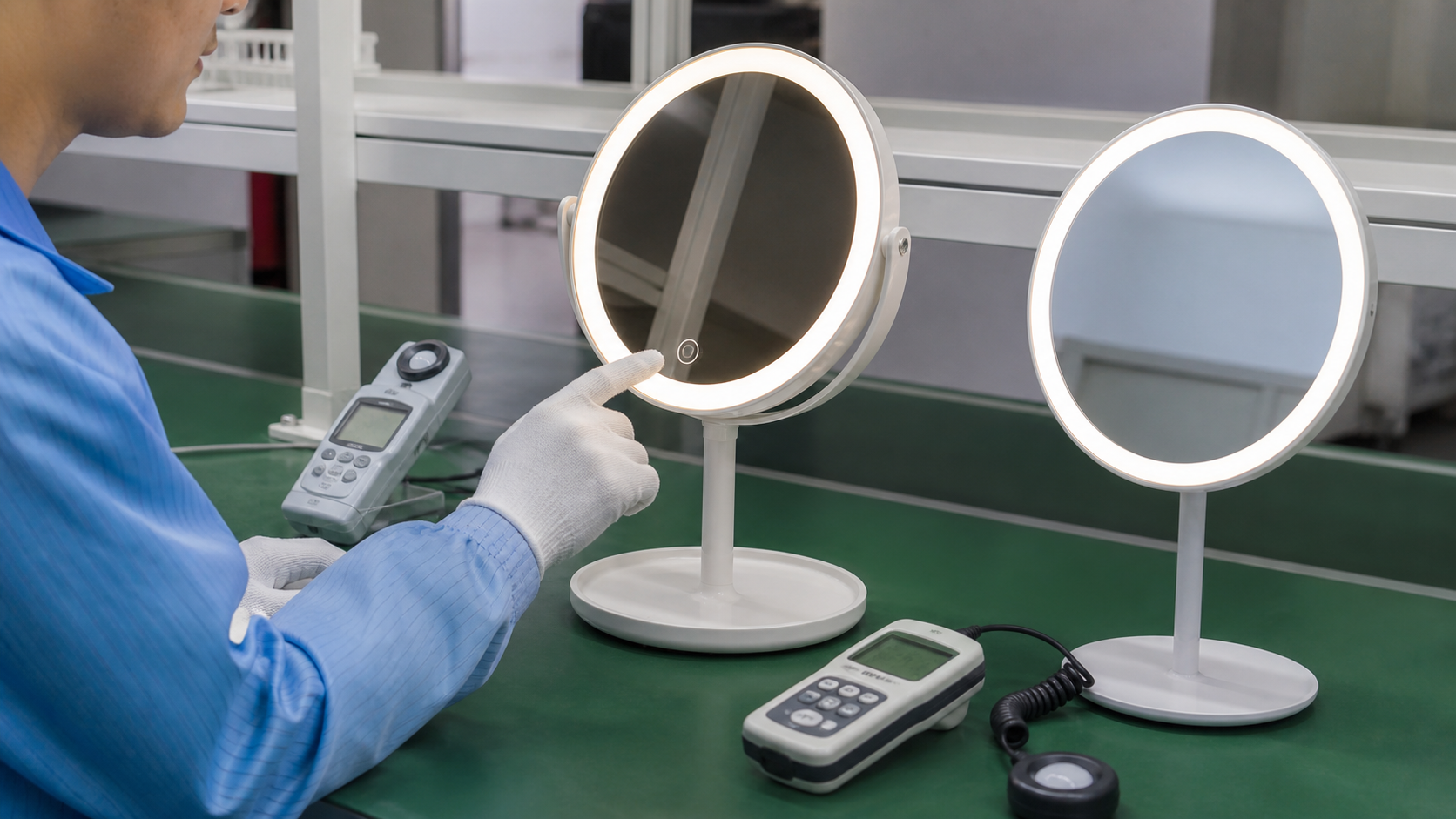
For dimmable models, sample approval should include both user experience and measurable testing. The buyer should check whether the dimming curve feels smooth, whether brightness changes are easy to control, and whether the mirror returns to an acceptable setting after being switched off.
Production QC should include at least these checks:
- Appearance and mirror-surface inspection before lighting tests.
- LED brightness and CCT check at defined positions.
- Dimming range test at low, medium, and high settings.
- Touch switch sensitivity and repeated-use check.
- USB-C charging or plug-in power test, depending on model.
- Heat observation after continuous lighting.
- Packaging vibration or drop review for the packed sample.
- Label, barcode, manual, and accessory confirmation.
For fixed-brightness models, the QC plan is simpler but still important. Buyers should lock the approved lux range, confirm LED color consistency, and test heat and stability across the planned production batch.
Bottom-Line Recommendation
Choose dimmable LED makeup mirrors when the product needs stronger feature value, wider channel flexibility, and better user adaptation across different lighting environments. Choose fixed-brightness mirrors when the order is cost-sensitive, the product position is simple, and the approved brightness level already fits the target channel.
For most B2B buyers building a long-term LED makeup mirror line, the best assortment is not one option only. Use a stable fixed-brightness model as the entry SKU and a dimmable rechargeable model as the higher-value SKU. That gives retailers, e-commerce sellers, and distributors a clearer price ladder while keeping QC and product claims manageable.
FAQ
Are dimmable LED makeup mirrors always better for Amazon sellers?
Not always. They are better when the dimming function is reliable and clearly shown in the product content. If the function is weak or difficult to explain, a fixed-brightness mirror with stable lighting and strong packaging may produce fewer complaints.
What is the main QC risk with dimmable LED makeup mirrors?
The main risk is inconsistent dimming behavior, especially flicker, uneven brightness changes, weak touch-switch response, or mismatch between sample and bulk production. Buyers should test multiple brightness levels before approving production.
Should a retailer sell both fixed and dimmable mirror SKUs?
Yes, if the category has enough shelf space or online traffic. A fixed-brightness SKU can cover entry-level demand, while a dimmable SKU supports trade-up pricing and stronger feature communication.
What information should buyers send before requesting a quotation?
Send the target channel, mirror type, power source, brightness range, CCT options, dimming method, magnification, finish, packaging requirement, order quantity, and required QC tests. This prevents suppliers from quoting a product that does not match the selling plan.
Can Mingda Mirror support private-label dimmable LED makeup mirror orders?
Yes. Mingda Mirror can support LED makeup mirror sourcing, OEM/ODM customization, sample approval, packaging planning, and QC checks for brands, retailers, e-commerce sellers, wholesalers, and distributors.
Request a Quote
If you are comparing dimmable vs fixed-brightness LED makeup mirrors for a retail, Amazon, wholesale, or private-label program, Mingda Mirror can help review the product position, lighting specification, packaging plan, MOQ, and sample approval steps. Explore Mingda Mirror makeup mirror products, review OEM/ODM customization support, check the quality-control process, or contact Mingda Mirror with your target channel and first order plan.
Social Media Content Ideas
LinkedIn: Share a sourcing rule for when dimmable LED makeup mirrors justify higher BOM and QC requirements.
Facebook: Explain why one fixed-brightness mirror may not fit every home, store, or gifting use case.
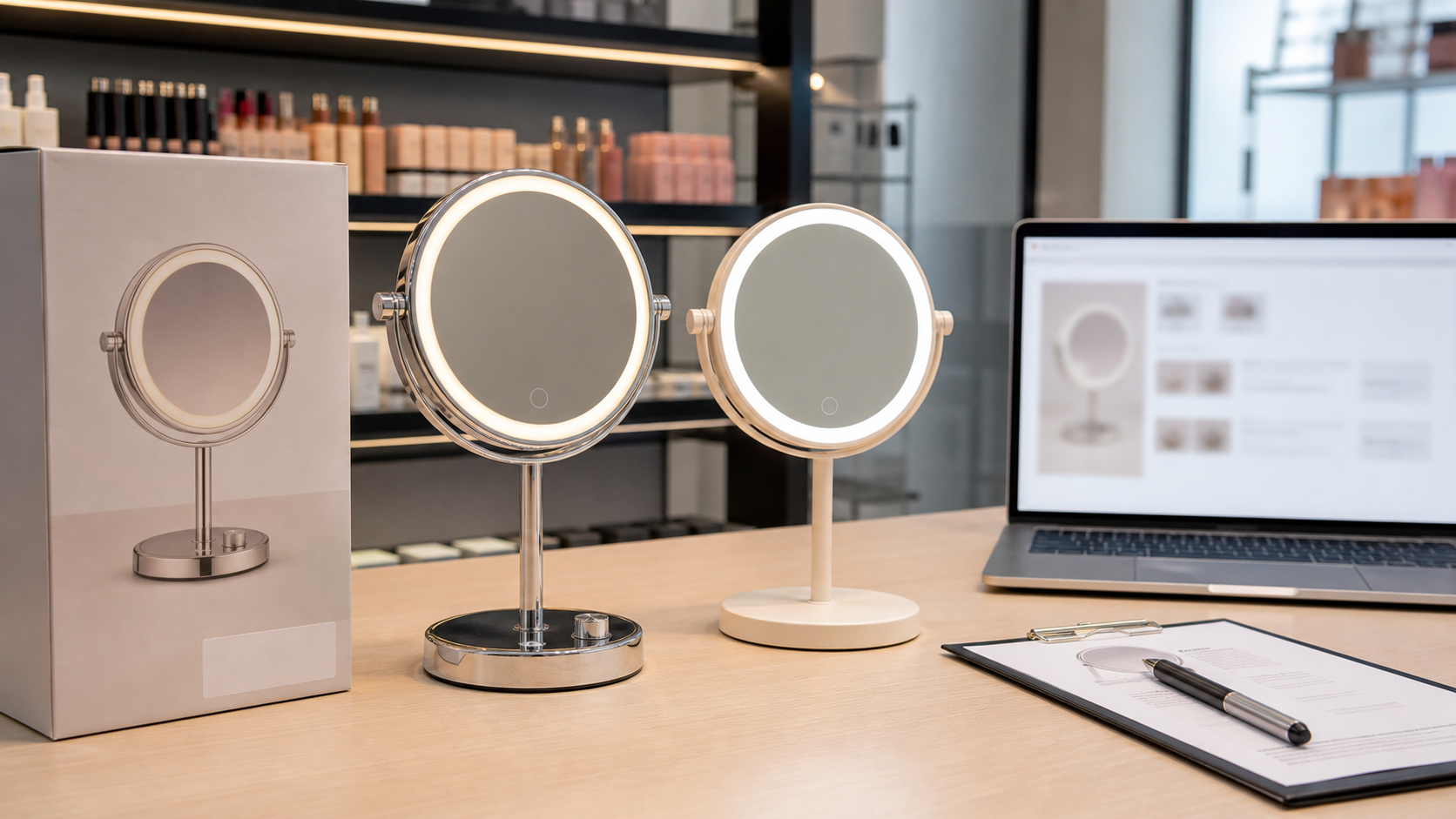
Instagram: Use the lighting QC image to show how dimming, CCT, and switch response are checked before bulk production.
CTA: Read the full buyer comparison and send Mingda Mirror your channel, target price, and packaging requirements for RFQ support.