
Private label mirror buyers should plan MOQ and lead time together, not as separate quotation lines. MOQ affects component purchasing, packaging setup, unit cost, and supplier capacity, while lead time depends on sample approval, material readiness, lighting components, packaging confirmation, inspection, and export scheduling. For LED makeup mirrors, handheld mirrors, and Hollywood vanity mirrors, the best ordering plan usually starts with a realistic launch quantity, a signed-off sample, confirmed packaging, and a reorder calendar that protects both cash flow and stock availability.
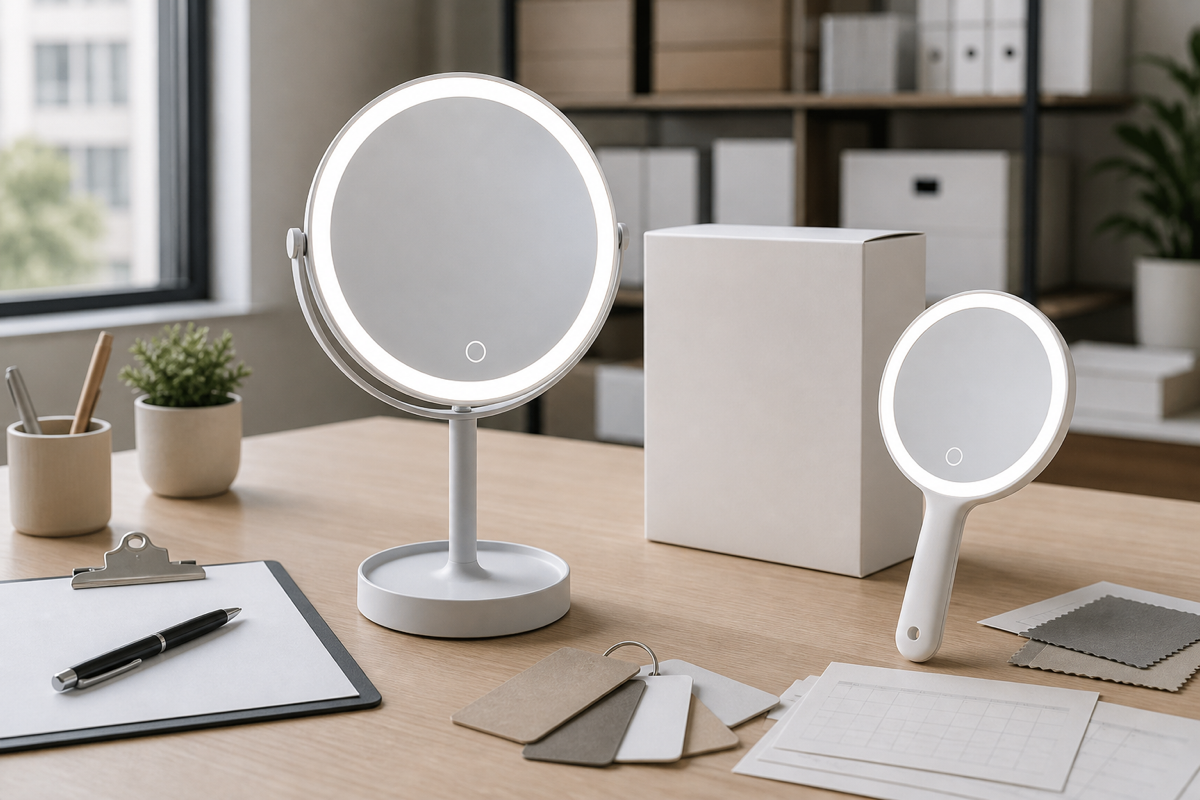
Why MOQ and Lead Time Matter More for Private Label Mirrors
For private label mirror programs, the buyer is not only purchasing a finished product. The supplier may need to prepare custom colors, logo application, printed packaging, foam inserts, charging accessories, manuals, barcodes, labels, and inspection standards. Each item can add time or create a minimum purchasing requirement.
This is especially important for brands, distributors, Amazon sellers, and retail chains that sell multiple mirror types in one line. A small LED makeup mirror, a rechargeable handheld mirror, and a Hollywood mirror may share the same brand identity, but they do not share the same production rhythm. Lighting parts, mirror glass, metal or plastic housings, cartons, plugs, batteries, and bulbs can all have different procurement cycles.
Buyers should therefore ask one practical question before requesting a quotation: what order quantity supports my sales channel without creating a production risk or inventory risk?
A Practical MOQ Framework for Mirror Buyers
MOQ should be evaluated by product complexity, customization level, packaging requirement, and sales forecast. A low MOQ is useful for testing the market, but it may limit customization options or raise the unit cost. A higher MOQ can improve pricing and packaging efficiency, but only if the buyer has enough sales confidence and warehouse capacity.
| Buying situation | Better MOQ approach | What to confirm before order |
|---|---|---|
| First private label test order | Start with a controlled launch quantity | Sample quality, packaging structure, logo placement, review-risk items |
| Amazon or e-commerce launch | Plan MOQ against 60-90 days of sales | Carton strength, barcode labels, replacement policy, replenishment timing |
| Retail chain seasonal promotion | Use higher MOQ with earlier approval | Store allocation, display packaging, delivery window, carton marks |
| Distributor stock program | Split quantities by best-selling models | Mixed-model shipment, spare parts, repeat-order lead time |
| Hotel or project buyer | Order by project phase and installation schedule | Electrical requirements, packing sequence, breakage allowance |
The buyer should avoid choosing MOQ only by the lowest unit price. For mirrors, an order that is too large can tie up cash in slow-moving models, while an order that is too small can make packaging, color matching, and accessory sourcing inefficient.
Lead Time Should Start After Approval, Not After Inquiry
A common sourcing mistake is counting lead time from the first email inquiry. In real production, the reliable lead-time clock starts after the supplier receives confirmed specifications, approved sample details, deposit or payment arrangement, confirmed packaging artwork, and clear shipping requirements.
For a private label LED mirror order, lead time usually includes:
- Specification confirmation, including size, lighting, magnification, power source, plug type, finish, and accessories.
- Sample preparation or existing sample adjustment.
- Buyer sample review and revision.
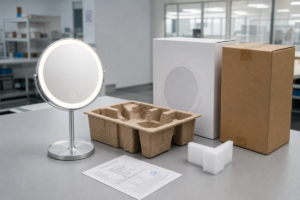
- Packaging artwork, carton structure, foam insert, barcode, and manual approval.
- Component procurement and production scheduling.
- Assembly, function testing, lighting inspection, and appearance QC.
- Final packing, pre-shipment inspection, booking, and export handover.
If one of these steps is not ready, the official production schedule can move even when the supplier has available capacity.
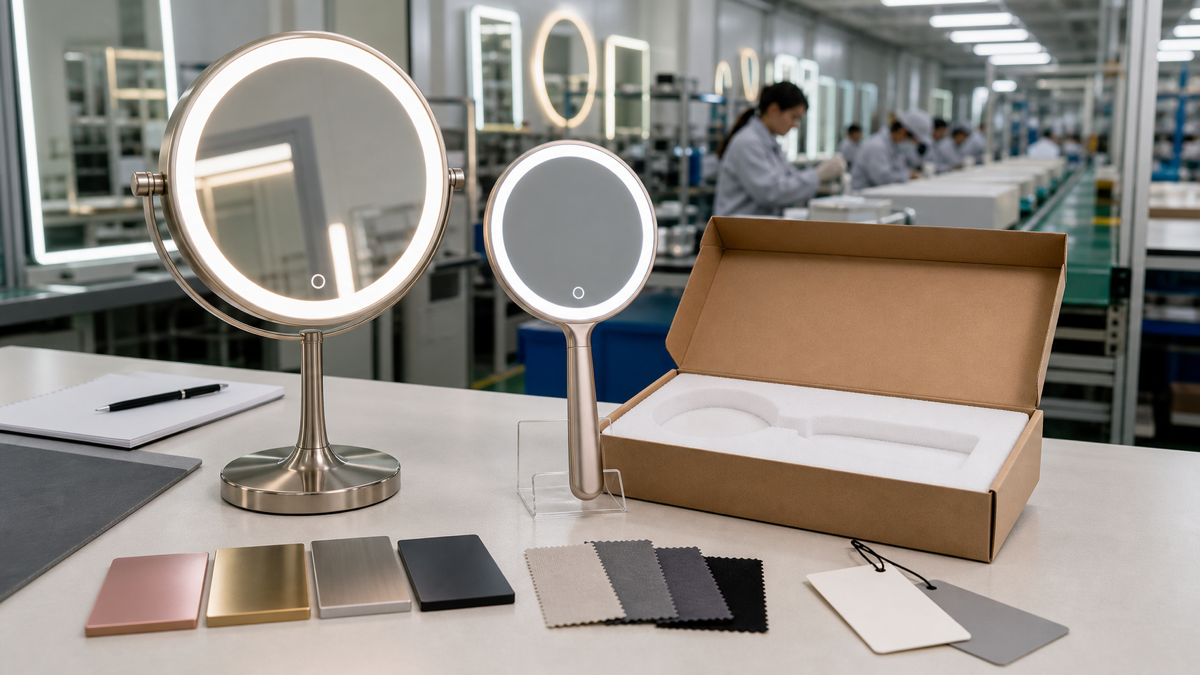
Product Type Changes the Production Plan
Different mirror categories require different planning buffers.
LED Makeup Mirrors
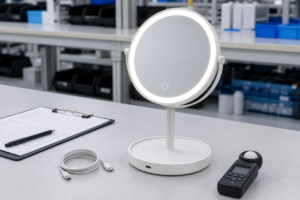
LED makeup mirrors often involve lighting color temperature, dimming performance, magnification, battery or plug-in structure, charging port, stand stability, and retail packaging. For rechargeable models, buyers should confirm battery specification, charging cable, instruction manual, transport packaging, and any market-specific compliance requirement early.
LED Handheld Mirrors
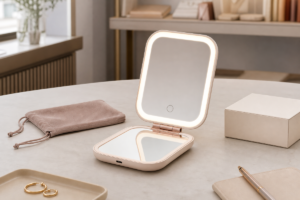
Handheld mirrors can look simple, but private label orders may involve frame material, finish durability, handle strength, magnification, foldability, display packaging, logo position, and travel-friendly protection. For gift, salon, or retail channels, packaging appearance can be as important as the product itself.
Hollywood Vanity Mirrors
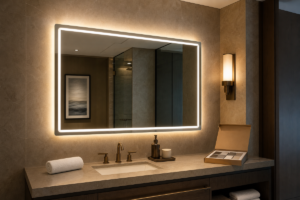
Hollywood mirrors need more space planning because of frame size, bulb layout, wiring position, switch design, tabletop or wall-mounted use, and breakage control. Packaging approval should not wait until production is finished. Foam, corner protection, master carton strength, and drop-test thinking should be part of the quotation discussion.
How Buyers Can Reduce Lead-Time Risk
The fastest order is usually not the order that skips details. It is the order where both sides approve details early. Buyers can reduce delays by sending a complete RFQ package instead of a short product name.
Before requesting a final quotation, prepare:
- Target product type: LED makeup mirror, handheld mirror, Hollywood mirror, or bathroom mirror.
- Quantity plan: launch order, repeat order, or annual estimate.
- Customization needs: logo, color, finish, packaging, manual, plug, battery, accessory set.
- Sales channel: Amazon, retail, wholesale, hotel project, salon, distributor, or private-label website.
- Market destination: required plug, language, label, test report, or shipping condition.
- Packaging expectation: color box, mailer box, gift box, master carton, foam, drop protection.
- Timeline: sample deadline, approval deadline, shipment target, and reorder window.
This helps the supplier identify which items can use existing tooling and which items need extra preparation.
MOQ, Unit Cost, and Cash Flow Tradeoffs
The lowest MOQ does not always create the safest buying plan. A small order may be useful for testing demand, but the unit cost can be higher because packaging setup, component purchasing, and labor arrangement are spread across fewer pieces. A larger order can lower cost, but it increases inventory exposure if the buyer has not validated color, mirror size, lighting preference, and channel demand.
For e-commerce buyers, the key question is not only “What is your MOQ?” It is “Can this MOQ support a repeatable sales cycle without causing stockouts or overstock?” For retail buyers, the key question is whether the MOQ matches store allocation, display timing, and seasonal promotion windows.
Reorder Planning for Private Label Mirror Programs
Repeat-order planning should begin before the first shipment leaves the factory. If a mirror sells well, the buyer needs enough time to review sales data, confirm whether any packaging or accessory change is needed, and place the next order before stock reaches a risky level.
For many mirror programs, buyers should track:
- weekly sell-through by model
- review feedback related to lighting, charging, packaging, and breakage
- return reasons by channel
- remaining stock by warehouse
- supplier repeat-order lead time
- seasonal demand peaks
- shipping method and transit time
When sales data is still new, a buyer can ask the supplier to keep critical components or packaging records ready for faster repeat production. This does not replace a formal order, but it can make reorder communication more efficient.

Pre-RFQ Checklist for MOQ and Lead-Time Planning
Use this checklist before asking for a final private label mirror quotation:
- Have we selected the exact mirror type, size, lighting, magnification, and power source?
- Do we know whether this is a launch test, repeat order, retail rollout, or project order?
- Are logo, color, packaging, manual, and barcode requirements ready?
- Have we approved the sample or listed all required sample changes?
- Do we understand which customized parts affect MOQ?
- Have we confirmed carton protection and shipping method?
- Do we have a realistic shipment deadline, not only a desired selling date?
- Have we planned a reorder point based on expected sales and supplier lead time?
Bottom-Line Recommendation
For private label mirror orders, buyers should treat MOQ, lead time, packaging, and production planning as one decision system. Start with a launch quantity that matches channel demand, approve the sample and packaging before mass production, and build a reorder calendar that includes production plus shipping time. This approach is more reliable than pushing for the lowest MOQ or the shortest quoted lead time without confirming the details that control production risk.
Mingda Mirror supports LED makeup mirror, LED handheld mirror, Hollywood mirror, and project mirror buyers with OEM/ODM development, sample review, packaging planning, QC inspection, and export delivery coordination. Explore our mirror product range, review our OEM/ODM customization services, and contact us through the Mingda Mirror inquiry page with your quantity plan, packaging requirements, and target delivery date.
FAQ: Private Label Mirror MOQ and Lead Time
What is a reasonable MOQ for private label mirrors?
A reasonable MOQ depends on mirror type, customization level, packaging, and component availability. Existing models with simple logo or packaging changes usually support more flexible planning than new molds, special finishes, custom electronics, or complex retail packaging.
When does lead time officially start?
For a reliable supplier, lead time should start after specifications, sample details, packaging artwork, order quantity, payment terms, and shipping requirements are confirmed. Counting from the first inquiry can create unrealistic delivery expectations.
Can buyers mix makeup mirrors, handheld mirrors, and Hollywood mirrors in one order?
Mixed orders may be possible, but each product type can have different MOQ, packing volume, production process, and inspection needs. Buyers should ask the supplier to separate MOQ, unit cost, carton size, and lead time by model.
How can Amazon sellers reduce mirror stockout risk?
Amazon sellers should plan reorder timing from sales velocity, production lead time, shipping transit time, and buffer stock. They should also monitor reviews for packaging damage, charging issues, or lighting complaints before repeating the same specification.
What should buyers send before asking for a custom mirror quotation?
Send product photos or target model, size, quantity, logo requirement, packaging style, destination market, power or charging requirement, expected sample date, and target shipment date. A complete RFQ allows the supplier to quote more accurately.
Social Media Content Ideas
LinkedIn angle: Explain why serious mirror sourcing teams should evaluate MOQ and lead time together instead of negotiating them as separate quotation points.
Facebook angle: Show how private label mirror buyers can avoid launch delays by approving samples, packaging, and reorder timing before mass production.
Instagram angle: Use the sample-room image to highlight LED mirror product planning, finish selection, and export packaging preparation.
Short CTA: Read the full MOQ and lead-time planning guide, then send Mingda Mirror your private label mirror RFQ for production planning support.