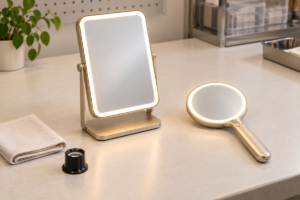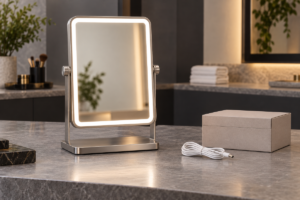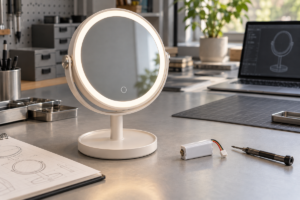

The mirror development process should move from RFQ details to sample approval, pilot confirmation, mass production, QC, packaging, and shipment with clear buyer sign-off at each stage. For LED makeup mirrors, handheld mirrors, Hollywood vanity mirrors, and bathroom mirror products, this process protects the buyer from wrong specifications, late artwork changes, unstable lighting, packaging damage, and unclear inspection standards.
This guide is written for beauty brands, retailers, Amazon and e-commerce sellers, wholesalers, distributors, importers, and OEM/ODM buyers who need a practical production roadmap before placing private-label mirror orders.
Related pages: OEM / ODM Customization | Makeup Mirrors | Hollywood Mirrors | QC Process | Contact Mingda Mirror.
Why buyers need a structured mirror development process
A mirror order is not only a product purchase. It usually combines appearance, lighting, magnification, power source, charging cable, adapter, switch function, frame finish, logo, packaging, manuals, certification documents, carton marks, and delivery planning. If these details are confirmed in the wrong order, the buyer may approve a beautiful sample but still face mass production delays or return risk.
The practical goal is to turn a buying idea into a repeatable production standard. A good supplier should help the buyer freeze specifications early, record sample changes, test the product under realistic conditions, and make sure the production team follows the same approved version.
Step 1: RFQ and product brief
The process starts with a clear RFQ. Buyers should share the mirror type, target sales channel, estimated quantity, target market, size, magnification, lighting requirement, color temperature, brightness, dimming method, power source, plug or USB requirement, finish, logo method, packaging level, and expected delivery date. For e-commerce or Amazon projects, the RFQ should also mention parcel-delivery expectations and barcode or FNSKU requirements.
For LED mirrors, the most important RFQ mistake is asking only for a general product price. The buyer should separate product specification, packaging scope, customization needs, sample cost, production MOQ, and lead time. This makes quotations easier to compare and prevents later disputes over what was included.
Step 2: Feasibility review and quotation
After receiving the RFQ, the supplier should review whether the requested structure, lighting, battery or plug configuration, finish, packaging, and certification expectations are realistic for the buyer’s quantity and market. This is where the supplier should flag tradeoffs before the sample stage.
For example, a rechargeable tabletop makeup mirror may support premium positioning, but it also requires battery safety attention, charging-port durability, manual accuracy, and stronger after-sales control. A plug-in Hollywood mirror may suit salon and vanity use better, but the buyer must confirm plug type, cord exit, bulb layout, carton strength, and installation scenario.
Step 3: Sample making and sample approval
The sample stage should not be treated as a photo opportunity only. Buyers should approve a working sample that represents the intended production standard. Check the mirror size, shape, hinge or stand stability, frame finish, LED brightness, color temperature, dimming response, magnification, charging or plug function, accessory set, label position, and packaging structure.
If the buyer needs a private-label product, logo artwork, color box direction, manual language, barcode data, and carton marks should be discussed before or during sample approval. Waiting until mass production starts can create avoidable delays.
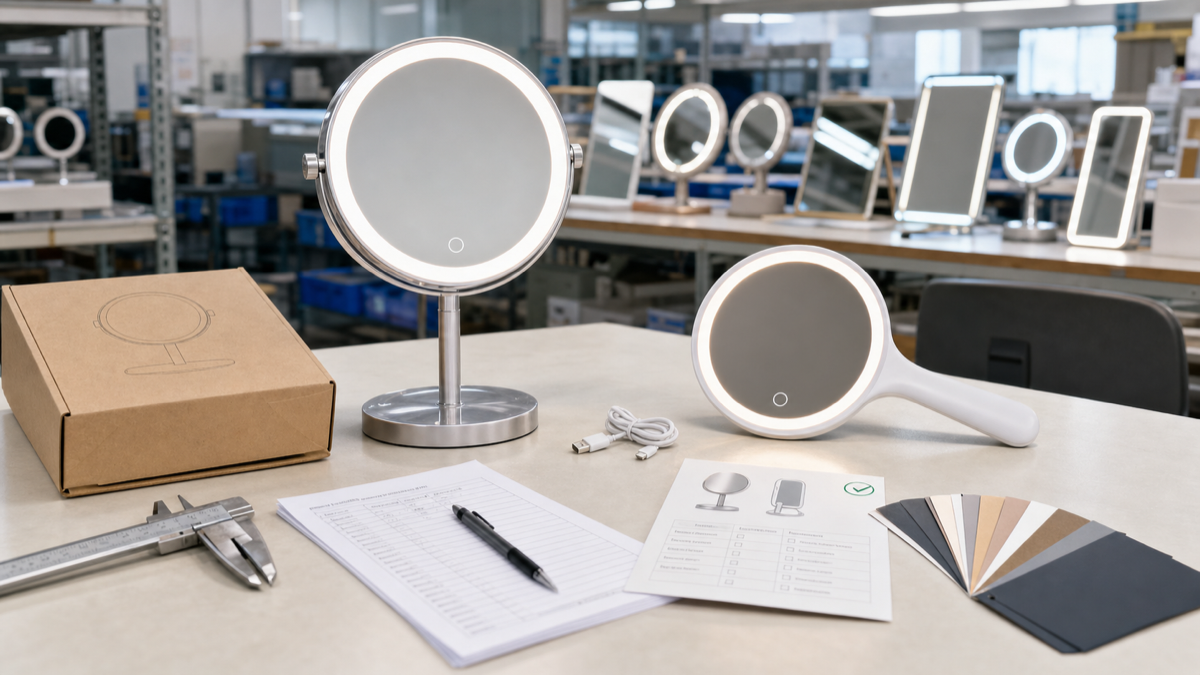
Mirror Development Process Matrix
| Stage | Buyer decision | Supplier output | Risk controlled |
|---|---|---|---|
| RFQ brief | Mirror type, channel, quantity, function, packaging | Feasibility review and quotation scope | Unclear price comparison |
| Sample approval | Lighting, size, finish, power, accessories, packaging | Approved physical sample and change record | Wrong mass production version |
| Pilot confirmation | Confirm production-ready details before bulk run | Pre-production sample or pilot batch | Unstable assembly or late artwork changes |
| Mass production | Monitor schedule and critical quality points | Production progress, QC records, packing plan | Delay, function defects, breakage risk |
| Final inspection | Approve shipment against agreed standard | Inspection report, photos, carton data | Returns and after-sales disputes |
Step 4: Pilot run or pre-production confirmation
For customized mirror orders, a pilot run or pre-production confirmation is useful before full mass production. This stage checks whether the factory can repeat the approved sample with stable assembly, lighting, finish, packaging, and labeling. It is especially important for new LED designs, custom finishes, special packaging, new accessory sets, or first-time buyers.
The buyer should confirm whether the pilot sample is the final production reference. If changes are still required, record them clearly. Small changes, such as a cable position, foam insert, barcode label, or manual page, can affect production timing if they are not finalized before bulk materials are prepared.
Step 5: Mass production control
During mass production, the supplier should control incoming materials, assembly consistency, LED function, charging or plug performance, mirror surface cleanliness, frame finish, switch response, magnification accuracy, accessory placement, and packaging protection. For Hollywood mirrors, extra attention should be paid to bulb layout, frame stability, glass protection, and carton corner support. For handheld mirrors, handle strength, hinge durability, finish quality, and gift or retail packaging matter more.
Buyers should ask for production progress updates at meaningful checkpoints instead of daily vague updates. Useful checkpoints include material arrival, assembly start, in-line inspection, packing start, final inspection, carton mark confirmation, and shipment booking.

Step 6: Packaging, carton planning, and shipment
Packaging should be confirmed as part of production, not after production. Mirrors are fragile products, and packaging affects customer reviews, replacement cost, warehouse handling, and freight efficiency. Retail buyers need shelf-ready packaging and correct barcodes. E-commerce sellers need parcel-delivery protection and clear instructions. Project buyers may need carton marks and installation accessories that are easy to identify on site.
Before shipment, confirm inner protection, color box, manual, labels, accessory bags, export carton strength, carton quantity, gross weight, pallet plan if needed, and final inspection photos. A small packaging mistake can damage the buyer’s sales channel even when the mirror itself is good.
Buyer checklist before approving mass production
- Confirm the final mirror specification: size, magnification, lighting, CCT, dimming, finish, power source, plug or cable, and accessory set.
- Approve the physical sample and keep a written change record for any difference from the first sample.
- Confirm logo, packaging artwork, barcode, warning label, manual language, carton marks, and target-market requirements.
- Ask whether production MOQ and packaging MOQ are the same or different.
- Confirm sample approval timing, mass production lead time, inspection timing, and shipment booking plan.
- Define the final inspection standard, including function checks, visual checks, packaging checks, carton checks, and acceptable defect handling.
Common mistakes in mirror development
The first mistake is approving a sample without testing the lighting and power function like a real customer would use it. The second is confirming product structure but leaving packaging, manual, barcode, and carton marks until too late. The third is changing finishes, batteries, adapters, or packaging after materials have already been ordered. The fourth is comparing supplier prices without confirming whether both quotations include the same sample, packaging, testing, and after-sales scope.
For private-label mirror buyers, the strongest protection is a shared approval file. It should include photos, specifications, artwork, packaging notes, inspection points, and the final approved sample reference. This file helps the buyer, supplier, QC team, and logistics team work from the same standard.
Bottom Line
The best mirror development process is not the fastest path from idea to shipment. It is the clearest path from buyer requirement to repeatable production. Buyers should use the RFQ, sample approval, pilot confirmation, mass production, QC, packaging, and shipment stages to remove ambiguity before money is committed to bulk materials and cartons. For LED makeup mirrors, handheld mirrors, Hollywood mirrors, and bathroom mirror products, this process reduces delay, return risk, and supplier misunderstanding.
FAQ
How long does mirror sample development usually take?
Timing depends on the product structure, customization level, packaging artwork, and component availability. Standard samples are usually faster, while new finishes, new molds, private-label packaging, or special electrical requirements need more review time.
What should buyers send before requesting a custom mirror quotation?
Send the mirror type, size, lighting requirement, magnification, power source, finish, target channel, order quantity, packaging level, logo needs, market, certification needs, and expected delivery date.
Is a pre-production sample necessary?
It is recommended for private-label orders, new product structures, custom packaging, first orders, and higher-risk LED mirror projects because it confirms the factory-ready version before full production.
What QC checks matter most for LED mirrors?
Important checks include LED brightness and color temperature, dimming response, charging or plug function, switch reliability, mirror surface quality, frame finish, accessory completeness, packaging protection, and carton labeling.
Can Mingda support OEM and ODM mirror development?
Yes. Mingda Mirror supports OEM/ODM development for LED makeup mirrors, handheld mirrors, Hollywood mirrors, and bathroom mirror products, including samples, packaging, QC, and production planning.
Social Media Content Ideas
LinkedIn: share the process matrix for sourcing managers planning private-label mirror orders. Facebook: explain why sample approval should include packaging and accessories, not only the mirror. Instagram: use the sample approval image to show the visual path from sample table to production line. CTA: invite buyers to send mirror type, target market, quantity, packaging level, and delivery timing for a practical development plan.
CTA
If you are preparing a new makeup mirror, LED handheld mirror, Hollywood mirror, or bathroom mirror order, contact Mingda Mirror with your product brief, target market, quantity, packaging needs, and launch schedule. Our team can help you move from sample approval to controlled mass production with clearer specifications and fewer avoidable risks.
Home | Product | OEM / ODM Customization | QC Process | Contact