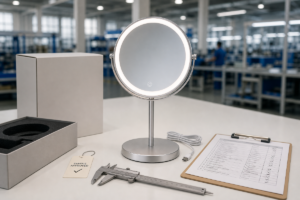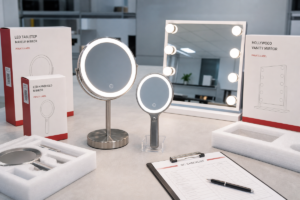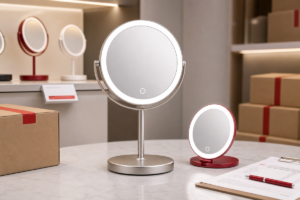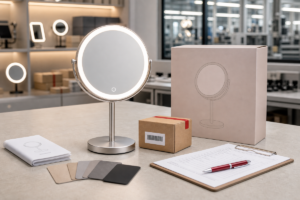

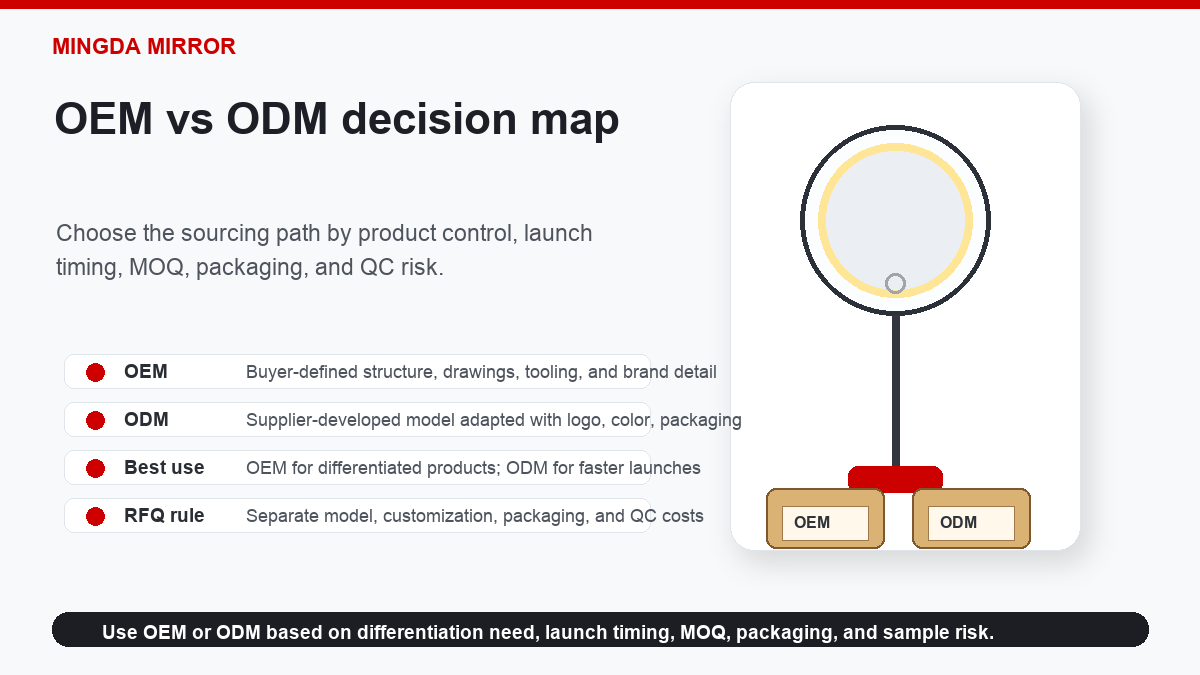
OEM vs ODM makeup mirrors should be chosen by how much control the buyer needs over product structure, launch timing, MOQ, packaging, and quality risk. OEM is better when a beauty brand or retailer needs a differentiated LED mirror based on its own specification, drawing, tooling, or exclusive design. ODM is better when the buyer wants to adapt a proven supplier model with logo, color, packaging, and channel-specific details for faster sampling and lower development risk.
For makeup mirror buyers, the decision is not only about wording. It affects sample lead time, tooling cost, certification documents, packaging MOQ, inspection standards, replacement policy, and how clearly suppliers can quote. This guide explains how brands, importers, Amazon sellers, retailers, and distributors should compare OEM and ODM before sending an RFQ.
Useful starting points: Makeup Mirrors | OEM / ODM Customization | QC Process | Contact Mingda Mirror.
What OEM means for makeup mirror buyers
OEM means the buyer provides a defined requirement and the supplier manufactures according to that requirement. In makeup mirrors, this may include a custom shape, mirror size, LED layout, CCT range, magnification level, stand structure, charging method, finish, accessory set, color box, or brand standard. The buyer usually expects more control and may need drawings, samples, tooling discussion, and stricter approval records.
OEM is useful when the product must look different from common market models, support a premium brand story, match a retail chain’s specification, or solve a specific user problem. The tradeoff is that development takes more communication. The buyer should prepare target market, reference product, function list, expected quantity, compliance needs, packaging direction, and target price before asking for a serious quotation.
What ODM means for makeup mirror buyers
ODM means the supplier already has a developed product direction, and the buyer adapts it for a market. For LED tabletop makeup mirrors, compact mirrors, rechargeable mirrors, and travel mirrors, ODM may include selecting an existing model, changing finish color, adding logo, adjusting packaging artwork, choosing accessory options, or confirming a channel-ready specification.
ODM is often the practical choice for first orders, new market testing, Amazon launches, distributor programs, and retail seasonal products. It can reduce sample risk because the structure is already more mature. However, buyers should still check whether the model fits their channel, whether the supplier can support consistent production, and whether packaging and inspection standards are clear enough for the target market.
OEM vs ODM decision matrix
| Decision point | OEM makeup mirror | ODM makeup mirror | Buyer implication |
|---|---|---|---|
| Product control | High control over structure, function, and appearance | Adapt a supplier-developed model | Choose OEM for differentiation; choose ODM for speed |
| Sample timing | Longer because design and tooling may be involved | Faster because base model exists | Plan launch calendars differently |
| MOQ and cost | May require higher MOQ, tooling, or setup cost | Usually more flexible for initial testing | Compare total landed cost, not only unit price |
| Packaging | Can be fully brand-led and channel-specific | Often color box, label, manual, and carton adaptation | Confirm packaging MOQ and artwork lead time |
| Quality risk | New structure needs stricter sample validation | Mature structure still needs batch consistency checks | Use packed sample and AQL inspection for both |
Match the choice to the sales channel
A beauty brand may choose OEM when the mirror must support a unique design language, premium finish, or exclusive product story. A retailer may choose ODM when it needs a reliable mirror range with clear packaging and stable replenishment. An Amazon seller may start with ODM to test reviews, then move toward OEM after learning which size, lighting, magnification, and packaging claims convert best. A distributor may prefer ODM because downstream buyers often need flexible, repeatable products rather than expensive custom development.
The most common mistake is asking for OEM when the buyer only needs private-label ODM. Logo printing, box artwork, barcode labels, manual language, and carton marks do not automatically require a new product structure. Over-customizing too early can increase MOQ and lead time without improving sell-through.
Prepare the right RFQ information
A useful RFQ should let the supplier understand the product role and quote the same scope each time. For OEM, include target customer, reference dimensions, lighting requirement, magnification, power source, material preference, finish, compliance destination, expected annual volume, packaging concept, and sample deadline. For ODM, include preferred model type, logo needs, color choice, packaging style, accessory list, target quantity, destination market, and whether the order is for retail shelf, e-commerce, gifting, salon, or wholesale distribution.
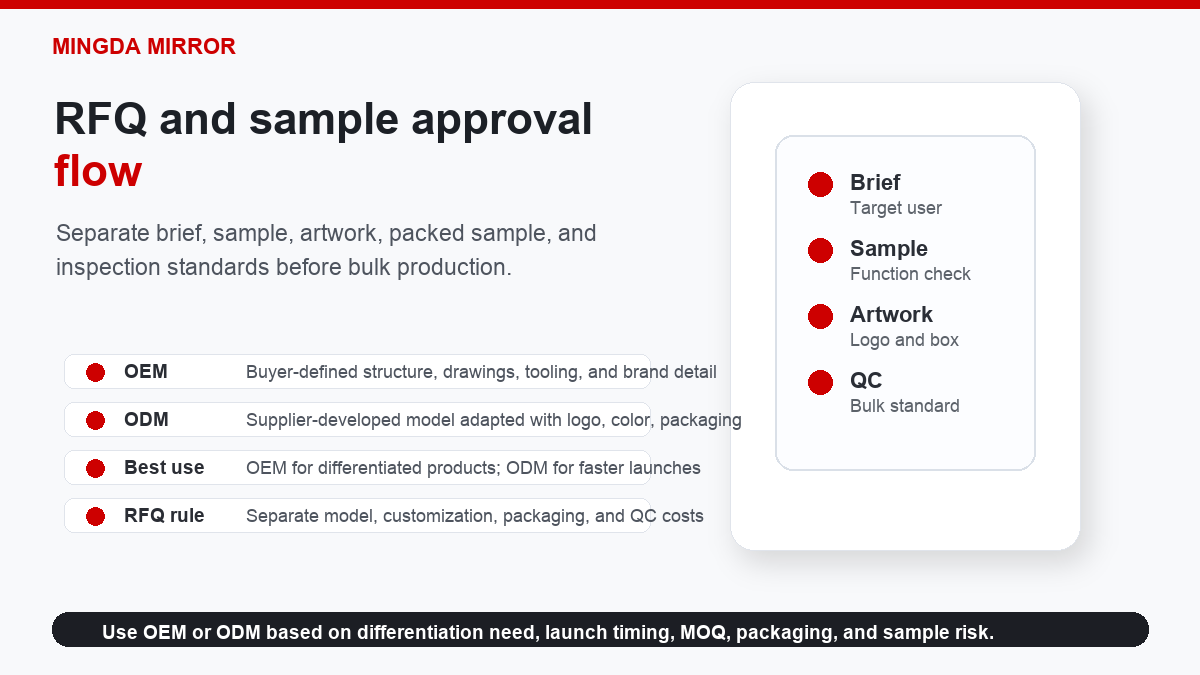
Buyers should also request separate quotation lines for mirror unit cost, logo or printing cost, color box, manual, inner protection, outer carton, spare parts, tooling, sample fee, and inspection requirements. This avoids the common situation where two suppliers look cheaper or more expensive simply because they included different items.
Check lighting, magnification, and power source before customization
Makeup mirror customization should not start with color alone. Buyers should first confirm LED brightness, CCT, CRI target, dimming method, glare control, mirror clarity, magnification level, working distance, power source, charging port, cable, adapter, battery label, and switch durability. These details influence user satisfaction more than surface decoration.
For rechargeable makeup mirrors, battery safety, charging behavior, labeling, and shipping documents deserve early attention. For plug-in mirrors, voltage, plug type, cable length, and adapter quality should be included in the sample review. For magnifying mirrors, packaging and instructions should explain working distance to reduce return risk.
Packaging and sample approval rules
Both OEM and ODM orders need packaging approval before bulk production. A mirror can pass product inspection but fail commercially if the color box feels weak, the mirror moves inside the carton, the manual is unclear, the barcode is wrong, or the e-commerce carton cannot protect the product during parcel delivery. Buyers should approve a packed sample, not only a loose working sample.
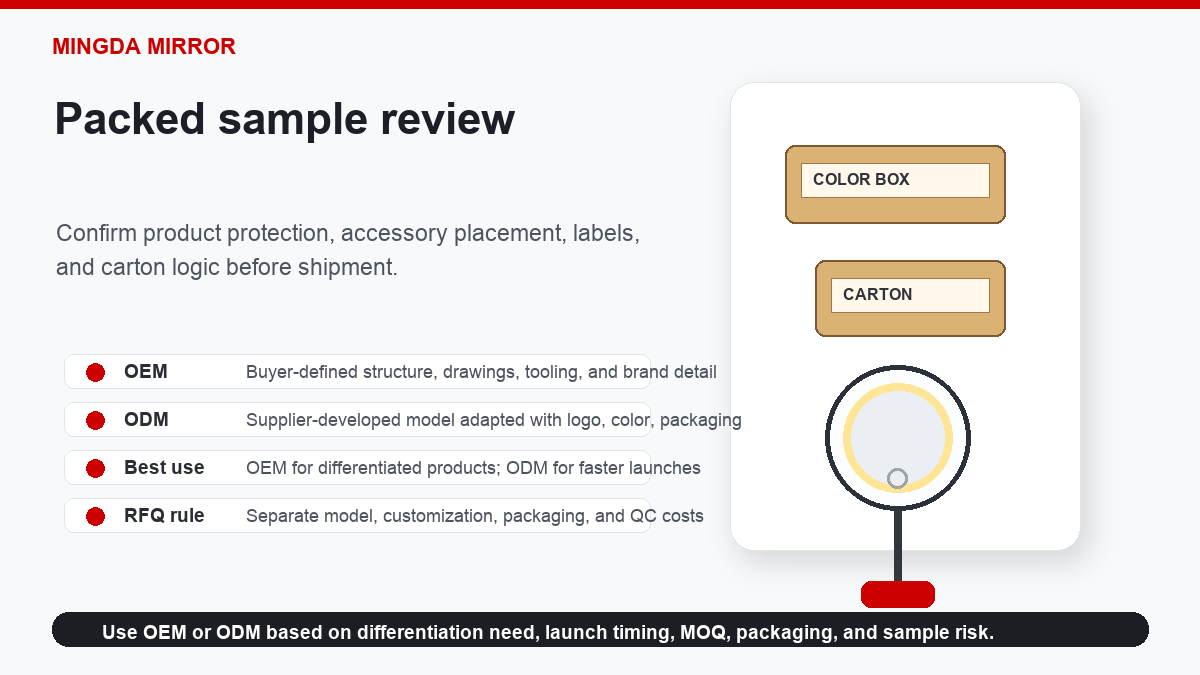
For private-label orders, the packed sample should contain the final mirror, accessory set, manual, warranty card if needed, color box, label, inner tray or foam, and outer carton marks. The supplier should confirm which parts are standard and which parts are custom, because each layer can affect MOQ and lead time.
Pre-order checklist for sourcing teams
- Decide whether the project needs new product development or supplier model adaptation.
- Define target market, sales channel, price range, order quantity, and launch timing.
- Confirm mirror size, LED lighting, CCT, dimming, magnification, power source, finish, and accessory set.
- Ask for separate quotation lines for product, logo, packaging, manual, barcode, carton, sample, tooling, and inspection.
- Approve working sample, artwork proof, packed sample, and QC criteria before mass production.
- Confirm MOQ, sample lead time, production lead time, replacement policy, and shipment photo requirements.
Bottom line recommendation
Choose OEM makeup mirrors when differentiation, exclusive design, or a strict buyer specification justifies more development time and stronger sample control. Choose ODM makeup mirrors when speed, lower launch risk, and proven product structure matter more. In both cases, a good supplier should help buyers define the RFQ, approve samples, control packaging, and verify quality before shipment.
FAQ
Is private-label logo printing OEM or ODM?
Logo printing on an existing supplier model is usually ODM or private-label customization, not full OEM. It becomes closer to OEM when the buyer changes product structure, tooling, or core function.
Which option is better for a first makeup mirror order?
ODM is often better for first orders because the buyer can test market demand with a mature model. OEM is better after the buyer has clear sales data or a specific product gap to solve.
Does OEM always require higher MOQ?
Not always, but OEM often has higher MOQ or setup cost because custom tooling, special materials, new packaging, or longer sample approval may be required.
What should buyers send before requesting a quotation?
Send target market, sales channel, product type, size, lighting, magnification, power source, customization needs, packaging style, quantity, compliance destination, and launch timing.
Social Media Content Ideas
LinkedIn: share the OEM vs ODM decision matrix for sourcing managers. Facebook: explain why first orders often start with ODM. Instagram: show the sample and packaging approval scene. CTA: invite buyers to send their mirror brief for RFQ guidance.
CTA
If you are planning an OEM or ODM makeup mirror project, contact Mingda Mirror with your target market, mirror type, quantity, packaging needs, and launch timing. Our team can help compare product routes, sample requirements, packaging options, and QC points before bulk production.
Home | Product | Makeup Mirrors | OEM / ODM Customization | QC Process | Contact