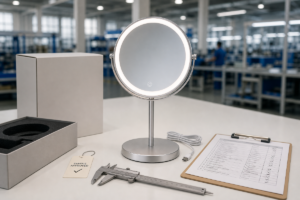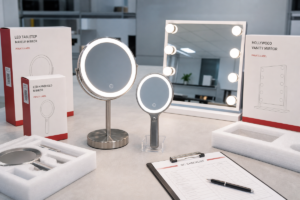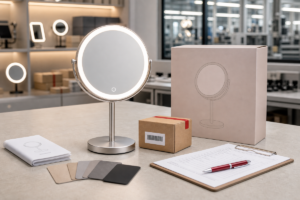

Private label makeup mirror orders should be approved through a clear checklist before bulk production: certification, product sample, logo and packaging artwork, packed sample, inspection standard, and shipment marking. For brand buyers, Amazon sellers, retailers, and importers, the risk is not only whether the mirror looks good. The order can fail if the battery label is wrong, the carton is weak, the logo position is inconsistent, the manual misses required information, or the packed sample is never tested before production.
This guide explains what sourcing teams should confirm when buying LED tabletop makeup mirrors, compact mirrors, rechargeable mirrors, or private-label beauty mirror lines. It is written for buyers who need fewer returns, smoother approvals, and a clearer RFQ before placing a bulk order.
Useful starting points: Makeup Mirrors | OEM / ODM Customization | QC Process | Contact Mingda Mirror.
Start with the market and sales channel
A private-label makeup mirror for a beauty brand is not the same as a mirror for a discount retailer, Amazon listing, salon distributor, or gift channel. Before selecting models, buyers should define the target country, sales channel, retail price range, power source, packaging style, and expected order quantity. These details decide whether the mirror needs a rechargeable battery, plug-in adapter, USB cable, color box, barcode label, manual language, or stronger e-commerce carton.
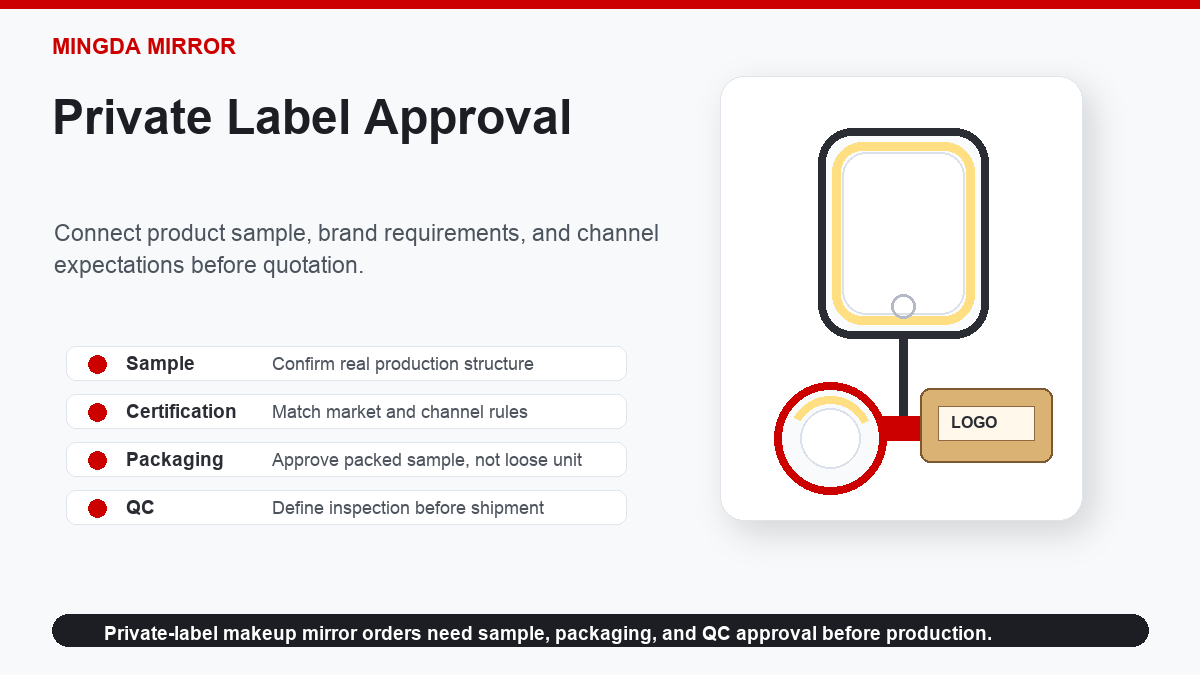
Confirm certification and labeling requirements early
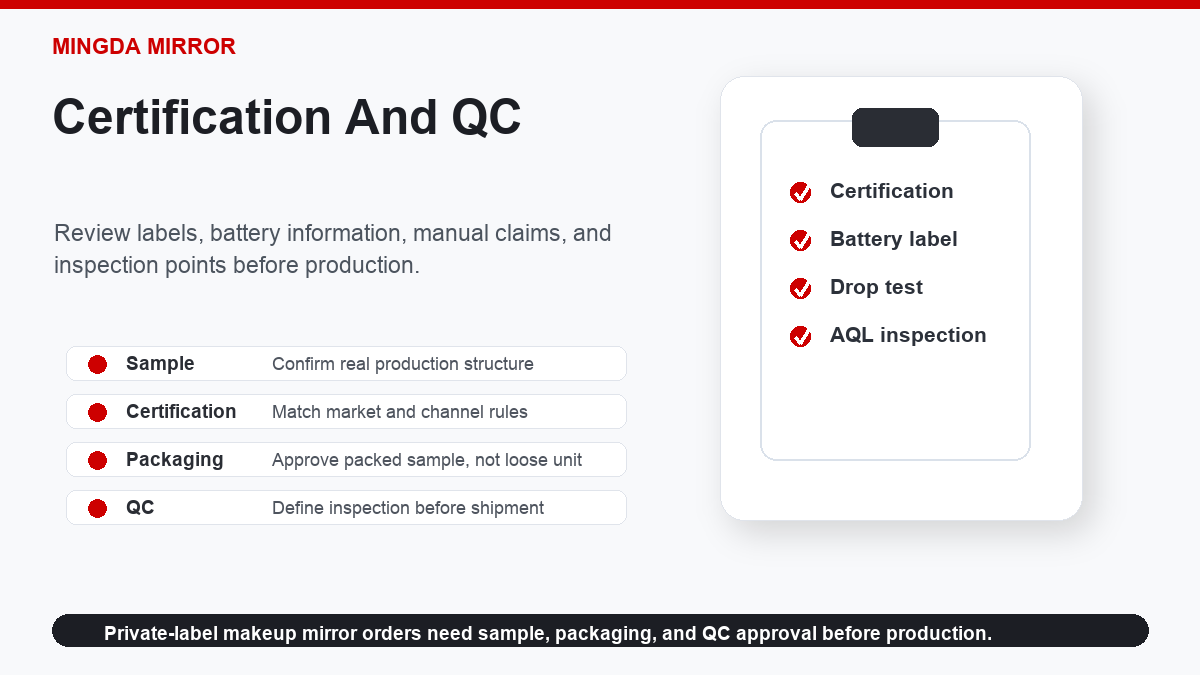
Certification should be checked before the buyer approves the final quotation. For LED makeup mirrors, sourcing teams may need to confirm electrical safety, battery and charging requirements, plug or adapter standards, material claims, packaging labels, recycling marks, and market-specific documentation. The exact requirement depends on destination country and sales channel. A retailer may ask for different documentation than an online seller, and a rechargeable product can need more careful labeling than a simple non-electrical mirror.
The practical rule is simple: do not treat certification as an after-sales document. Add it to the RFQ and sample checklist. Ask which certificates already exist, which reports match the selected model, whether battery information is complete, and whether labels on the product, box, manual, and carton will match the approved order.
Approve the real product sample, not just a picture
Photos are useful for early screening, but they cannot replace a working sample. Buyers should check LED brightness, CCT, dimming response, charging port, switch feeling, mirror clarity, magnification distance, stand stability, hinge strength, frame finish, surface scratches, and accessory quality. If the mirror is rechargeable, charging behavior and cable quality should be checked before mass production.
A good sample review also records what cannot change after approval. This includes mirror size, LED layout, finish color, logo position, packaging dimensions, accessory list, and manual version. Without a written sample approval record, the buyer and supplier may quote the same item but expect different production details.
Separate product cost from private-label cost
Many quotations become confusing because product cost, logo cost, packaging cost, manual printing, barcode label, sample fee, tooling fee, and carton upgrade are mixed together. For private-label orders, ask for a line-by-line quotation. This helps the purchasing team understand what is included and what will change if order quantity, packaging style, or artwork version changes.
Private Label Approval Matrix
| Approval item | What to confirm | Why it matters | Buyer risk if missed |
|---|---|---|---|
| Product sample | Lighting, mirror clarity, power, stand, finish, accessories | Locks the product specification | Different bulk quality from approved expectation |
| Certification and labels | Market documents, battery label, adapter/plug, manual claims | Supports import, retail, and platform requirements | Customs delay, listing issue, or retailer rejection |
| Logo and artwork | Logo position, print color, color box, barcode, manual language | Protects brand consistency | Wrong packaging, rework, or launch delay |
| Packed sample | Foam, inner tray, carton, drop logic, accessory placement | Controls breakage and customer experience | High return rate or damaged shipment |
| QC standard | AQL level, defect list, inspection photos, replacement rule | Defines pass/fail before shipment | Disputes after production is complete |
Make packaging part of the sample approval
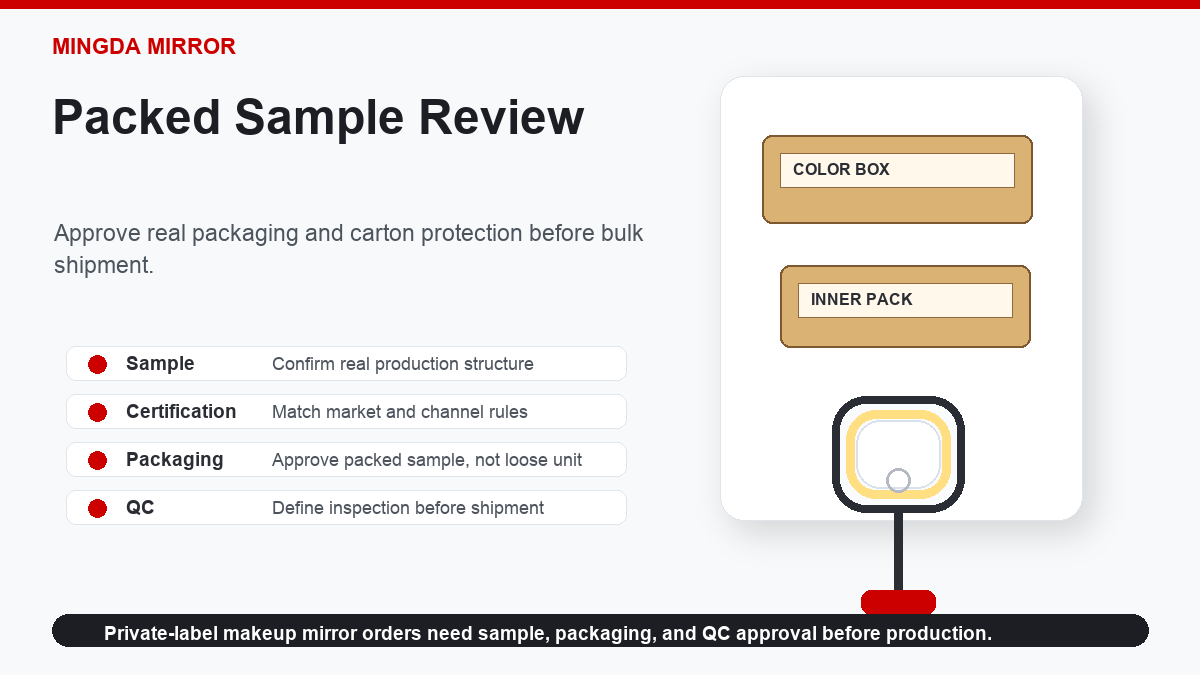
For makeup mirrors, packaging affects both visual value and return risk. A color box may look attractive but still fail if the inner support is weak, the mirror moves inside the box, the cable scratches the surface, or the carton is not suitable for parcel delivery. E-commerce sellers should be especially careful because a mirror can pass factory inspection and still break during last-mile delivery.
Buyers should request a packed sample after product and artwork approval. The packed sample should include the real mirror, actual accessories, manual, logo, insert, color box, labels, and outer carton if possible. This step is slower than approving a loose sample, but it prevents expensive packaging problems after production has started.
Define cosmetic and functional QC standards
Makeup mirror QC should include both appearance and function. Cosmetic checks usually include scratches, dents, color difference, coating marks, logo placement, mirror stains, and packaging print quality. Functional checks include LED brightness, dimming, touch control, charging, battery behavior, magnification clarity, hinge movement, stand stability, and accessory completeness.
The buyer should also define major and minor defects. For example, a non-working LED, loose charging port, broken mirror, wrong logo, or missing adapter is usually a major issue. A small mark on a hidden surface may be handled differently. Clear standards reduce arguments when inspection happens close to shipment.
Check MOQ, lead time, and artwork timing together
Private-label orders often have two MOQ layers: product MOQ and packaging MOQ. A supplier may support the product quantity, but color box printing, logo plate, special finish, or manual printing may have different minimums and lead times. Buyers should ask for the sample lead time, artwork approval time, production lead time, inspection window, and shipping preparation time in one schedule.
This is especially important for seasonal launches, Amazon inventory planning, retailer planograms, and distributor replenishment. A product can be technically ready but commercially late if packaging approval or labeling is not scheduled early enough.
Pre-RFQ Checklist for Buyers
- Define target market, sales channel, quantity, retail price range, and product role.
- Confirm mirror type, size, LED lighting, CCT, dimming, magnification, power source, and accessories.
- Ask which certification documents, battery labels, plug standards, and packaging marks apply.
- Request separate quotation lines for product, logo, packaging, manual, barcode, and carton upgrade.
- Approve product sample, artwork proof, packed sample, and inspection criteria before production.
- Confirm AQL level, major/minor defects, replacement policy, carton marks, and shipment photos.
Bottom Line
A private-label makeup mirror order is ready for bulk production only when the buyer has approved the product sample, certification and labels, logo artwork, packed sample, QC standard, and shipment marking. The best suppliers help buyers turn these details into a clear checklist before the purchase order, not after problems appear.
FAQ
What should be checked first in a private-label makeup mirror order?
Start with the target market, sales channel, mirror type, power source, certification needs, packaging style, and order quantity. These decisions affect quotation, sample approval, and lead time.
Should buyers approve a packed sample?
Yes. A loose mirror sample cannot prove packaging strength, accessory placement, barcode accuracy, or carton protection. A packed sample is especially important for e-commerce and retail orders.
Why does certification matter before production?
Certification and labeling can affect import, retailer approval, platform listing, and customer safety expectations. If the wrong document or label is discovered late, launch timing can be delayed.
Can Mingda support OEM/ODM private-label makeup mirror orders?
Yes. Mingda Mirror can support product selection, logo placement, packaging planning, sample approval, QC inspection, and shipment preparation for makeup mirror and related LED mirror orders.
Social Media Content Ideas
LinkedIn: share the approval matrix as a procurement checklist for beauty brands. Facebook: explain why packed samples reduce return risk. Instagram: show a clean mirror, box, and QC checklist scene. CTA: invite buyers to send target market, quantity, packaging, and certification needs for a quotation.
CTA
If you are preparing a private-label makeup mirror order, contact Mingda Mirror with your target market, product type, quantity, packaging style, logo requirements, and certification needs. Our team can help review the product, packaging, and QC points before bulk production.
Home | Product | Makeup Mirrors | OEM / ODM Customization | QC Process | Contact