

Focus keyphrase: LED makeup mirror touch control validation
SEO title: LED Makeup Mirror Touch Control Validation | Mingda Mirror
Meta description: Validate LED makeup mirror touch controls with sample tests, cleaning checks, and RFQ requirements before retail production.
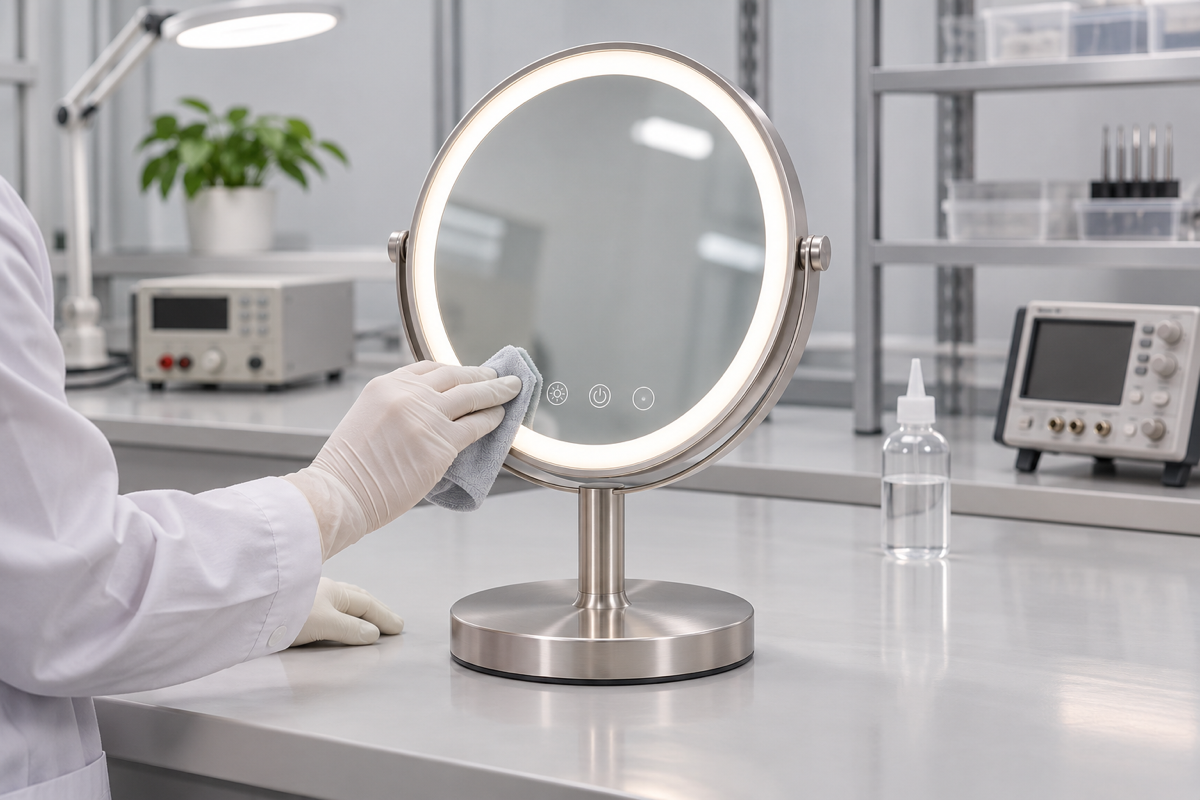
Retail buyers should approve an LED makeup mirror touch panel as a complete user interface, not as a decorative icon on a sample. LED makeup mirror touch control validation means confirming that the final mirror responds correctly after normal use, cleaning, packing, transport, and the lighting/control sequences promised to the customer. For beauty brands, retailers, and e-commerce sellers, the relevant question is simple: can a customer turn the mirror on, adjust it, and understand its behavior every time without an avoidable return or support ticket?
This guide explains how to validate a capacitive touch-control area on a finished tabletop LED makeup mirror before a bulk release. It is not a claim that every model needs the same test; the method should match the approved product design, target market, instructions, and buyer risk tolerance.
Start with the customer interaction, not the icon layout
A touch symbol can look clean while the customer interaction is unclear. On an approved finished sample, identify what a short tap, long press, repeat tap, and power-off state are meant to do. Typical functions may include on/off, brightness adjustment, color-temperature selection, and memory. The supplier, buyer, user manual, carton copy, and online listing should describe the same sequence.
Check the actual production-intent configuration: mirror glass, printed icon area, LED driver, control board, power source, housing, stand, cable or adapter, and firmware or control logic where applicable. A touch-panel result from an early engineering sample is not enough if any of those elements have changed.
| Buyer question | What to validate on the finished mirror | Risk if it is not agreed |
|---|---|---|
| How does it wake or switch off? | Short-touch response, response timing, and intentional versus accidental activation | Customer confusion and returns |
| How is brightness adjusted? | Long-press logic, low-end dimming, release behavior, and repeatability | Product feels inconsistent or hard to use |
| How are light modes selected? | Tap sequence, visible mode change, and final user instruction | Listing/manual mismatch |
| Does it remember a setting? | Power-off and power-restoration behavior under the agreed use case | Unclear customer expectations |
| Does cleaning affect operation? | The approved cleaning method and function after the surface is dry | Service claims that cannot be supported |
Avoid calling a panel “waterproof” or “spill-proof” unless the specific construction and agreed evidence support that claim. A tabletop makeup mirror is usually evaluated for normal consumer handling and cleaning, not for an unstated ingress rating.
Validate normal-use and cleaning conditions separately
Touch controls can be influenced by surface residue, fingerprints, incorrect cleaning materials, incomplete drying, protective films, and the way the product is held. The buyer should specify the intended cleaning instruction first—such as a soft dry cloth or a lightly dampened cloth followed by drying—and then confirm the finished sample works as intended before and after that approved procedure.
The goal is not to make unsupported durability promises. It is to ensure that the product, its packaging inserts, and the user guidance are aligned. If the touch area must be dry before use, state that clearly in the instruction set rather than leaving the consumer to discover it.
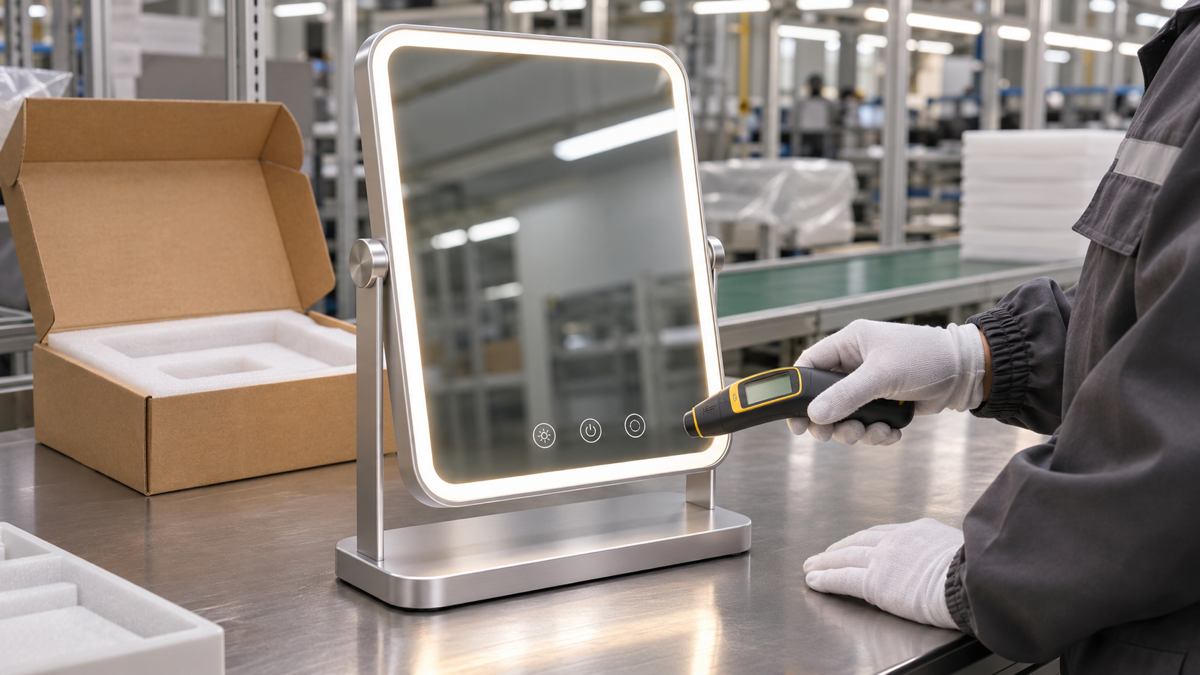
A practical buyer-side sample check
Use a final-configuration sample and an agreed check sheet. First inspect the icon printing, glass edge, panel alignment, and visible residues. Then operate each function repeatedly under normal dry use. Next, follow the approved cleaning instruction, allow the surface to reach the stated dry condition, and repeat the same control sequence. Record observations, not just a generic “pass.”
For rechargeable models, validate the control behavior while charging and after charging only if those are intended and safe operating states for that model. For plug-in models, validate with the final adapter and cable specification. This keeps a control-panel decision connected to the accessories that actually reach the customer.
Turn touch-control approval into a production control
A buyer-approved sample should lead to an inspection point, not remain only a photo in an email thread. Agree what the factory will check during incoming component review, assembly, final functional inspection, and pre-shipment sampling. The exact frequency and acceptance standard are commercial decisions, but the inspection description should be unambiguous.
| Control point | Buyer should ask the supplier to confirm | Commercial consequence |
|---|---|---|
| Printed glass / icon area | Icon position, finish, adhesion or appearance standard, and approved artwork revision | Prevents visual mismatch with packaging and listings |
| Assembly | Correct sensor/control-board location, wiring, and glass fit for the approved model | Reduces intermittent operation caused by variation |
| Final functional check | The agreed basic on/off, dimming, and mode sequence | Makes a user-visible function part of release control |
| Packing check | Whether protective film, foam, instructions, or accessories can interfere with the panel | Avoids an unboxing failure that looks like a product defect |
| Change control | Whether a glass, printed icon, controller, driver, or firmware revision needs buyer notice | Protects the approved customer interaction across repeat orders |
Ask for a reference to the golden sample or approved video/check sheet in the purchase-order file. If the supplier changes the touch controller, glass construction, icon artwork, LED driver, or power arrangement, assess whether the change can alter function before it reaches a later production lot. See Mingda Mirror’s quality-control process for the broader production-control context.
Control the packaging and channel risk
For retail and Amazon-style channels, a functional mirror can still be returned if the first-use experience is unclear. The inner tray, protective film, quick-start card, manual, cable position, and retail display unit should not hide the touch area or cause the customer to assume the unit is defective.
Confirm whether a protective film covers the control area and whether it must be removed before first use. If so, make that instruction visible in English without adding an unsupported performance claim. A buyer should also check that the first-use instruction matches the actual control sequence and the selected product variation.
MOQ, sample lead time, and bulk lead time may change if the buyer requests a special icon layout, private-label artwork, extra functional sampling, a revised manual, or a new controller. Put those impacts in the quotation before approving production. For private-label decisions, Mingda Mirror’s OEM/ODM support can be the starting point for defining the approved configuration.
RFQ-ready touch-control validation checklist
Before issuing a purchase order, ask the supplier to confirm:
1. The exact model, mirror size, finish, power version, and touch functions to be approved. 2. Short-touch, long-press, dimming, mode, and memory behavior in plain English. 3. The final glass/icon artwork revision and whether a protective film is fitted. 4. The intended cleaning instruction and any condition that must be met before operation. 5. The complete sample configuration: driver, controller, battery or adapter, cable, housing, and LED layout. 6. The functional checks included in final inspection and the evidence available to the buyer. 7. Which component or artwork changes require a new sample review or written buyer notice. 8. Manual, carton, listing, and customer-service wording required for the approved behavior.
Common buyer mistakes to avoid
Approving a function on an early sample only
An early sample may use a different panel, driver, cable, or housing. Approve the production-intent mirror, especially when the user interface is part of your retail promise.
Writing claims before the operation sequence is frozen
Do not publish “one-touch,” “memory,” or cleaning-related language until it matches the approved finished sample and instructions. Marketing copy should describe the released configuration, not an assumed feature.
Treating packaging as separate from the product experience
A misplaced film or unclear quick-start card can create a return even when the control works. Validate the unboxing sequence together with the mirror.
Bottom line for buyers
Treat LED makeup mirror touch control validation as a finished-product and customer-experience approval. Define the intended control sequence, validate it on the final configuration before and after the approved cleaning procedure, connect it to inspection and change control, and align every instruction and listing claim. That approach is more valuable than a broad promise: it gives your team a traceable decision for bulk release.
To build an approval plan around your mirror model, explore Mingda Mirror’s makeup mirror range, review the quality-control process, and contact Mingda Mirror with your target market, control functions, packaging format, and expected order quantity.
FAQ
Should buyers ask for a touch-control cycle test?
Ask for a test approach that fits the product, intended use, and agreed specification. More importantly, confirm that the final sample’s basic operation is checked consistently and that any specific endurance requirement is documented in the RFQ or purchase order.
Can a damp cloth be used on a touch-control mirror?
Follow the product’s approved cleaning instruction. Buyers should validate the instruction on the final sample and avoid making waterproof or moisture-resistance claims that are not supported by the product design and evidence.
What changes require another buyer approval?
Changes to the glass/control area, icon artwork, controller, driver, power arrangement, operating sequence, or instructions can affect the customer experience. Assess the change against the approved sample and release record before mass production.
What should an e-commerce seller retain after approval?
Keep the approved sample record, control sequence, final artwork and instruction files, packaging photos, inspection agreement, and any relevant change notices. These records help the team investigate a listing or service issue without guessing which configuration shipped.