

Focus keyphrase: LED makeup mirror driver revision control
SEO title: LED Makeup Mirror Driver Revision Control | Mingda Mirror
Meta description: Control LED makeup mirror driver revisions with sample re-approval, test points, and RFQ records before mass production.

When a supplier proposes a new LED driver, PCB, touch-control board, or power component for an LED makeup mirror, buyers should treat it as a controlled product change—not a routine substitution. LED makeup mirror driver revision control means confirming what changed, why it changed, which functions can be affected, and which production-intent sample must be re-approved before mass production. For brands, retailers, and e-commerce sellers, this protects lighting consistency, dimming behavior, charging performance, user safety, and listing claims from an unrecorded component change.
This guide is for buyers sourcing rechargeable and plug-in tabletop makeup mirrors. It turns an unseen electronics change into clear sample, quotation, and release decisions.
Start with a specific change notice
A useful notice names the affected model, old and new component or revision, reason for the change, proposed effective lot, and expected mechanical, electrical, firmware, packaging, label, or test-report impact. “Same function” is not sufficient. A driver with a similar input rating can still alter low-end dimming, color-temperature steps, standby draw, touch response, flicker, heat, or charging interaction.
Ask the supplier to identify the bill of materials, approved sample, artwork or manual statement, inspection plan, and agreed test evidence affected by the change. This prevents a buyer from approving a board on a bench while a different mirror configuration enters production.
| Proposed change | Buyer should re-check | Risk if skipped |
|---|---|---|
| LED driver or constant-current circuit | Brightness range, dimming, CCT steps, flicker and heat | Inconsistent experience or lighting claims |
| Touch-control or memory board | Tap/hold logic, response time, power-off memory | Reviews and support requests |
| USB-C charging or protection circuit | Charge behavior, cable fit, indicator behavior and runtime | Charge failures or listing mismatch |
| LED strip or diffuser interface | Uniformity, glare, color appearance and assembly fit | Visible variation between units |
| Adapter or cable source | Input compatibility, labeling and packed-set function | Accessory failures or market-specific issues |
Decide whether the change needs sample re-approval
The practical question is whether the revised part changes a buyer-approved function, appearance, claim, interface, or risk control. A lot-code-only update with no specification effect may need traceability records. A new driver revision normally needs a production-intent sample review.
Re-approve when the change can affect lighting, control logic, charging, power consumption, heat, cable or adapter compatibility, user manual, product label, online listing, test report, PCB fit, diffuser, switch, housing, or an agreed inspection point. The sample must represent the final mirror size, LED layout, control interface, battery or adapter, cable, housing, and finish. A board alone cannot show how the finished illuminated mirror behaves.
| Review level | Typical example | Minimum buyer action | Release decision |
|---|---|---|---|
| Traceability update | Same approved circuit and function; lot documentation changes | Record lot and retain comparison evidence | Release only if no agreed specification changes |
| Functional verification | Component revision claimed to have equivalent output | Test complete sample against approved reference | Release after documented buyer acceptance |
| Full re-approval | New driver design, control logic, charging behavior, LED interface or rating | Production-intent sample, targeted tests, records | Do not start mass production before written approval |
Avoid approving from a component data sheet alone. Compare the finished sample side-by-side with the approved reference at the same brightness and color modes. For makeup use, include the lowest dimming level and the normal viewing distance—not only a fully lit studio photo.
Use a finished-mirror verification plan
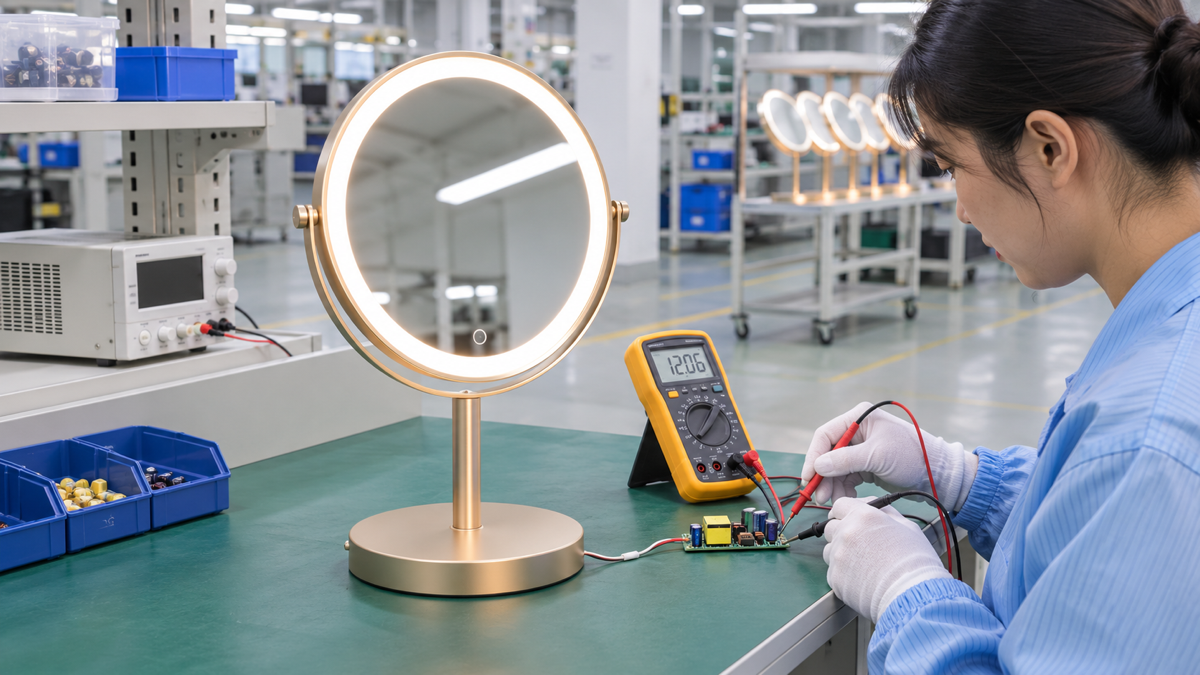
Agree test methods and pass/fail criteria that match the product and target market. Do not insert unsupported performance numbers merely because another model used them. A concise comparison record is more useful than a generic test list.
For a revised driver, the approval record should capture:
1. Model, revision identifier, sample date, and old-versus-new component reference. 2. Input source and final accessory set used for review. 3. On/off, dimming, color-temperature, memory, and touch or switch behavior. 4. Lighting uniformity, glare behavior, unexpected noise, and flicker observation under the agreed method. 5. Charging and indicator behavior for rechargeable models, or adapter/cable compatibility for plug-in models. 6. Thermal, appearance, housing-fit, wiring, and final-function observations after the agreed run-in or cycle check. 7. Decision, exceptions, corrective-action owner, and written release status.
Retain the same configuration as a reference sample or link the record to the golden sample. This lets buyer and factory distinguish an authorized revision from an uncontrolled substitution when later orders retain the same model number.
Connect technical approval to channel claims
If a revision changes charging time, indicator color, operating sequence, rated input, power consumption, or accessory specification, review the manual, carton wording, warning label, online listing, and customer-service instructions before shipment. A correct product can still generate negative reviews when its published instructions describe the old behavior.
For Amazon and other e-commerce channels, keep a finished-sample functional record with listing assets. A new driver may not change the exterior photo, but it can change a long press, remembered setting, charging indicator, or usable dimming range. For retail, ensure display units and replenishment stock use the released revision.
MOQ, sample timing, and lead time can change when a driver revision requires new board stock, revised manuals, additional testing, or a market-specific accessory. Request that impact in the quotation or change notice before purchase-order confirmation.
RFQ-ready driver revision checklist
Before approval, ask the supplier to confirm:
1. Affected model numbers, colors, sizes, and production lots. 2. Old and proposed component identifiers and reason for change. 3. Impact on lighting, controls, charging, battery, heat, labels, or accessories. 4. Which final production-intent sample will be supplied. 5. Agreed verification method, evidence format, and pass/fail decision owner. 6. Whether manuals, cartons, listings, or compliance files require revision. 7. First mass-production lot that may use the revision and its traceability marking. 8. Corrective-action and replacement-part plan if a post-shipment issue is linked to the revision.
Common mistakes buyers should avoid
Treating a driver change as invisible
An internal electronics change can alter visible lighting and consumer interaction. Review it in the finished product, not only on a supplier statement.
Approving the sample but not the effective lot
State which production lot may use the revised driver. Otherwise the factory, trading team, and buyer can each assume a different release date.
Forgetting channel assets
If the operating sequence or accessory changes, revise the manual, listing, and retail display before delivery.
Bottom line for buyers
Treat LED makeup mirror driver revision control as a finished-product approval decision. Require a specific change notice, compare a production-intent sample with the approved reference, record the critical lighting and control checks, and release a traceable first lot only after commercial materials match the revised product.
For a buyer-specific approval plan, review Mingda Mirror’s makeup mirror range, see the quality-control process, explore OEM and ODM support, and contact Mingda Mirror with your model, target market, control functions, and expected quantity.
FAQ
Does every LED driver revision need a new approval sample?
No. The level should match the risk. A change that can affect lighting, controls, charging, safety, a buyer claim, or an agreed inspection point should be reviewed in a complete production-intent sample.
What should be written in the approval record?
Record the model, old and new revision, sample configuration, test observations, decision, effective production lot, and related manual, label, or packaging changes.
Can a supplier start production while the buyer reviews the new driver?
Only if the buyer has explicitly authorized that risk in writing. For a buyer-visible or safety-relevant change, hold the configuration until the release decision is documented.
How does a driver revision affect private-label orders?
It can affect control instructions, rated-input or accessory statements, retail packaging, online claims, and replacement-part planning. Review those assets alongside the finished sample.