

Focus keyphrase: LED makeup mirror hinge durability SEO title: LED Makeup Mirror Hinge Durability Guide | Mingda Mirror Meta description: Approve LED makeup mirror hinge and stand durability with practical sample tests, packaging checks, and RFQ points before bulk production.
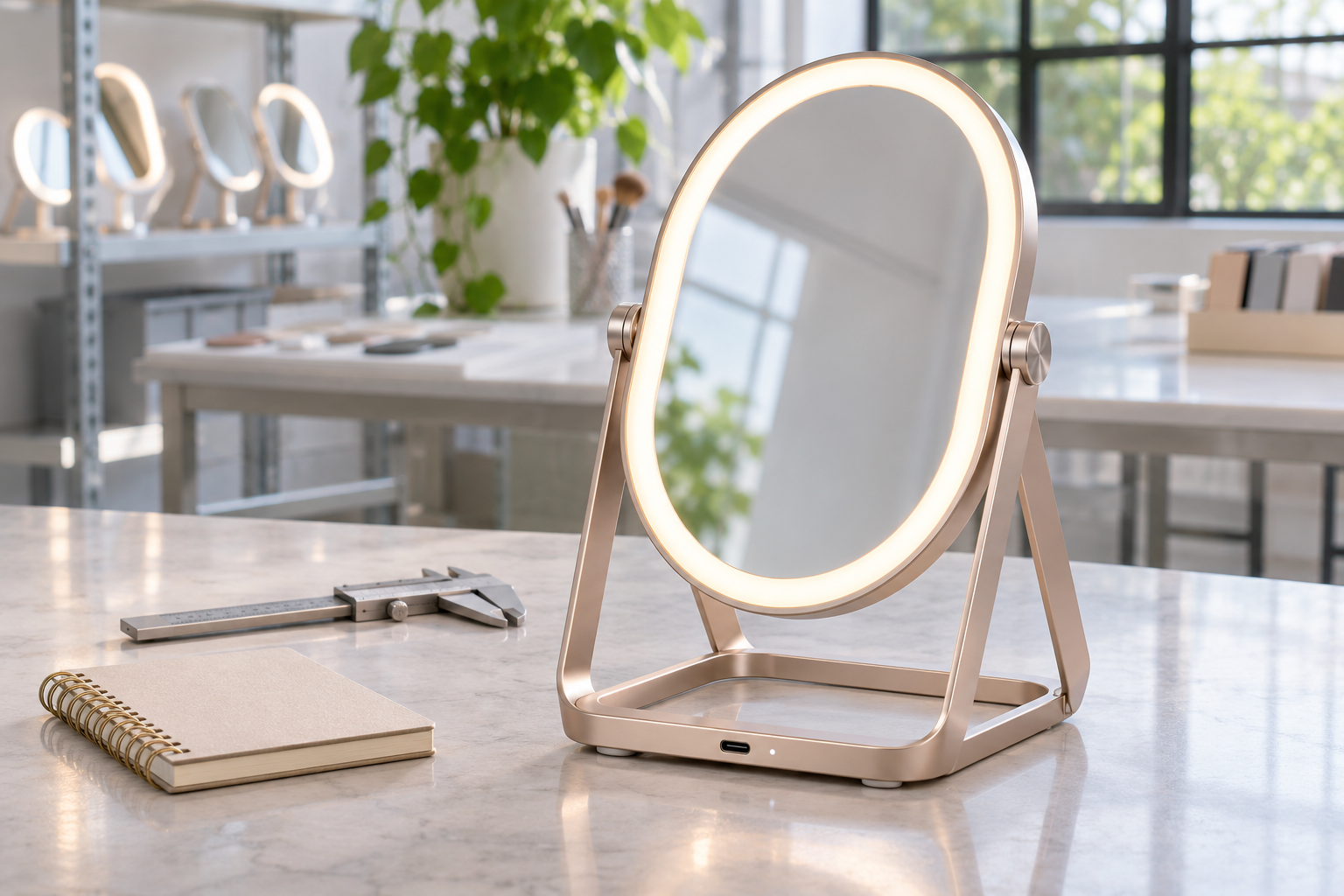
For a folding LED makeup mirror, the hinge and stand determine whether the product still feels stable after it has been opened, adjusted, packed, and used repeatedly. Beauty brands and e-commerce sellers should approve LED makeup mirror hinge durability by defining the opening range, holding force, wobble limit, finish acceptance, cycle-test method, and packed-product check before bulk production. A bright, well-designed mirror can still earn returns if its lid drops, its stand loosens, or the hinge develops play after normal use.
This guide is for buyers sourcing rechargeable tabletop or folding LED makeup mirrors for retail, gifting, and online channels. It turns a vague “strong hinge” request into clear sample and quotation decisions.
Start with the user position, not a generic durability claim
The acceptable hinge feel depends on how the mirror is used. A compact carried in a cosmetics bag faces different risk from a tabletop vanity mirror left open on a counter. Ask the supplier to demonstrate the approved product at the same positions a consumer will use.
| Sales scenario | What the hinge or stand must do | Main return risk |
|---|---|---|
| Travel compact or gift item | Open smoothly, stay closed in transit, resist accidental activation | Loose lid, scratched face, broken hinge after bag use |
| Tabletop retail mirror | Hold the chosen viewing angle on a stable surface | Stand creep, wobble, mirror dropping backward |
| E-commerce launch | Work intuitively for first-time users after repeated opening | Inconsistent torque, pinched fingers, confusing adjustment |
| Salon or store display | Withstand frequent demonstrations | Early play, noisy movement, cracked decorative cover |
The buyer should identify whether the product uses a friction hinge, a detent hinge, a folding kickstand, or a linked base mechanism. These parts can look alike in photos while behaving very differently after cycling. The approval sample should show the complete production-intent housing, mirror glass, LED assembly, battery configuration, and stand—not only an early mechanical mock-up.
Compare hinge and stand choices before tooling is frozen
| Construction | Best fit | What to approve | Trade-off |
|---|---|---|---|
| Friction hinge | Adjustable tabletop mirror | Holding force at minimum, middle, and maximum intended angle | Too much force can feel premium but make one-hand adjustment difficult |
| Positive-stop / detent hinge | Compact mirror with defined open positions | Each stop position, click feel, and no unexpected release | Fewer usable angles; detent wear must be tested |
| Folding kickstand | Slim rechargeable mirror | Contact area, anti-slip pads, and stability at normal makeup distance | Small feet or a narrow base can create tipping risk |
| Linked base and mirror arm | Larger vanity mirror | Joint play, cable routing, and angle retention after cycling | More assembly points and cosmetic gap controls |
Do not choose only by the first opening feel. A hinge that is excessively tight can pull on a thin housing or make the product frustrating to use; one that is too free can allow the illuminated mirror to drift during makeup. For online retail, a stable, repeatable user action normally matters more than adding the broadest possible adjustment range.
Use a repeatable sample test instead of “open and close it a few times”

Agree a practical cycle plan with the supplier before the purchase order. The relevant count, speed, force, dwell position, and pass/fail criteria should suit the product and channel; there is no reliable universal number that can be copied between constructions. At minimum, record the test method and inspect the same unit before and after cycling.
Check these points:
1. Open and close the hinge or stand through the agreed operating range. 2. Hold the mirror at the intended consumer viewing angles and check for downward creep. 3. Confirm the base remains stable on a smooth, level surface at normal touch force. 4. Inspect hinge covers, screws, housing gaps, LED light output, touch control, and charging function after the test. 5. Recheck the closed fit, magnetic or latch behavior where applicable, and any decorative finish around the joint. 6. Photograph or retain the tested sample with the approved test record for reorder comparison.
A useful report does not need unsupported lifetime promises. It should show the actual unit, configuration, test condition, result, visual inspection points, and any change from the approved reference. If the hinge uses a custom color, metal plating, logo panel, or a revised front cover, repeat the evaluation because assembly tolerance can change the feel.
Packaging can protect or damage the approved mechanism
The hinge can pass on the bench and still arrive loose if the product moves inside its retail box. Request a packed-sample review with the mirror in its normal shipping position. Confirm whether the stand is folded, whether foam or a molded insert supports the fragile side, how the USB cable is separated, and whether the carton prevents the lid from being forced open.
For private-label orders, include the mechanism condition in the packaging approval sheet: closed position, protective film or pouch requirement if specified, accessory location, drop-test scope when agreed, and post-transit functional check. Custom packaging, new inserts, or a changed cable compartment can affect pressure on the mirror body. MOQ, sample timing, and lead time may change if a new insert or protective structure is required, so request that cost and timing with the quotation rather than after artwork approval.
RFQ-ready hinge and stand checklist
Before requesting a quotation, provide or confirm:
1. Mirror format, size, and intended sales channel. 2. Required open positions or adjustment range and whether the mirror must stay closed during transit. 3. Preferred construction: friction hinge, detent, kickstand, or linked base. 4. Required stability check and the surface or use condition to simulate. 5. Cycle-test method and visual/function acceptance points after the test. 6. Final housing, finish, logo, cable, battery, and lighting configuration for the sample. 7. Packaging position, insert support, and post-packaging inspection request. 8. Replacement and lot-traceability process if a recurring looseness issue appears after shipment.
Common buying mistakes
Approving only the open display angle. Ask to see the mirror at the full expected use range; a stable upright photo does not prove that intermediate positions hold.
Testing a bare mechanical sample. The production mirror’s glass, LEDs, battery, cable path, and decorative covers change load and clearance.
Ignoring packaging force. A well-made hinge can be damaged by an insert that presses on the lid or stand during transit.
Treating looseness as cosmetic. Excess movement can become a functional complaint and an after-sales cost, especially when a user cannot keep the lighted mirror at a usable angle.
Bottom line for buyers
Approve LED makeup mirror hinge durability as a stability, user-experience, and packaging requirement. Select the mechanism for the actual channel, test the complete production-intent sample at realistic positions, document holding and appearance criteria, and repeat the check after packaging review. This gives the factory a workable standard and helps the buyer avoid returns caused by a mirror that feels unstable even though its lighting performs well.
To prepare the full product brief, review Mingda Mirror’s makeup mirror range, see the quality-control process, explore OEM and ODM support, and contact Mingda Mirror with your target channel, preferred mechanism, sample plan, packaging requirement, and estimated quantity.
FAQ
What should buyers ask for when approving a makeup mirror hinge?
Ask for a production-intent sample, the intended angle range, a documented cycle method, stability checks at use positions, post-test visual and function results, and packaging-condition verification.
Can a tighter hinge always mean a better mirror?
No. Excessive force can reduce ease of use or stress a thin housing. The target is controlled, repeatable holding force suited to the product’s size and user action.
Should hinge performance be checked before shipment?
Yes. Add an agreed open/hold/close inspection to pre-shipment checks, together with lighting, controls, charging, glass, appearance, and packing inspection.
Can a new retail box affect hinge quality?
Yes. An insert or accessory compartment can exert pressure on the lid or stand. Review a packed production-intent sample whenever packaging structure changes.