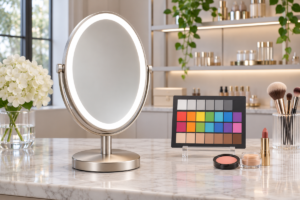

An LED makeup mirror can meet a nominal brightness target and still create costly returns if its light is visibly uneven. For a brand, retailer, or e-commerce seller, the practical decision is not simply “how bright is it?” It is whether the ring or frame delivers consistent illumination around the face at the agreed color temperature and dimming levels. Specify the measurement method, sample conditions, and acceptance rule before approving mass production; otherwise a supplier and buyer can both call the same sample “acceptable” while judging different things.
Why light uniformity belongs in the RFQ
Uniformity describes how evenly light is distributed across the illuminated perimeter and onto the user’s face. Hot spots, dark corners, visible LED dots, and a noticeably warmer or cooler section can make a mirror feel low-grade even when the glass, stand, and package are sound. They also create a listing-to-delivery mismatch for online sellers whose product photos show a soft, continuous light line.
For sourcing teams, light uniformity is a system result: LED binning, diffuser material and thickness, LED pitch, driver behavior, housing tolerance, and assembly all matter. A request for “bright LED” does not control any of those variables.

The buyer decision: what should be tested?
Ask the factory to approve a test method that can be repeated on the golden sample, pilot run, and final inspection sample. The table below is a practical starting point; final thresholds should be agreed for the product’s price position and target channel.
| Checkpoint | What to observe or measure | Why it matters commercially |
|---|---|---|
| Perimeter appearance | Look for a continuous light line at normal viewing distance | Visible dots or corner shadows drive perceived-quality complaints |
| Multi-point output | Compare readings at the top, bottom, left, and right light zones | Confirms one section is not substantially weaker than the rest |
| CCT consistency | Check each zone at every selectable color mode | Avoids one side looking warmer or cooler in customer photos |
| Dimming behavior | Test at high, mid, and low settings after a short warm-up | Some unevenness only appears at reduced output |
| Reflection and glare | View a face or neutral target in normal use position | Bright internal reflections reduce makeup-use comfort |
| Repeatability | Re-check several units from the pilot run | A good engineering sample alone does not prove production control |
Use a simple acceptance protocol
For a lighted tabletop mirror, a buyer can ask for a neutral room condition, a stabilized power state, and readings at four equivalent light positions. Record the reading method and a pass/fail rule in the signed sample sheet. Do not require a laboratory claim when a practical visual-and-meter protocol is sufficient—but do not rely on a phone photo alone, either. Camera auto-exposure can hide unevenness that a user will see.
Choose the right specification for your sales channel
The most demanding specification is not always the right one. An entry retail line may prioritize a smooth visual perimeter and stable low-light dimming. A prestige beauty line may need tighter visual matching between CCT modes, refined diffusion, and more sample approvals. An Amazon seller should add repeatable photo/video checks because the listing imagery sets buyer expectation before delivery.
| Buyer channel | Prioritize | Avoid |
|---|---|---|
| Beauty retail | smooth halo, premium diffusion, consistent color appearance | approving only one maximum-brightness photo |
| Amazon / e-commerce | repeatable visual check, listing-match review, carton-safe sample | claims that cannot be demonstrated in the listing |
| Gift / travel compact | stable low dimming, controlled heat, battery-state check | judging only while plugged in at full power |
| Distributor | documented sample rule and replacement decision path | different acceptance standards for each reorder |
Design and production factors that change the result
Diffuser and LED pitch
A diffuser can soften individual LED points, but its performance depends on the spacing between LEDs and the internal optical distance. A very thin diffuser may look economical in a static photo but reveal hot spots when the user is close to the mirror. Ask to view the mirror from typical makeup distance as well as from the front.
Driver, dimmer, and power state
Check uniformity after the product warms up and at each requested dimming level. For rechargeable products, test both a charged battery condition and the agreed charging/plug-in mode. This complements the charging specification work in our USB-C rechargeable mirror buyer guide.
Housing and assembly tolerance
Uneven fit around a light frame can change perceived brightness or create light leaks. Include a visual inspection point for diffuser seating, corner alignment, and visible gaps. For a broader view of production controls, see our mirror development process guide.
Common buyer mistakes
- Approving an overexposed sample photo. Request a normal-exposure video sweep and an in-person or agreed remote visual check.
- Testing only the center brightness. The customer sees the entire perimeter, especially on rectangular and Hollywood-style formats.
- Leaving CCT undefined. “Three colors” is not an acceptance standard; confirm the required modes and visual consistency of each.
- Skipping pilot-run sampling. A tooling or engineering sample may not reflect production LED bins, assembly fixtures, or material lots.
- Treating a cosmetic complaint as separate from QC. Uneven light is a product-experience defect that needs a clear rework, replacement, or release decision.
Pre-RFQ checklist for light-uniformity control
- Identify the mirror type, light-frame shape, target CCT modes, brightness range, and dimming method.
- State the viewing condition: normal makeup distance, neutral ambient light, and power state.
- Define visual defects to reject: LED points, shadows, light leaks, corner discontinuity, or visible CCT shift.
- Agree the multi-point meter method and whether results are recorded by unit or by lot.
- Request golden-sample photos and video at high, mid, and low brightness.
- Confirm pilot-run sampling quantity, AQL or agreed inspection approach, and corrective-action timing.
- Align carton, manual, and listing images with the approved light appearance before shipment.

Bottom line
For most B2B mirror programs, specify visual continuity plus a repeatable four-zone check across the requested CCT and dimming modes. That gives your team a usable production control without pretending that a single brightness number guarantees a premium experience. Approve the rule on the golden sample, repeat it on pilot units, and make the release decision traceable.
Mingda Mirror can help buyers turn that rule into a product-specific sample checklist covering light frame, CCT, dimming, power mode, packaging, and inspection. Explore our LED makeup mirror range or contact the manufacturing team with your target channel, dimensions, CCT modes, and expected order volume for an RFQ-ready review.
FAQ
Is a lux reading alone enough to approve an LED makeup mirror?
No. A lux reading supports comparison, but the buyer should also inspect visible continuity, CCT consistency, glare, and dimming behavior under agreed viewing conditions.
Should uniformity be checked on every production unit?
The right plan depends on the order and risk level. Buyers typically agree a documented golden sample, in-process checks, and a defined final-inspection sample plan. Critical visual defects should have an agreed containment and replacement route.
Can a supplier guarantee identical light appearance in every reorder?
No manufacturing program should promise literal identity without a defined process. A better approach is to lock the approved sample, components and test method, then require the same acceptance criteria for reorder samples and production inspection.
Social Media Content Ideas
- LinkedIn: “A brightness spec is not a uniformity spec.” Share the four-zone test rule and link procurement teams to this guide.
- Facebook: Show how a smooth LED light line protects retail presentation and reduces mismatch complaints.
- Instagram: Use the QC-meter image to explain “check the whole perimeter, not only the center,” then direct viewers to the full buyer checklist.