
For LED makeup mirror buyers, the best sourcing path depends on how much product control you need before the order becomes commercially risky. Stock models are best for quick channel testing and low-MOQ trial orders. Private label is better when the product structure is proven but the brand needs packaging, logo, color, or accessory control. OEM development is the right route when the buyer needs a unique mirror size, frame, lighting system, tooling, or sales-channel specification. Before sending an RFQ, buyers should decide which path matches the launch goal, target quantity, approval timeline, and acceptable development cost.
This decision matters because many quotation delays start with a mixed request: the buyer asks for stock-model speed, private-label branding, and OEM-level changes in the same inquiry. A supplier can support all three, but the quotation, sample cost, lead time, and quality control plan will be different.
Why This Decision Should Come Before the RFQ
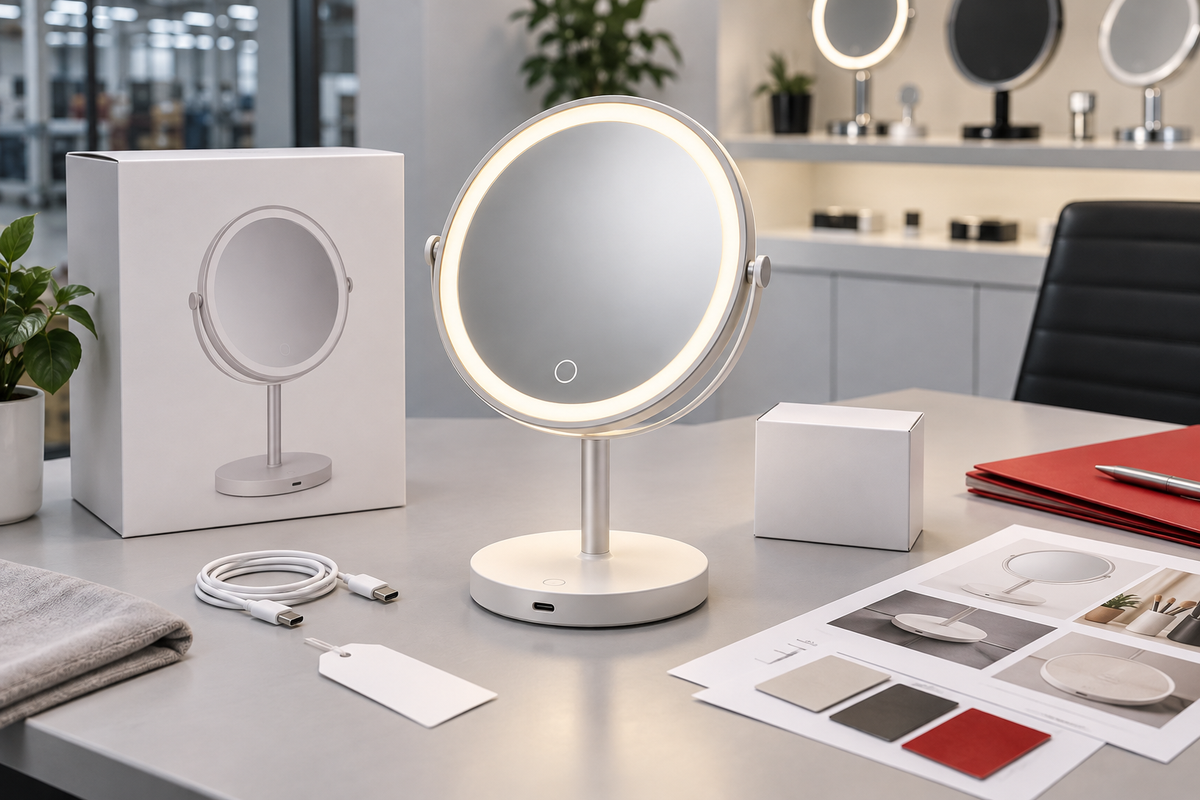
An RFQ for LED makeup mirrors is not only a price request. It is also a product-definition request. The supplier needs to know whether the buyer wants to select from existing molds, add brand identity to a proven model, or develop a different product structure.
For beauty brands, retailers, Amazon sellers, distributors, and gift-channel buyers, this choice affects:
- sample availability and approval speed
- MOQ and reorder flexibility
- retail box, master carton, and barcode setup
- lighting specification, battery capacity, charging port, and adapter requirements
- tooling, mold, or fixture cost
- compliance file preparation for the target market
- inspection checkpoints before shipment
If the sourcing path is unclear, the first quotation may look attractive but fail later during sample approval, packaging artwork confirmation, or mass-production scheduling.
The Three Sourcing Paths Compared
| Sourcing path | Best for | Buyer control level | Typical risk if misused | What to confirm before RFQ |
|---|---|---|---|---|
| Stock LED makeup mirror | Fast market testing, small trial orders, urgent replenishment | Low to medium | Product may not fully match brand positioning or packaging needs | available colors, existing specification, MOQ, lead time, carton data |
| Private label LED makeup mirror | Brand launches using proven product structures | Medium | Packaging, logo, and accessory details may be approved too late | logo method, retail box artwork, color, cable, manual, barcode, inspection standard |
| OEM LED makeup mirror | Unique product line, exclusive design, long-term SKU strategy | High | Tooling cost, sample cycles, and timeline may be underestimated | target drawing, size, lighting, battery, mold change, testing, forecast quantity |
The decision is not about which option is “best” in general. It is about which option protects your launch goal with the least unnecessary cost.
When Stock LED Makeup Mirrors Make Sense
Stock models work well when the buyer needs speed and proven production stability. A distributor may need a quick replenishment SKU. An Amazon seller may want to test a mirror shape before building a private-label line. A retailer may need a small seasonal order to validate price points.
The main advantage is that the product structure, tooling, and production process already exist. The buyer can often review a sample faster, confirm basic packaging data, and move to a trial order without paying for new tooling.
Stock sourcing is usually a good fit when:
- the buyer accepts the existing mirror size, frame, base, and LED layout
- minor changes such as color, plug, cable, or instruction sheet are enough
- the launch goal is speed, not exclusivity
- the order is a test before larger private-label planning
- the buyer needs stable carton dimensions for freight calculation quickly
The commercial trap is assuming stock always means low risk. Buyers still need to check lighting comfort, mirror stability, charging quality, carton strength, and after-sales parts. A stock model can be fast, but it should not skip QC approval.
When Private Label Is the Better Route
Private label is often the strongest middle path for LED makeup mirror buyers. The buyer uses an existing product platform but customizes the brand-facing details: logo, color, retail box, instruction manual, barcode, gift box insert, accessory set, or bundle plan.
This route is useful when the brand wants a professional launch but does not need a new mold. It is also practical for e-commerce sellers who need differentiated packaging and consistent review quality without carrying the cost of full OEM development.
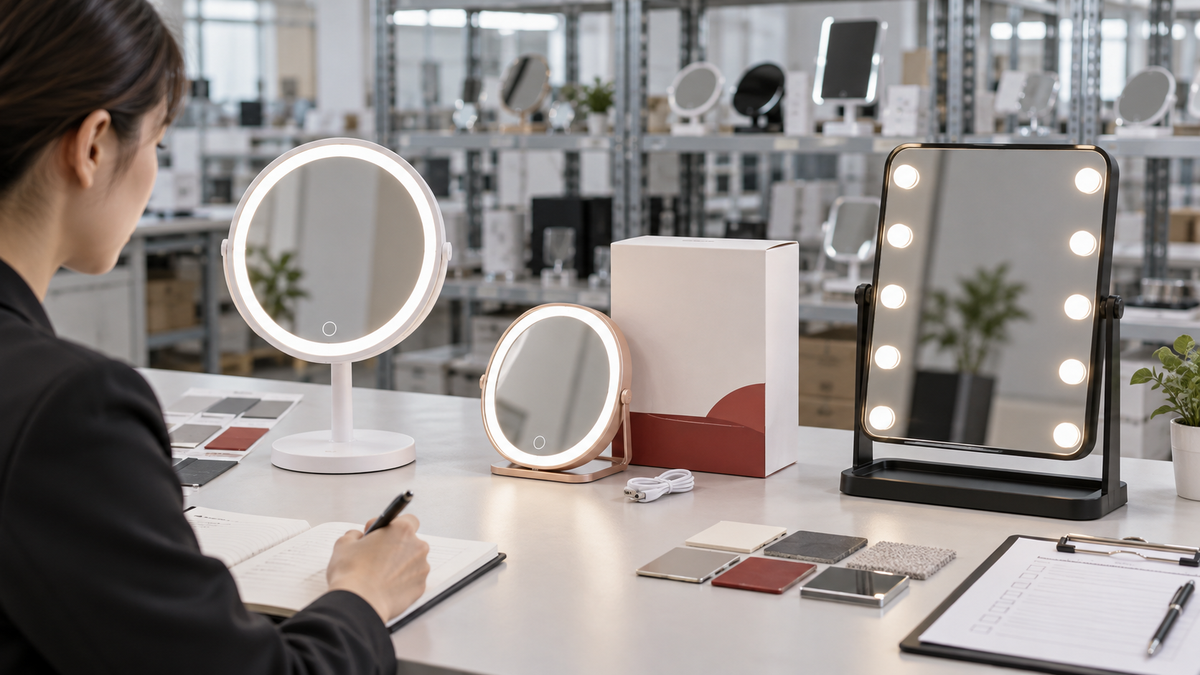
Private-label buyers should confirm these details before RFQ:
- logo position and process: printing, laser, metal plate, sticker, or packaging-only branding
- retail box structure: color box, mailer box, gift box, window box, or e-commerce protective box
- sales-channel requirements: Amazon FBA, retail shelf, salon distributor, gift channel, or wholesale carton
- product color and finish: white, black, rose gold, chrome, matte finish, or custom color
- accessory list: USB-C cable, adapter, manual, cleaning cloth, insert card, or spare parts
- artwork approval timeline and who owns the final print-ready files
Private label becomes risky when packaging is treated as an afterthought. Artwork, barcode, warning marks, manual language, and carton labels must be approved before mass production, not after the product is already scheduled.
When OEM Development Is Worth the Extra Work
OEM development is the right path when the buyer needs a product that cannot be achieved through stock selection or surface branding. This can include a new mirror size, a different stand, a special hinge, a different magnification panel, a revised LED layout, a battery-capacity change, a new housing shape, or a more channel-specific design.
OEM makes sense when the buyer has a clear market reason for the change. For example, a beauty brand may need a premium tabletop mirror with specific lighting modes and a higher perceived value. A retailer may need a compact rechargeable mirror sized for a gift set. A distributor may want an exclusive model that cannot be easily compared with competitors.
Before requesting OEM quotation, buyers should prepare:
- target product size, mirror diameter, base size, and placement requirement
- lighting needs: CCT, CRI, brightness, dimming method, memory function, and glare control
- power requirement: rechargeable battery, USB-C input, plug-in adapter, or dual power
- material and finish target: ABS, metal, chrome, painted finish, soft-touch coating, or mixed materials
- sales forecast by market and first order quantity
- compliance needs for the destination market
- packaging and drop-test expectations
- acceptable sample cycle and development budget
OEM development can create stronger differentiation, but it should be supported by quantity planning. If the forecast is still uncertain, buyers may be better served by stock or private-label testing first.
RFQ Decision Checklist for Buyers
Use this checklist before sending an inquiry:
- Do we need a fast market test, a branded launch, or a unique product design?
- Can an existing LED makeup mirror model meet the core sales promise?
- Which changes are essential, and which are only nice to have?
- What MOQ can we accept for the first order and the reorder?
- Do we already have logo, packaging artwork, barcode, and manual requirements?
- Does the target market require battery, charger, or material documentation?
- What sample approval steps must happen before mass production?
- What carton, drop-test, or e-commerce delivery risk must be controlled?
- Are we comparing suppliers on the same specification, or only on headline price?
For a clean RFQ, separate the request into three parts: product specification, branding or packaging requirement, and commercial requirement. This helps the supplier quote the correct path instead of guessing.
Common Buyer Mistakes
One common mistake is asking for OEM customization without a forecast. Tooling and development work can be reasonable for a long-term product line, but inefficient for a small uncertain test order.
Another mistake is calling every branded order “OEM.” If the mirror structure is already available and only the box, logo, color, or accessory set changes, the project is usually private label, not full OEM. This distinction helps control sample cost and lead time.
A third mistake is comparing stock pricing with OEM pricing as if the products are identical. A custom housing, new battery setup, or new packaging structure changes the supplier’s cost, risk, and inspection plan.
Bottom-Line Recommendation
Choose stock LED makeup mirrors when speed and low-MOQ testing matter most. Choose private label when the product structure is already right but the brand needs packaging, logo, and channel-specific presentation. Choose OEM when differentiation, exclusive specification, and long-term SKU control justify development cost and sample cycles.
For most first-time LED makeup mirror buyers, the safest route is to start with a proven stock or private-label platform, validate channel demand, then move into OEM development once reorder data and specification priorities are clear.
FAQ
Is private label cheaper than OEM for LED makeup mirrors?
Usually yes. Private label uses an existing product platform, so the buyer mainly pays for branding, packaging, color, or accessory changes. OEM may require tooling, engineering, repeated samples, and a longer approval process.
Can a buyer start with stock models and later move to OEM?
Yes. This is often a practical path. Stock or private-label orders help buyers test price points, reviews, packaging damage, and channel demand before investing in a more exclusive product.
What information should be included in an LED makeup mirror RFQ?
Include target market, product type, size, lighting mode, magnification, power source, battery or adapter requirement, color, packaging, logo method, expected quantity, compliance requirement, and delivery destination.
How does packaging affect the sourcing path?
Simple packaging changes may fit private label. A completely new box structure, molded insert, e-commerce mailer system, or retail display package may require more sample approval and cost planning, especially for fragile mirrors.
What should buyers ask Mingda before choosing a route?
Buyers can share the target channel, price band, expected quantity, branding needs, and product reference. Mingda can then recommend whether a stock, private-label, or OEM LED makeup mirror path is the most efficient starting point.
Request a Supplier Recommendation
If you are preparing an LED makeup mirror RFQ, send Mingda your target market, order quantity, preferred mirror type, packaging needs, and customization goals. Our team can recommend a practical sourcing route across makeup mirrors, OEM/ODM mirror services, packaging planning, and quality control before you commit to samples. For project details or a sample quotation, contact Mingda through the Contact page.
Social Media Content Ideas
LinkedIn angle: Explain why stock, private label, and OEM LED makeup mirror orders should not be quoted as the same project type.
Facebook angle: Show brand buyers how private-label packaging can create a professional launch without starting from a new mold.
Instagram angle: Use the sample review image to show the difference between product selection, packaging approval, and OEM specification review.
Short CTA: Read the full RFQ decision guide and contact Mingda for a stock, private-label, or OEM LED makeup mirror recommendation.